
Ankle brace for volleyball: brace, tape or nothing?
Somebody rolls an ankle under the block, and two weeks later half the squad is wearing braces. Or the opposite: the player who needs one most plays without, because it feels awkward. The question isn't whether braces work, but who they work for. That is a decision per player, and you can make it with three questions.
Where the conversation usually goes wrong
The discussion in the hall is almost always about the team: should we be doing this or not? But the reasoning behind ankle braces isn't about teams — it is about recurrence. The research the recommendations rest on was nearly always done with athletes who had already sprained an ankle once, and there the benefit is clear: fewer new sprains. For players with no history, that picture is much weaker, and the same attention pays off more if you put it into landing technique and net discipline.
So this is not a team decision but a list of names. In a senior squad of twelve players, that is usually two to four of them. Those players wear one, the rest don't. That feels unequal, and it is — in the same way the player who needs glasses wears them and the rest don't.
One boundary first: this article is about the kit and the choice. When a player is allowed back in the hall at all after a sprain is a different question, and it is answered by the physiotherapist or the doctor — not by the calendar and not by the coach. The broader story about ankles, knees and shoulders is in injury prevention in volleyball.
The decision rule: three questions per player
- Has this player sprained an ankle in the last twelve months? If so: a brace at every practice and every match, for the rest of the season. Not just for matches, because most sprains simply happen on a Tuesday evening in a game-based drill at the net.
- Does he roll it repeatedly, or does the ankle sometimes give way for no obvious reason? Then a brace isn't enough. That pattern points to instability, and that is something you train away with a physiotherapist. The brace is the patch while the repair is going on.
- Neither? No brace. This player is better off with landing work, balance and a firm agreement about the centre line.
Two exceptions to that third rule. A player who feels noticeably more confident with a brace and therefore commits fully into the block shouldn't be told to take it off — that feeling isn't a side issue. And for a player just back from a serious sprain, the schedule is set by whoever is treating him, not by this article.
What you don't do as a coach is prescribe. You advise, you explain the rule and you make sure the player ends up with somebody who knows what they are doing. A fresh or recurring injury belongs with a (sports) physiotherapist or a doctor.
Three types, and what they actually do
The shelves are full, but in practice there are three categories. What matters for volleyball: the brace has to limit the sideways movement (the foot rolling inwards) and leave the up-and-down movement free. If it also gets in the way of your take-off, nobody wears it longer than three weeks.
- Elastic sleeve. Neoprene or fabric, pulled on over the foot. Gives compression and warmth and hardly any mechanical support. Useful in the last phase of a recovery or for a nagging ankle, but no protection against a sprain. Reckon on roughly 10 to 20 euros.
- Lace-up brace. The workhorse for indoor volleyball: a fabric brace you pull tight with laces, often with two elastic straps in a figure-of-eight around it. Stays flat enough for a volleyball shoe and is the default choice for anyone who wants to play a whole season protected. Reckon on roughly 25 to 45 euros each, and on one to two seasons before the laces and the fabric are stretched enough that you can no longer get it tight.
- Semi-rigid with stays or a hinge. Hard plastic shells on either side of the ankle joint, sometimes hinged. The most support, the most bulk, and the hardest to fit inside a tight indoor shoe. Usually a choice made on a clinician's advice, after a serious sprain or with demonstrated instability. Reckon on roughly 35 to 70 euros.
Prices differ by country and by shop; the ratios between the three are much the same everywhere. Don't buy on brand but on closure: if a player can get it tight in ten seconds with one hand, he really will tighten it again in the third set.
Tape or brace? The sum that usually settles it
Tape does something no brace can: it follows exactly that one ankle and that one direction of movement you want to restrict. Against that stands a problem coaches rarely weigh up: tape loses a large part of its stiffness after roughly twenty minutes of play. For a ninety-minute practice that means that from the first proper quarter of game play onwards, you are mostly playing on feel. Anyone who wants to use tape seriously has to re-tape halfway through — and in a club team that never happens.
Then there is the cost side. A roll of sports tape 3.8 cm wide and 10 metres long costs roughly 3 to 6 euros, and taping one ankle properly easily uses half a roll. Work it out for a player who trains twice and plays once:
- Per session: roughly 2 euros of tape for one ankle.
- Per week: taping three times, so roughly 6 euros.
- Per season of thirty playing weeks: roughly 180 euros — for one ankle.
- For comparison: one lace-up brace at 35 euros that lasts two seasons.
On top of that, tape only works if somebody applies it properly. Badly applied tape does nothing except pinch, and most amateur teams have no therapist on the sideline. That makes tape mainly suitable for occasional use: a tournament day, one match that really matters, a forgotten brace, or a specific technique a physiotherapist applies for a specific problem. For structural, weekly use in the hall, the brace wins on almost every point.
What it costs on court: jump height and feel
The objection you hear most often is: I jump lower with that thing on. What measurements show is a small difference in jump height; what players feel is usually a bigger difference. That gap between measuring and feeling is exactly where you can do something as a coach, because getting used to it does most of the work.
- Never introduce a brace on a match day. The first time is a Tuesday, in the warm-up, with time to re-lace it twice.
- Allow two weeks to get used to it. The first three or four sessions the take-off feels strange, after that it doesn't. Anyone still complaining after two weeks has a fit problem, not an adaptation problem.
- Watch the lace tension at the top. If the upper part across the instep is pulled too tight, you restrict the foot's extension — and that really does cost take-off. Tight at the bottom, one notch looser at the top.
- Too loose is useless, too tight tingles. Tingling toes or a cold foot always mean: re-lace it, don't grit your teeth.
The most stubborn myth is that a brace makes the ankle lazy. There is no evidence that muscles weaken from wearing a brace. What is true: a brace does not replace the balance work. Anyone who buys a brace after a sprain and changes nothing else has done half the job.
Size and fit: the shoe is the real problem
Almost every failed brace fails in the shoe, not around the ankle. A lace-up brace adds a few millimetres all around the foot, and in a tight volleyball shoe that is enough to change the whole fit.
- Fit shoes with the brace on. Buy shoes in June and a brace in November and you will be disappointed. Often you have to start two eyelets lower, sometimes buy half a size up.
- Always over a sock, never on bare skin. Otherwise you get blisters on the instep and the heel within two sessions. A thin sock underneath and the normal sock over the top works best.
- Watch the heel position. The brace lifts the foot a few millimetres; if that makes the heel slide up inside the shoe, you get play in the fit and lose grip when braking.
- Only the ankle that needs it. Buying two braces to be on the safe side is double the cost for nothing, unless a clinician advises it.
- Care. Hand wash at 30 degrees and air dry, not on a radiator — plastic stays warp. If somebody plays four times a week, two braces drying in turn is not a luxury.
With youth players, growth comes into it: a brace that fitted last season is often too small a season later, or so roomy that it no longer restricts anything. Check that every six months, at the same time as the shoe size. What else belongs in a junior's bag and what you can safely skip is in what your child needs for volleyball.
How long do you wear it, and how do you phase it out?
The rule of thumb is deliberately blunt: anyone who sprained an ankle this season plays the rest of the season in a brace. Not because something magical happens in the last playing week, but because the risk of recurrence is highest in the first months after a sprain and a season is a boundary a coach can remember and check. Nobody remembers a schedule of "another six weeks"; everybody remembers "this season".
After that you phase it out in steps, and not in the busiest part of the year:
- Phase 1 — everything. Brace at every practice and every match. Lasts at least a few months, and in practice the rest of the season.
- Phase 2 — everything at the net. Brace for blocking, hitting and every drill where players land under the net, plus matches. Off during warm-up, balance work and ball skills away from the net.
- Phase 3 — matches only. Train without, play with. The match is busier at the net and more tired at the end.
- Phase 4 — off. The balance work stays, even once the brace is gone.
Never plan a transition between two phases in a tournament week or a week with two matches. And attach the balance block to something that happens every week anyway: five minutes of single-leg balance three times a week, eyes closed once it gets easy, fits neatly into the activation part of your warm-up. For this player that block isn't an extra but the actual work; the brace only bridges the period in which it isn't finished yet.
What you arrange as a coach
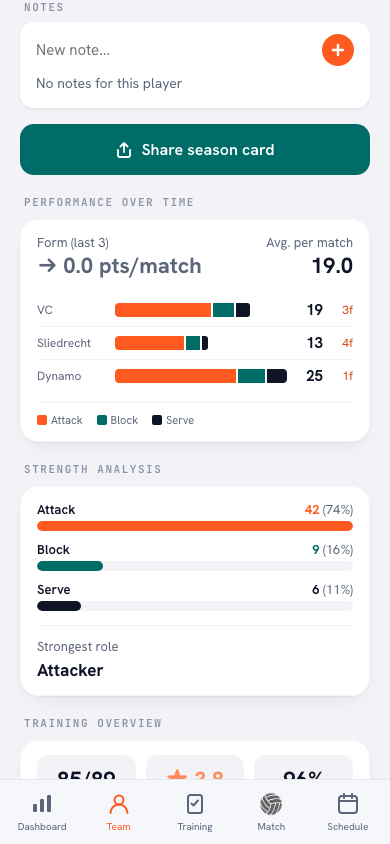
The hardest part of this rule isn't the choice but the memory. A sprain in November is forgotten by March, and that is exactly when it goes wrong again. So note per player the date, which ankle it was and how long he was out — in Koach a note like that hangs on the player profile, so you see it again without going looking for it. That note is also your case towards parents: not an opinion, but a date.
Sort out the practical things too, before they turn into a discussion:
- The bag rule. The brace lives in the bag, not in a drawer at home. A forgotten brace is no reason to send a player home, but it is reason to take him out of the blocking and hitting drills that evening.
- Spare laces. A snapped lace halfway through the season otherwise leaves a player without one for three weeks.
- Who pays. Agree that before you advise it. Some clubs keep a few braces in the first aid cupboard — usually in the wrong size, so measure first.
- The centre line agreement. Never step under the net, in any drill, even when nothing is going on. That is the intervention that costs nothing and that most ankles benefit from — it belongs in the list of team agreements you set at the start of the season.
And then match day. The rules prohibit objects that could cause injury; a fabric brace with plastic stays rarely causes any discussion in practice, but a protruding metal buckle or hinge can get a referee to ask you to tape it over. How this is handled exactly differs from federation to federation and from level to level, so check it with your own federation before you find out on a Saturday. What happens if somebody does go down during a match, from recovery time to the exceptional substitution, is in injury during a match.
For the players with no history, the conclusion stays uncomfortably simple: no brace, but four minutes of landing practice every week. What that looks like and which mistakes you see most often is in learning to land safely, and where it actually goes wrong in the hall shows up in the way you block and move back off the net. That is less tangible than buying a brace, and for the group as a whole it pays off more.
Key point: an ankle brace is a measure against recurrence, not against bad luck. Anyone who sprained an ankle in the last twelve months wears one for the rest of the season at every practice and match; anyone who didn't is better off with landing technique and net discipline. With a fresh or repeatedly recurring injury, a (sports) physiotherapist or doctor decides — not the coach and not the fixture list.
Frequently asked questions
Should my whole team wear ankle braces?
No. The reasoning behind braces is about preventing recurrence in players who have already sprained an ankle, not about bracing everybody preventively. For players with no history, the same attention pays off more in landing technique, balance and the agreement never to step under the net.
Is tape better than a brace for volleyball?
For weekly use, usually not. Tape loses a large part of its stiffness after roughly twenty minutes of play, has to be applied by somebody with experience, and over a season quickly costs several times the price of one brace. Tape is mainly useful for occasional use or when a physiotherapist applies a specific technique.
Do you jump lower with an ankle brace?
Measurements show a small difference at most; the difference players feel is usually bigger. Allow two weeks to adapt, introduce the brace at a practice and never on a match day, and lace the upper part across the instep one notch looser than the lower part — that is where most of the lost take-off comes from.
How long should a player wear a brace after a sprain?
As a rule of thumb, the rest of the season, because the risk of recurrence is highest in the first months after a sprain. After that, phase it out in steps: first everything, then only net drills and matches, then matches only, then off. The medical part of that decision belongs with the treating physiotherapist or doctor.
Does an ankle brace fit inside a volleyball shoe?
A lace-up brace does, provided you fit the shoe with it on. Start two eyelets lower or buy half a size up, and always try new shoes wearing the brace. Semi-rigid braces with hard shells are noticeably harder to accommodate in a tight indoor shoe.
Is a player allowed to play with a brace or tape?
Usually yes: the rules target objects that could cause injury, and a fabric brace with plastic stays rarely falls into that category. Protruding metal parts or buckles may have to be taped over. Because the interpretation differs by federation and by level, check it with your own federation before it comes up on match day.