
How long should a volleyball practice be? Times per group
You have the gym from eight until half past nine. That is ninety minutes, but your team does not practise for ninety minutes — you notice the moment you glance at the clock while the last player is still tying his shoes. So the question is not how long a practice ought to last, but how many minutes are left at the bottom of the sum. This article does that sum and gives you three templates that hold up against the clock.
Gym time is not the same as practice time
Take the most common situation: ninety minutes of gym, one team, a programme of three drill blocks plus a warm-up. Now subtract what goes no matter what, whether you plan for it or not:
- Setting up and gathering: 5 minutes. Net tensioned, posts, ball cart, antennas — and the last two players always walk in on the hour, not before it. If you are the first group in an empty gym, count on seven.
- Warm-up: 12 minutes. Not wasted time, but time that is not spent on your theme.
- Explaining the blocks: 5 minutes. Thirty seconds for a variation, two minutes for a new drill. Three blocks cost you five minutes of talking.
- Water and changing the set-up: 5 minutes. One water break plus the time it takes to rearrange the court.
- Finishing, huddle and packing away: 8 minutes. If you are the last group in the gym, the nets come down as well.
That is 35 minutes of fixed costs. Of ninety minutes of gym time, roughly 55 minutes are left in which your team is genuinely playing on your theme. That is the number you steer on — not the ninety on the gym schedule. Once you have seen that, your whole planning changes: you stop inventing drills until the time is full and you start driving the fixed costs down, so that sixty or sixty-five minutes are left.
Notice, too, where those fixed costs scale and where they do not. Packing away, nets and gathering cost the same in a sixty-minute session as in a two-hour one. A shorter slot therefore hurts disproportionately — unless you know exactly what you are cutting.
Guide times per group
There is no magic number that fits every group. What does exist: a range per age, and the honest translation into what is left of that time.
| Group | Gym time per session | Of which playing on your theme | What to watch |
|---|---|---|---|
| 6–9 years | 45–60 min | 30–40 min | Attention span is the limit, not fitness. The huddle and the finish take up relatively much time. |
| 10–11 years | 60–75 min | 40–50 min | The best age to learn technique: quality of the repetition over volume. |
| 12–14 years | 75–90 min | 50–55 min | Growth spurt. The number of maximal jumps counts for more here than the clock does. |
| 15–18 years | 90 min | 55–65 min | A full adult programme is possible, but plan recovery between two practice evenings. |
| Adults, recreational | 75–90 min | 45–55 min | People arrive from work and want to talk. Count on five extra minutes at the start. |
| Adults, competitive | 90–120 min | 65–85 min | Only above ninety minutes does a second theme or a physical block fit in. |
Two footnotes. First: age categories are named differently by every federation and the cut-offs shift slightly from country to country. So count in years, not in category letters, and check with your own federation which format and match duration belong to that age — the youngest level is called mini volleyball in most places, with different court sizes and playing times per country. Second: this is about the length of one session, not about how often you practise per week. How much a youth player can handle in total — jump load and rest days included — is in how often youth players aged 10 to 14 should train.
The ninety-minute template
This is the standard evening. The times below are gross blocks: the explanation is in there and so is the changeover. This is what a session with a single theme looks like, say handling serving pressure:
- 0–5 — set up and gather. Finish with one sentence: what are we watching for tonight. No more than one sentence.
- 5–17 — warm-up with a ball (12 min). Moving, throwing, catching, playing. No laps.
- 17–34 — core block 1 (17 min). The theme in isolation, low pressure, plenty of repetitions. Two minutes of explanation, fifteen minutes of playing.
- 34–37 — water and changing the set-up (3 min).
- 37–56 — core block 2 (19 min). Same theme, now with resistance and decisions. Two minutes of explanation, seventeen minutes of playing.
- 56–58 — switch to 6v6 (2 min).
- 58–82 — scrimmage (24 min). Free play with a scoring system that rewards the theme. One minute of explanation, twenty-three minutes of playing.
- 82–90 — huddle, finish and pack away (8 min).
Add up the playing time: 15 + 17 + 23 = 55 minutes. Exactly the number from the sum above. Which kinds of blocks you put in which order, and why the heaviest work belongs in the second quarter, is in building your session with practice blocks — this article is only about the minutes.
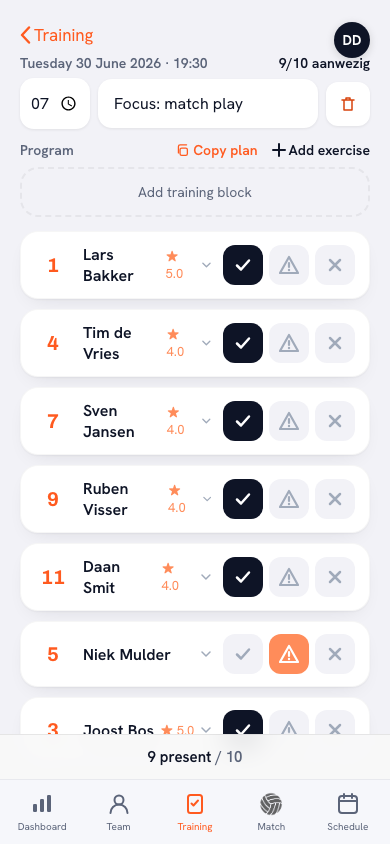
Lay the programme out beforehand as blocks with minutes and you can see whether it fits before you set foot in the gym. In Koach the blocks add up to your practice time automatically; if it says 105 for a gym slot of 90, you already know which block you are going to rush. Better: take that block out now, while planning, rather than at quarter past nine.
The 75-minute template: the scenario you actually have
The gym is yours from half past seven until quarter to nine, because at quarter to nine the next team arrives. Or: you get ninety minutes, but you share the first ten with a team still finishing up. This is the situation most amateur coaches are in, and most practice plans online do not account for it.
- 0–5 — set up and gather. Unchanged: there is nothing to win here.
- 5–13 — warm-up with a ball (8 min). Short, and already in the shape of the first block, so you do not have to rearrange the court afterwards.
- 13–31 — core block (18 min). The theme, two minutes of explanation.
- 31–33 — water (2 min). Once. No changeover.
- 33–49 — the same theme under pressure (16 min). Same court set-up, only different demands. One minute of explanation, because this is a variation and not a new drill.
- 49–69 — scrimmage (20 min). One minute of explanation.
- 69–75 — huddle and pack away (6 min).
Playing time: 16 + 15 + 19 = 50 minutes. So you give up five minutes of playing, not fifteen. That is because you attacked the fixed costs and not the playing: one warm-up that is already the first drill, one court set-up for two blocks, one water break, one explanation less. A coach who simply shaves a couple of minutes off everything instead ends up with three half blocks and a ten-minute scrimmage — and has turned fifteen minutes less gym time into fifteen minutes less practice.
What you cut — and what you never cut
When time gets tight, the order in which you cut matters more than how much you cut. These five things may go, in this order:
- The second theme. Two themes in fifty minutes means too few repetitions of both. Pick one and hold on to it; see setting the focus of your practice.
- The separate explanation. Run your second drill as a variation on the first: same set-up, same balls, different demand. That saves you two minutes of talking and two minutes of hauling equipment.
- The second water break. One break halfway through is enough in seventy-five minutes.
- The spare drill. That one extra form you had thought up "in case it goes well" — leave it at home, then you do not have to cut it off halfway either.
- A separate fitness or strength block. On a short evening that does not belong in the gym but in the intensity of your game forms.
And this stays, whatever happens:
- The scrimmage. This is payday for the practice and the only place where the theme comes under real pressure. Cut here and you are left with a drill evening instead of a practice. Shorten it to twelve minutes if you must, but do not scrap it.
- The warm-up. Shortening is fine — down to eight minutes, with a ball — scrapping is not. See warm-up drills: in a sport built on jumping and landing this is not a luxury.
- The three-minute finish. One question ("what went better than at the start?") and one look ahead. This is the cheapest block in your whole practice and the only moment where the theme sticks.
Key point: a shorter slot should cost you fixed costs, not playing time. Cut one theme, one explanation and one changeover — then fifteen minutes less gym costs you five minutes less playing instead of fifteen.
Sixty minutes: youth and half a gym
With the youngest groups, sixty minutes is not an emergency solution but the norm. At this age attention span is the constraint: an hour in which the tempo stays high delivers more than ninety minutes of which the last half hour drifts. The same template works, incidentally, when two teams share one gym and you have half the court.
- 0–4 — gather and one sentence about today.
- 4–12 — warm-up as a game with a ball (8 min).
- 12–28 — one core block (16 min). Two minutes of explanation, fourteen minutes of doing.
- 28–30 — water (2 min).
- 30–54 — game form and scrimmage (24 min). Small courts, adapted scoring that forces the theme.
- 54–60 — huddle, a compliment and packing away (6 min).
Playing time: 38 minutes on one theme. That is enough to change something, provided those thirty-eight minutes are not spent standing in lines. Note that there is only one core block in there: at sixty minutes the temptation to cram in three drills is at its greatest, and that is exactly the mistake that makes the evening restless.
More than ninety minutes: when it pays off
Two hours only works if something is added that you cannot fit into ninety minutes, not if you stretch the existing blocks. Worthwhile additions, in the order in which they are worth it: a proper eight-minute injury prevention routine at the start, a second theme in the second half, and a finishing block in which you play out one situation (serving at 24-24, the first ball after a time-out).
A workable split for a hundred and twenty minutes: 8 minutes for the gym and the prevention routine, 14 warm-up, 20 theme 1 in isolation, 3 water, 25 theme 1 against resistance, 5 water and changeover, 30 6v6 match play with scoring agreements, 10 a finishing block, 5 to close. Two water breaks are not a luxury here but a necessity.
The limit is reached when you stretch the same drill. As soon as you see execution drop while fatigue rises, the block has become too long — at that point you are training bad technique in. Two ninety-minute sessions a week beat one of a hundred and eighty for virtually every amateur group.
Density beats duration
A tight hour beats two sloppy ones, and that is not a motivational slogan but a matter of ball contacts. Two players who keep one ball going together for twelve minutes touch that ball more often than a player who spends half an hour in a line of seven waiting for his turn. The length of your practice sets the ceiling; the density determines how much of it you use. How to raise that concretely — more balls, shorter lines, second stations — is worked out in stop standing in line.
It is density with demands, though. A hundred sloppy repetitions without a target zone or a score deliver less than thirty repetitions in a form that resembles the match; see match-realistic drills. In other words: pick the right form first, optimise for touches within it, and use the clock only to guard that each block gets what it was promised.
Measure once how long your practice really lasts
The sum above is an average. Your gym, your group and your nets deviate from it, and you can find that difference in three practices. Note three moments on your phone:
- When the first ball of the warm-up is struck. Everything before that is set-up time.
- When the scrimmage starts. That tells you whether your programme is too heavy at the front.
- When the last ball drops. Everything after that is packing-away time.
Do that three times and you have your own fixed costs. If you are at forty-five minutes of set-up and breakdown instead of thirty-five, you know where to cut first — usually it is the start time, and you solve that with an agreement, not with a drill. Record the measured times per block in your programme and within a few weeks you will have built templates that fit your gym and that you reuse every season. A practice that starts five minutes earlier delivers, over a season of thirty practices, two and a half extra hours of playing time — almost three complete practices' worth of theme time, without a single extra minute of gym rent.
Frequently asked questions
How long should a volleyball practice last?
For adults, ninety minutes is the common norm and a hundred and twenty minutes only makes sense for competitive teams. For youth: 45–60 minutes for the youngest groups, 60–75 minutes up to about twelve and 75–90 minutes above that. More important than the gym time is what is left of it: count on roughly thirty-five minutes of fixed costs per evening.
My gym slot is only 75 minutes. What do I cut first?
The second theme, then one explanation (run the second drill as a variation on the first) and the second water break. That way you lose about five minutes of playing time instead of fifteen. The scrimmage, a shortened warm-up and the three-minute finish always stay.
Does the warm-up count as practice time?
As practice time yes, as time on your theme no. Budget it separately in your plan: ten to twelve minutes in a ninety-minute slot, eight in seventy-five. Do it with a ball and it delivers ball contacts as well as warmth.
Is two sessions of sixty minutes better than one of a hundred and twenty?
For virtually every amateur group, yes. Two evenings give you two learning moments, two rounds of repetition with a day in between and less quality loss through fatigue. The downside is that you pay the fixed costs of setting up and packing away twice.
Should the last practice before a match be shorter?
Usually yes: keep it to about two thirds of your normal length and take the heavy jumping out. Finish with serve and pass and a calm run-through of the line-up instead of a long scrimmage.
How long should a practice be for the very youngest players?
Forty-five to sixty minutes is plenty for six- to nine-year-olds; attention span runs out before fitness does. Plan one core block and one long game form, not three drills in a row.