
Knee pain in volleyball: managing jumper's knee
A player rubs the bottom of their kneecap after a session and says it's nothing serious. Six weeks later they are still jumping, but only half-heartedly. The standard response — two weeks' rest — works for exactly as long as the rest lasts. With jumper's knee the treatment isn't that week off, it is what goes into your training schedule over the next three months.
Why rest disappoints here
Jumper's knee is the nickname for an overloaded knee tendon, usually where it attaches to the bottom of the kneecap. In a study of Norwegian elite athletes from nine sports, the condition was by far most common among volleyball players — almost half of them had dealt with it at some point (Lian et al., Am J Sports Med 2005). In club volleyball with two sessions a week the figure is lower, but the ratio holds: there is no sport in which so many players push off and land at maximum so often.
Tendon tissue adapts to load, just slowly: in weeks to months, where muscles do it in days. A tendon you unload for two weeks doesn't get stronger in those two weeks, it becomes less able to take load. The pain fades because nothing is happening and comes back the moment the player plays volleyball again — often harder than before, because they go straight back to doing everything. That is the circle most club players are stuck in.
So the dial you turn isn't rest or no rest, but how many jumps this player makes this week and what kind of jumps those are. That is a coaching decision.
Recognising it: where the pain sits and how far it has gone
You don't make a diagnosis, but in thirty seconds you can answer the most important question: is this a tendon story or something else?
- Can they point at it with one fingertip? That is the most telling sign. Jumper's knee sits on one point, usually just below the kneecap, and the player points at it without hesitating. If they put a whole hand on the knee, you are probably in a different story.
- Does it warm up and come back later? Classic: stiff on the first jumps, bearable during the session, clearly present in the evening and the next morning.
- What provokes it? Jumping, and landing above all. Plus deep squatting and walking down stairs. A tendon finds braking harder than pushing off — which is why the landing hurts more than the jump.
- What doesn't belong? A swollen or warm knee, a knee that locks or gives way, and pain at night on a day with no jumping. Those aren't dosing questions but referral signals.
How far the complaint has progressed is described with the four-stage classification that has been in use since the seventies (Blazina et al., 1973) — the handiest tool a coach has, because you need no equipment for it.
- Pain only afterwards. Nothing during the session, plenty in the car or the next morning. The cheapest moment to intervene, and the moment almost nobody reports it.
- Pain on starting up that fades during the session and returns at the end as the player tires. This is usually when you first hear about it, and at this stage a player can carry on perfectly well on an adjusted jump budget.
- Pain during and after, with loss of performance. The player jumps lower, avoids landings and picks the ball that costs them least. This stage needs professional support and a serious cut in the jump budget.
- Pain that no longer goes away, including on rest days. Stop jump load and refer on. A sudden snap followed by an inability to straighten the knee is an emergency.
Players don't move through those stages neatly in order: someone can sit in stage two for months. What the stage mainly tells you is what you change tonight.
Jumper's knee, Osgood-Schlatter or patellofemoral pain?
Three different things all get called "knee pain" in the locker room, while each asks for a different jumping policy.
- Jumper's knee sits in the tendon, in a player who has finished growing — roughly from fifteen onwards. Pinpointable on one spot below the kneecap, provoked by jumping and landing. Approach: manage the dose and load the tendon progressively harder.
- Osgood-Schlatter sits lower, on the bony bump three to five centimetres below the kneecap, in growing players of roughly eleven to fourteen. That is where a growth plate sits that the same tendon pulls on: often a palpable lump, painful when kneeling and under pressure. Different age, different tissue, different timeline — in a growing player it is bound up with the growth spurt and the mismatch in load tolerance that comes with it.
- Patellofemoral pain sits around or behind the kneecap and precisely cannot be pointed at: the player lays a hand over it. Provoked by walking down stairs, squatting and sitting for a long time with a bent knee — that last one is characteristic, because a tendon is untroubled by sitting still. It usually has more to do with strength and control from the hip and trunk than with the number of jumps.
This is a tool for asking your question more sharply, not a diagnosis. If the picture fits none of the three, the question isn't which one it is but who is going to look at it.
The pain score: the one thing you can measure yourself
Without a number you are talking to a player about feelings, and feelings shift with how important the match is. Introduce one fixed measurement. Have the player do the same test before every session — for example five slow single-leg squats to about sixty degrees — and give it a score from 0 to 10. Ask for the same score the next morning. Two numbers per session, no more.
The decision rule that goes with it is the rule of thumb widely used in sports physiotherapy for tendon complaints:
- 0 to 3 during the load and back to the old level the next morning: full participation. A tendon is allowed to grumble.
- 4 or 5 during, back to 3 or lower within 24 hours: joining in is fine, but not fully. Jump budget down and the maximal jumps out.
- Above 5, or a morning score higher than yesterday's: no jump load today. Ball work on the floor, defence, setting, coaching roles inside a game drill.
- A score creeping up week after week: the real alarm, even if the number is low. Two weeks of rising with no improvement means referring on.
The exact cut-offs vary per treatment plan; if the player is seeing a physiotherapist, their numbers apply. The principle stays the same: you steer on the difference between today and yesterday, not on whether it hurts.
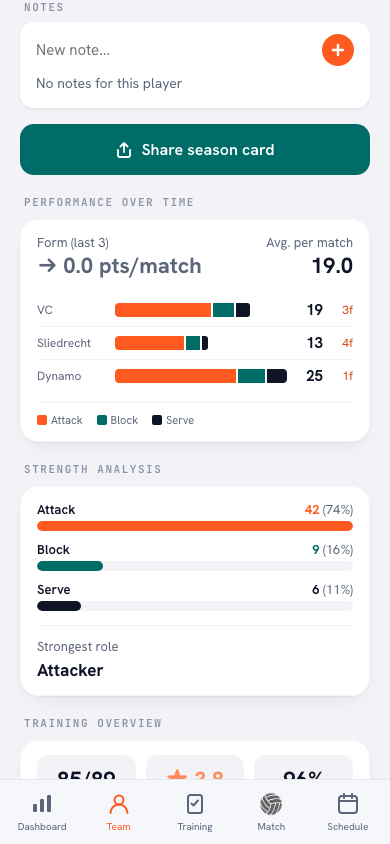
Loose numbers in your head are gone within a week. Note them per player, in the player notes in Koach or in a notebook with four columns, because the value sits in the trend across weeks. A score of 4 says nothing; a 4 that was a 2 three weeks ago says everything.
Load as the medicine, not the enemy
The treatment for a tendon complaint consists of loading it — just differently from the way volleyball does. Two forms keep coming back.
Isometric, right before the session. The player holds a position instead of moving: a Spanish squat with a band around the knees against a post, or a knee extension against resistance. Roughly five times 45 seconds at three-quarters effort, with a minute or two of rest in between. Costs six minutes and can be done in the corner of the gym. Many players notice less pain immediately in the session that follows; the evidence for that isn't clear-cut, but it costs nothing and does no harm.
Heavy and slow, outside gym time. This is the part that actually changes the tendon. The classic version is the single-leg squat on a slanted board of about 25 degrees, lowering over three seconds: three sets of fifteen, twice a day, for twelve weeks. Easier for club players to sustain is the loaded variant: three to four sets of six to fifteen reps, three seconds down and three seconds up, three times a week. Which one you pick matters less than whether it is sustained for twelve weeks.
Three rules go with it. Pain during these exercises is allowed, up to roughly a 5, as long as the morning score the next day isn't higher. Progression comes from the weight, not from the speed. And the timeline is twelve weeks, not two. Around that, build ordinary strength training for legs, glutes and calves: a stronger engine lowers what each individual jump costs. Also worth having is landing technique: a cushioned landing on two feet lowers the peak load on every one of the thousands of landings in a season.
What doesn't count as treatment, however popular: stretching the front of the thigh, ice and a strap under the kneecap. Those can dampen the pain while playing, but change nothing about load tolerance.
The jump budget: count first, then cut
"Take it easy" is not an instruction, a jump budget is. So count properly once, for one player over one week — after that you can estimate. Count every jump where they leave the floor to block, hit, serve or set. An ordinary week for an outside hitter then looks something like this:
- Tuesday: jump series in the warm-up 15, ten minutes of block footwork with three jumps per turn 36, fifteen-minute hitting block 30, thirty-minute game drill 25. Around 105 together.
- Thursday: similar but without the blocking block, around 90.
- Saturday: hitting warm-up 20 plus four sets at a good 25 jumps per set, around 120.
That is around 315 jumps a week. Now "jump less" becomes arithmetic. At stage two you set the budget at about two-thirds — around 200 — and then the question is which hundred jumps go. Three cuts deliver exactly that: skip the block footwork block entirely (36), halve the hitting block (15) and do the last ten minutes of the game drill as a back-row player or coach (25). The rest comes out of the match by having them play two sets instead of four.
Four rules make a budget like that usable. Never cut everything out of one evening, because then the player loses a whole session instead of part of their load. Take out the maximal jumps first and only then the ordinary ones. Never let two heavy jumping days follow each other, and always treat a match day as a heavy jumping day. And build back up in steps of about ten percent of the weekly total: from 200 to 220, not to 300 because it feels good. That planning is easier if you write your sessions out in advance in blocks with a duration, because then you see the jumps on paper before the player makes them.
Which drills are secretly the most expensive
Jumps are not equal. The most expensive ones are maximal, come close together, end sideways or on one leg, or are made by tired legs. That makes these elements heavier than they feel:
- Block footwork series at the net. Three jumps per turn, short rest, off-balance landings. Feels like technical work, counts as jump training.
- Long hitting lines. Every turn is a maximal jump. A "quiet" fifteen-minute hitting block easily produces thirty maximal jumps; the waiting time in the queue disguises that.
- Jump training in the same week as blocking and hitting work. The problem isn't the plyometrics but the stacking. Whoever trains jumping power takes jumps out elsewhere.
- The setter who jump-sets every ball. They often make the most jumps in the team and appear in no count at all, because they aren't attacks.
- The last ten minutes of open play. Tired legs produce the worst landings and the highest peak load per jump, while the learning return is at its lowest.
- Tournaments and catch-up weekends. Two days that count as three to four heavy jumping days, usually followed by an ordinary training week as if nothing happened.
On top of that comes one moment that returns every season: the first two weeks after a holiday or the winter break. Everyone fresh, everyone keen, and the weekly total doubles from one week to the next. That is the classic starting point of a jumper's knee — the same pattern as with virtually all overuse complaints in injury prevention.
Back to full: four steps with criteria
The way back runs on criteria, not on days. Four steps, each at least a week, and you only move on once the morning score after the heaviest day of that week hasn't gone up.
- No jump load. Ball work on the floor, defence, setting, plus the heavy slow strength work. Move on once the standard test is under 3 and stairs are pain-free.
- A quarter of the budget. Only jumps from a standstill with a two-footed landing: blocking on the spot, playing at the net. No block footwork, no maximal attacks.
- Half. Approach jumps added, in series of at most four in a row. No match yet.
- Three-quarters plus match minutes. One set, then two, and only once that works two weekends in a row with no after-effects, full participation.
Expect six to ten weeks for a complaint at stage two or three, and longer if it has been smouldering for months. Going back a step isn't a failure, it is how the system is meant to work. The real risk isn't in the knee but in the calendar: the important match you skip one step for costs more weeks on average than it gains.
When you don't manage the dose but refer on
Send the player to a (sports) physiotherapist or doctor for: an acute snap followed by being unable to straighten or lift the knee (same day), a swollen or warm knee, a knee that locks or gives way, pain at rest or at night, pain in a growing player on the bony bump below the kneecap, and complaints that haven't improved after three to four weeks of adjusted load. A pain score that rises while the budget went down is also a reason to get it looked at.
Whether you can go straight to a physiotherapist or need a referral first, and what is reimbursed, differs per country and per insurer. Look that up once for your club and write it down, so a coach doesn't have to improvise the answer on a Tuesday evening. What is described here are general principles for recognising and dosing, not treatment advice; whoever treats the complaint also sets the pace of the build-up.
Key point: with jumper's knee, your training schedule is the treatment. A coach who knows that one player's weekly jump count, cuts the most expensive jumps first and steers on two numbers — during and 24 hours later — does more for that knee than any rest period ever will.
Frequently asked questions
Can a player with jumper's knee keep playing volleyball?
In most cases yes, provided the load goes down and you measure the effect. The rule of thumb: pain up to roughly a 5 while playing is acceptable, as long as the score is back to the old level the next morning. If that morning score rises, or creeps up week after week, it was too much and a physiotherapist needs to be involved.
How long does it take for jumper's knee to go away?
Count on months, not weeks. The exercise programmes that work run for twelve weeks, and the build-up back to full volleyball costs another six to ten weeks on top. Players who stop as soon as it feels better usually see the complaint return within a season.
Does a patellar strap or tape help with knee pain in volleyball?
A strap under the kneecap dampens the pain while playing for some players, and that can be handy temporarily. It doesn't make the tendon more load-tolerant and doesn't solve the cause. Use it at most alongside an adjusted jump budget and strength work, never as a replacement for them.
My twelve-year-old has knee pain: is that jumper's knee too?
Probably not. In players of roughly eleven to fourteen the sore spot usually sits lower, on the bony bump three to five centimetres below the kneecap, where a growth plate is — that is Osgood-Schlatter and it has a different timeline. The principle of managing load rather than resting is similar, but always have persistent complaints in a growing player checked.
How many jumps a week is too many?
There is no general number; what matters is the change relative to what that player is used to. Count along for one week to know your baseline, then raise the weekly total in steps of about ten percent, and never double it after a holiday or an injury break.
Should a player with knee pain do less strength training, or more?
Usually more, but the right kind: heavy and slow, with three seconds down and three seconds up, outside gym time. That loads the tendon in a way that makes it stronger, while you lower the explosive jump load in the gym. Jump-power and plyometric exercises don't belong in the programme during this period.