
4v4 beach volleyball rules: what changes on the sand
You have played indoor for ten years, and on your first summer evening in the sand you get whistled three times in two sets for things that are perfectly legal indoors. More annoying still: on the court next to you they are visibly playing to different agreements than you are. That is because 4 against 4 on sand is not an official discipline with one fixed rulebook — it is a tournament format, and the organiser writes the rules. Below is the version you will meet most often, and alongside it the list of questions you ask before your first match.
There is no world rulebook for 4 against 4
Internationally, beach volleyball is 2 against 2. The rulebook, the referee training and the tournament calendar are all built around that. Four against four exists alongside it as a recreational and tournament format: some federations publish a set of rules for it, and organisers of a summer tournament add their own house rules on top — usually to get the day finished on time.
The practical consequence: your tournament's rules always beat whatever you read here or anywhere else. So everything below is phrased as "most common", not as "this is how it is". Those rules are on the tournament page or in your confirmation email, and otherwise at the tournament desk. Read them once before you put your bag down — two minutes, and it saves you the argument at 19-19.
The full difference between indoor and sand is in indoor volleyball versus beach volleyball; this article is about what comes on top of that the moment there are four of you out there.
The court: 16 by 8, and the lines that aren't there
The standard beach court is 16 by 8 metres, against 18 by 9 indoors. Some organisers play 4 against 4 on exactly that court, others lay the lines out at 18 by 9 because four players can cover more ground. So look at the lines before you make your defensive agreements: on 16 by 8 the ball behind the block is nearly always reachable, on 18 by 9 it drops.
More important are the lines that are missing:
- No three-metre line. Everyone may attack and block from anywhere. The whole rule set around back-row players does not exist on sand — there is no back-row attack fault, because there is no back row.
- No centre line. Running under the net is allowed, as long as you don't interfere with the opponent. Indoor players instinctively brake here and leave balls that they could have got to.
- Lines are tapes. A ball on the tape is in, and tapes shift through the sand: agree who straightens them.
Net height on sand is the same as indoors: 2.43 metres for men and 2.24 for women — see all net heights. At mixed tournaments that is nearly always deviated from, and which height it then is differs per organiser. Also check whether there are antennae. If there aren't, which is often the case on recreational courts, the usual rule is that the ball has to pass between the poles — ask about it, because otherwise the ball that comes back just outside the pole is a guaranteed row.
Four moments where you get whistled as an indoor player
The ball-handling rules on sand are stricter than indoors, and those are exactly the four things you do without thinking as an indoor player. You will meet them in this order:
- The set with a turn in it. Overhand setting is allowed, but every turn in the torso and every audible double contact gets whistled. The requirement: shoulders square to where the ball has to go, and the ball leaves your hands in that direction. If in doubt, set with your forearms — uglier and completely legal. What a clean set involves technically is in overhand setting; on sand you apply the same technique with less margin.
- The tip with your fingertips. Attacking with open, spread fingers is forbidden on sand. You tip with your knuckles, with straight closed fingers, or you place the ball with your whole hand. You have to convert your tipping techniques for that; do it in the warm-up and not in the third rally.
- Setting sideways over the net. Playing a ball overhand across the net is only allowed straight forwards or straight backwards relative to your shoulder line. The setter's sideways dump — a standard trick indoors — is a fault on sand, as is the third ball you "just steer a bit" with your fingers.
- Carried ball, but the other way round. Here it works in your favour: on a hard-driven attack a brief double contact in defence is actually allowed. If the ball was not hard — a tip, a lob, a deflection off the block — that exact same movement is a fault. So the referee judges the ball first and your hands second.
At a recreational summer tournament a lot of this gets waved through, certainly when there are no appointed referees and the team that has just played does the whistling. Just don't count on it. Play the first two rallies of your first match deliberately strictly and see what does and doesn't get whistled: after that you know where the line sits that day.
The block counts as a contact — unless your tournament does it differently
This is the rule 4-against-4 teams stare at each other over on the first evening. On sand a block touch does count as a team contact: after the block your team has only two contacts left. Indoors it is the other way round — how that indoor rule works exactly is in does a block count as a ball contact.
The beach rule was designed for two players per team. With four, many organisers find that a block counting as a contact makes the rallies too short, and they put it back to the indoor version. You will meet both, and you can't tell from looking at the court. So this is question number one at the tournament desk.
The answer changes your game immediately. If the block counts, a soft block touch is expensive: you lose a contact with it, so you want your block either to really put the ball back or to let it go deliberately. If the block does not count, that same soft block is your best weapon again. Agree that with your blocker beforehand.
No positions, but there is a serving order
On sand there are no positions. No front-row or back-row player, no libero and no positional fault: you may stand where you like, including during the serve. For indoor players the nicest discovery of the evening, because half the rotational thinking disappears.
One thing is fixed: the serving order. At the start of the set you set a fixed order of four, and it applies for the whole set. Win the rally on the opponent's serve and the next player in your own order serves — not whoever happens to be at the back. That is the mistake 4-against-4 teams make most often, and it costs you the point plus the serve.
So say that order out loud at the start of every set: four names, in order, all together. And ask how the order works with a substitution — usually the substitute takes the place of the player going off, but that isn't written that way everywhere. In 2 against 2 this doesn't come up, because there are no substitutions there; in 4 against 4 there are, and that is exactly where it goes wrong. For the rest, just as indoors, you may not screen the serve.
Set format and switching ends: why you change every seven points
The beach format is best-of-three: sets to 21 points, a deciding third set to 15, always with two points clear — compare the indoor format of best-of-five to 25. And then the rule that surprises indoor players most: you switch ends every 7 points played in the first two sets, and every 5 points in the third. That is not a quirk but a necessity — with sun in your eyes and wind at your back one half of the court is simply better, and by switching often you share out that disadvantage.
At a summer tournament with pools that format is nearly always shortened. What you will meet:
- One set to 21 or 25 in the pool, best-of-three only from the quarter-finals.
- A cap: two points clear, but to a maximum of 25 or 27 — above that the next point decides.
- On the clock: twelve or fifteen minutes, with the rally in progress played out after the signal. Ask on: what happens at a tied score, and does points difference count towards the pool standings?
- Switching ends halfway instead of every seven points: at 11 in a set to 21, or at the halfway point of the playing time.
A match on the clock changes your behaviour. Every ball left lying behind the court costs you a rally, so put two spare balls behind your half and serve on: teams that hold a discussion after every point play half a match less that day.
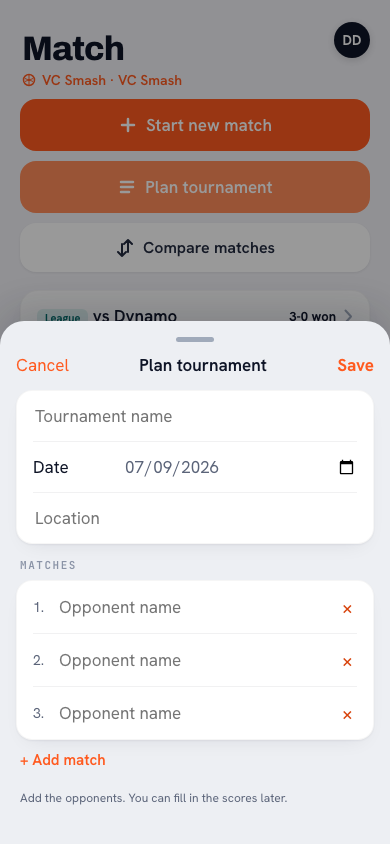
If you want to be able to look back at how that day went, put the matches under one tournament instead of entering them as separate games — in Koach via Plan tournament, and how to keep such a day manageable on paper is in planning a tournament.
Mixed play and substitutions: where 4 against 4 really differs from 2 against 2
Most summer 4-against-4 tournaments are mixed tournaments, and that is where the house rules your rulebook is really about are hiding. The most common set-up is two women and two men on court, often as a minimum rather than an exact number. Variants you will meet and should therefore check beforehand:
- Net height for mixed. Often a height between the women's and men's measurement, sometimes the women's measurement. This is rarely in the email and always on the court.
- A women's contact. Some tournaments require that if a team plays the ball more than once, at least one contact must have been made by a woman. Others have no such rule at all.
- Restrictions on men attacking, from "no attacking above the top of the net" to no restriction whatsoever.
- Substitutions. In 2 against 2 there are none: whoever starts finishes the match. In 4 against 4 you usually may substitute, often freely and with a fifth or sixth player on the side. Ask whether that is allowed per set or per point.
There is no guarantee your tournament uses even one of them. So treat this not as the rules of 4 against 4, but as four questions.
| Element | 2 against 2 (official) | 4 against 4 (most common) |
|---|---|---|
| Court | 16 x 8 m | 16 x 8 m, sometimes 18 x 9 |
| Contacts after a block touch | Block counts: 2 contacts left | Often 2, but many tournaments play the indoor rule |
| Substitutions | None | Usually yes, often free with 1 or 2 reserves |
| Positions and rotation | Free positioning, fixed serving order | The same, only with four names in the order |
| Set format | Best-of-three to 21, third to 15 | Often one set to 21 or 25, or on the clock |
| Switching ends | Every 7 points, every 5 in the third set | Every 7, or only halfway, or not at all |
| Team composition | Two players, one gender per category | Usually mixed, commonly two women and two men |
Ask this before your first match
Walk past the tournament desk when you arrive and ask these eight questions one after the other. Two minutes, and you take away virtually every argument of the day:
- Does the block count as a team contact, or do we still have three after it?
- What size are the courts, 16 by 8 or 18 by 9?
- How high is the net, and is it the same height on every court?
- How long is a match: one set to how many, or on the clock? With or without a cap?
- When do we switch ends?
- May we substitute, how often, and does the substitute take over the place in the serving order?
- How many women minimum on court, and are there extra mixed rules?
- Who referees, and how strictly is setting and tipping judged?
Write the answers on the back of your pool sheet. That day you play four different teams with as many referees; that sheet is the only thing that doesn't move.
Organising one yourself? Put this on a single sheet
Anyone setting up a summer tournament halves the number of arguments at the desk by hanging one sheet of A4 at every court. At the very least, cover these points:
- Block counting as a team contact or not. At the top, because this is the question you will get twenty times.
- Court size and net height, with the mixed height stated explicitly.
- Number of players on court and the minimum composition for mixed.
- Set format: how many points, cap or no cap, what happens at a tied score on the clock.
- Switching ends: at which moment, and who calls it.
- Substitution rules and how the serving order responds to them.
- How setting and tipping are judged. "Only the obvious cases" is a perfectly good rule, provided it is written down somewhere.
- Antennae or no antennae, and what applies if they are missing.
- Who referees which match, and that the captain is the only point of contact.
- What counts for the pool standings: points, points difference, head-to-head result.
- Weather and heat: at what temperature you add extra drinks breaks.
- Who decides in case of doubt, and that the decision stands for that day.
That last point is the most important: you don't have to regulate every situation, you only have to have agreed in advance who cuts the knot. If you want to put your indoor team in the sand seriously over the summer, the training side is in beach volleyball drills.
Key point: in 4 against 4 the most important rule is that you ask for it. One question at the tournament desk — does the block count as a team contact? — changes your whole game plan, and the organiser is the only person who can answer it.
Frequently asked questions
How many players are on court in 4v4 beach volleyball?
Four per team, and in the usual mixed format normally two women and two men. Unlike 2 against 2, this format generally allows substitutions, often with a fifth or sixth player on the side. How many substitutions are allowed differs per tournament.
Does the block count as a ball contact in 4v4?
On sand the standard is that the block does count: after it your team has two contacts left. Many organisers put that rule back to the indoor version for 4 against 4 because the rallies otherwise become too short. Ask at the tournament desk, because you can't tell from looking at the court.
How big is the court for beach volleyball with four players?
Usually the normal beach court of 16 by 8 metres, but some organisers lay out the lines at 18 by 9 for 4 against 4. In both cases the three-metre line and the centre line are missing, so everyone may attack and block from anywhere.
Why do you switch ends every seven points in beach volleyball?
Because sun and wind make one half of the court worse than the other. In the official format you switch every 7 points played in sets to 21 and every 5 points in a third set to 15. In short tournament matches many organisers switch only halfway, or not at all.
Are you allowed to run under the net in beach volleyball?
Yes. There is no centre line on sand, so you may enter the other half as long as you don't interfere with the opponent's play. Because of this indoor players leave balls lying that they could easily have reached.
Can I set overhand in the sand?
Yes, but it is judged more strictly than indoors: every turn in the torso and every double contact goes against you. Set with your shoulders square to the hitter, and choose your forearms if in doubt. At recreational tournaments this is often handled more leniently, but don't count on it.