
Beach volleyball drills for your indoor team
The moment the indoor season is over, a good number of coaches suddenly find themselves with eight weeks of sand and no plan. What you find online is either loose beach games or training material for beach pairs who do nothing else all year. You need something different: drills that attack the problems of your indoor team, in an environment where nobody can hide. This is that summer, written out.
What the sand solves for you — and what it does not
Sand is not a bit of pleasant variety but a measuring instrument. Three things that take real effort to make visible indoors happen in the sand by themselves. One: poor footwork is punished immediately. A player who indoors still saves the ball with an outstretched arm because the floor cooperates simply does not get there in time in soft sand. Two: in two against two nobody can hide. There is no libero taking the hard serve and no setter always taking the second ball — your middle blocker has to pass, and your passer has to set. Three: four players on one court touch the ball more often in half an hour than twelve players do in a whole indoor session.
What the sand does not solve: block timing at indoor speed, rotation, and everything that has to do with a system of six. So count on losing two or three practices at the start of the new indoor season to bring the speed and the rotation back. I will not repeat the differences in rules and court here: those are covered completely in indoor versus beach volleyball, and you read that article once before you head for the beach.
Footwork first, drills second
If you do one thing wrong in your first sand session, it is starting straight in with game play: your players then spend an hour doing indoor footwork on a surface that does not allow it, and mostly remember that beach is heavy and frustrating. Spend ten minutes of the first two sessions on moving. This is what changes:
- You cannot brake. Indoors you stop with a braking step; in sand that foot sinks away and you keep going. So players have to leave earlier: "be still at the moment of contact" falls half a second earlier in the sand.
- Short steps, knees higher. Every step begins with lifting your foot out of the sand. Big steps cost strength and deliver no speed.
- No crossover steps. The sand grabs the trailing foot and you spin on your own axis. Sideways you move with shuffle steps, hips facing the net.
- Falling is free. Players who never dare to dive indoors are doing it within twenty minutes in the sand. A player who has learned that the ground is not a punishment takes that back indoors with him.
- The take-off is deeper and slower. You are pushing sand away instead of a floor. Jumping costs more and delivers less; that is normal and not a lack of fitness.
A warm-up form that covers all of this: four cones in a square of three by three metres, player in the middle. You point at a cone, he shuffles across to it, touches it and comes back. Thirty seconds of work, thirty of rest, four rounds per player — then the same form, but you throw a ball in the direction you point.
A 75-minute sand session, block by block
A sand session is shorter than your indoor practice, and that is not a luxury but a necessity. This is a set-up that works for a group of eight to twelve indoor players on two courts:
- 0-10 minutes — warm-up in the sand. Not jogging along the waterline, but on the court: shuffle steps, skips, accelerations over five metres and ten low jumps at the end. The same build-up as your indoor warm-up, only you halve the running elements — the sand does the rest.
- 10-20 minutes — footwork and ball contacts in pairs. One ball per two players, five metres apart, forearm passing back and forth with one step sideways after every contact.
- 20-35 minutes — passing under pressure. Drills 1, 2 and 3 below.
- 35-45 minutes — the approach and attacking. Drills 4 and 5 — alternate drill 5 with the blocking form below (drill 6) from session to session.
- 45-50 minutes — water and change of ends. Actually schedule this block. In sun and wind this is not a break but maintenance.
- 50-70 minutes — two against two. The main course; see below.
- 70-75 minutes — finisher. One game form everybody enjoys, and done. Never run over time in the sand.
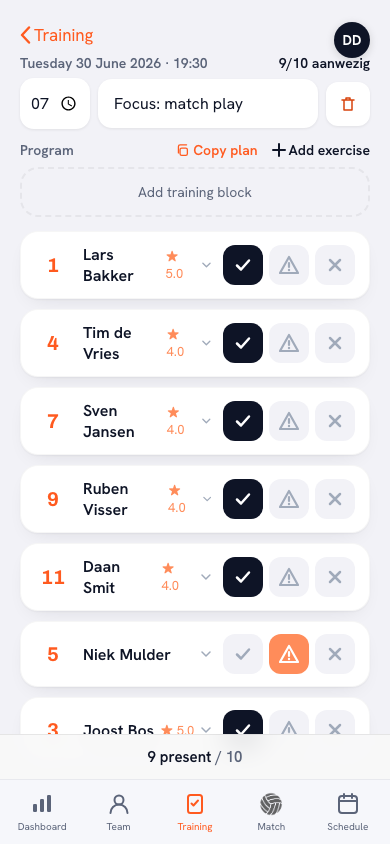
Keep the first two sand sessions to sixty minutes instead of seventy-five, even if everyone is fit. And save the set-up as a template — in Koach as a practice programme with times per block, on paper just as well. You will run this session six times in eight weeks with only different emphases, and you do not want to reinvent it every time.
Three drills for passing under pressure
This is the core of your summer: in the sand nobody can hide behind a second passer, and that makes every passing drill honest automatically.
- One passer, half a court. One player stands alone in one half, one player serves from the other side, one player catches at the net on the spot where the pass is supposed to arrive. Ten serves, target: eight out of ten within a two-metre radius of the catcher, then rotate. The full width of the court belongs to the passer, so every serve he does not reach is a movement problem — not a technical one. Make that distinction out loud; indoors, players almost never get feedback on it.
- Short-long, two balls in a row. You throw or serve ball 1 short by the net, and as soon as the passer has played it, ball 2 comes deep into the corner. Six series of two balls per player, then swap — count on a player who is genuinely done afterwards. Coaching point: after ball 1 he may not stand watching where his pass goes.
- Pass and second ball. Two players per half. Player A passes the serve, player B sets, player A catches the set. Straight after that, another serve. Five minutes per role. This trains the beach chain that indoor players never make: pass, get up, and then be the hitter yourself. It also ruthlessly exposes who loses sight of the ball after his pass — the most common shortcoming you take back indoors, where it hides behind a tidy platform.
The approach: two steps instead of three
The approach is where indoor players hit the hardest wall in the sand. The three-step rhythm does not work: the first, accelerating step delivers no speed in soft sand and only costs energy. In the sand you take two steps, plant both feet almost simultaneously and push yourself up with a deeper, slower knee bend. Anyone who knows the three-step rhythm from indoors has to unlearn this deliberately and relearn it later — how that rhythm should run indoors is in the attack approach.
- Ten jumps without a ball, ten with. From a standstill four metres from the net: two steps, two-footed take-off, arms with it, land on two feet. First ten times without a ball, then ten times with a ball thrown high from the side by a team-mate. Two series per player. Watch only the feet, not the swing.
- Attacking off a set that is wrong. The setter deliberately puts the ball a metre too far outside or too tight to the net. The hitter has to choose for himself: put it over the imaginary block, hit hard through the hands, or lay the ball back cross-court. Eight balls per player. In a pair you rarely get the set you wanted, so this is not a punishment drill but the normal situation; players who learn here that a bad set can still be a point force less indoors.
One blocking drill is enough
Do not expect a summer of beach to improve your blocking, but one form belongs in there — it trains a decision that applies just as much indoors.
- Block and pull off. One player at the net, you on the other side with balls. Before you touch the ball, he chooses which half he is covering and calls it out loud ("line"). You hit or tip: if he touches the ball, great; if you tip over him, he has to land, turn and still get the ball. Eight repetitions, then swap. In the sand you barely move along the net, so the choice before the attack is everything — precisely what indoor blockers do worst.
More blocking work than this is wasted jump load: jumping in sand is expensive, so spend those jumps on attacking.
Setting and serving: what happens to your drills
Overhead setting is judged far more strictly on the beach than indoors: every spin or double contact on the set is called. For your drills that means two things. First: have your players set every second ball with their forearms for the first few weeks. It feels clumsy, but it delivers height and a ball above the hitter, and it takes the argument about fingers away immediately. Second: if they do set overhead, the requirement is "straight at the hitter, shoulders squared behind it, no rotation in the torso" — have a team-mate stand alongside who calls "turn" the moment the shoulders rotate. What a clean set is technically is in overhead setting; in the sand you apply that same technique with less margin.
Serving changes because of something you never have to deal with indoors: wind. Make it a fixed block of ten serves per side, and have players say out loud what they are adjusting. The rules of thumb: wind behind you carries the ball on, so serve flatter over the net and aim at the front half of the court; wind against you holds the ball up and drops it earlier, so hit harder and deeper; crosswind makes a float swerve, so aim half a metre into the wind. Tactically something changes too: with two players the weaker passer cannot hide, so you serve at whoever has just attacked and still has to get back, or short behind the net. How to build that targeting is in serving tactics — the thinking is the same, only the targets differ.
Two against two: the format it was all for
Everything above is preparation for this twenty-minute block. Two against two is not a smaller version of six against six: it is the format in which every player makes choices every rally that indoors he leaves to somebody else. Three variants that work:
- Rotate per point. Two pairs play to 11 with a change of ends at 6. The winning pair stays on, the losing pair swaps one player with the waiting pairs — so nobody plays half an hour with the same partner.
- Forearm setting only. Same game, but the second ball may only be played with the forearms. Frustrating for the first five minutes, after which you see the quality of the first ball go up: a player who passes badly can no longer paper over his own error with his fingers.
- Winner stays, with a queue. The classic king-of-the-court format, with a court you defend and a line of pairs wanting in. The set-up and the variations are in Queen of the Court; in the sand you only need to lower the set target, because a rally costs twice as much there.
Coach almost nothing during this block: two against two corrects itself, because whoever makes the wrong choice loses the rally. Save your remarks for the change of ends, one thing per pair.
Key point: you do not go into the sand to make beach players, but to put your indoor players in situations for eight weeks where they have to decide for themselves. Every drill above is recognisable by the same feature — there is nobody standing next to them who can take over.
The load: calves, hamstrings and the way back indoors
The first sand session is the most dangerous one, and not because players go too hard. Sand loads the calves and the Achilles tendon in a way no indoor session imitates: every step starts with a push off the toes without the surface pushing back. Two to three days of solid muscle soreness in the calves is normal after the first session. Pain in or just above the heel that is still there a week later with every push-off is not — that player belongs at a physiotherapist, not on the beach. The hamstrings get it harder too, because accelerating in sand takes longer.
In practical terms that means: first week two sessions of sixty minutes with at least two days in between, weeks two and three up to the full seventy-five minutes, and only after that tournaments or long afternoons. On hot days do not play barefoot on sand you cannot hold in your own hand for two seconds. Let players with existing knee complaints join the game forms but jump less; in the sand you can dose that easily without it being noticed.
The reverse warning is at least as important, and it is structurally forgotten. After eight weeks of sand your players have learned to land on a surface that absorbs everything. The first indoor session after that is a hard floor with the same jumps on it, and that is precisely the moment when knee tendons protest. Build the jump load up over the first two indoor weeks: no blocking, hitting and jump-strength work in the same week, and in the first week at most half your usual number of attacking repetitions. What else you arrange structurally to stay ahead of overload is in injury prevention in volleyball. When your indoor season ends and starts again differs per federation, so count back from the date in your own competition calendar: the last two sand weeks are the weeks in which you are already bringing the load back down.
Frequently asked questions
How often can I have my indoor team practise in the sand?
Once or twice a week is enough for most club teams, with at least two days between the first two sessions. More often is fine once the calves are used to it, but the gain sits in the quality of the two against two, not in the number of hours.
Can I do beach drills on a normal court if there is no sand?
The game forms yes, the footwork no. Two against two on half a gym delivers the same 'nobody can hide' gain, but the corrective effect on moving and taking off falls away. A grass field is a reasonable alternative for the game forms, with the same rule: no crossover steps and stop earlier.
Are these drills suitable for youth players as well?
Yes, with two adjustments: shorten the session to forty-five to sixty minutes and lower the net, because you do not get as high in sand. With young players, work with smaller courts and more pairs at once, so the rallies stay short and nobody stands still in the sun for long.
Will my team get worse indoors from a summer of beach volleyball?
On two points temporarily, yes: the three-step rhythm of the approach and block timing at indoor speed have to come back, and that costs two to three practices. Against that, players pass better under pressure, dare to go to the floor more and make choices more independently.
How many players do I need as a minimum for a worthwhile sand session?
Four is enough for a full session: two against two on one court with rotation inside the drills. With eight to twelve players on two courts the programme above runs most smoothly; above twelve you need a third court, or more players are waiting than playing.
Try it yourself in Koach
Less admin, more coaching.
Get started with KoachOr read first what the volleyball coaching app does.