
Serving strategy: where do you serve and why?
An ace is nice, but it isn't the goal. The goal of every serve is to break the opponent's organization: a mediocre pass means no fast attack, and no fast attack means your block is set in time. Serving is aiming, not hammering.
Why 'just get it in' isn't enough
The serve is the only moment in the game you fully control: no pass that falls short, no set that is too tight — just you and the ball. Using that moment to 'lay it in safely' hands the opponent a free perfect pass and, with it, every attacking option. Serving with a target is effectively playing the first defensive action of the rally: every half meter you push the pass off the net makes the attack more predictable and your block more effective.
The six classic targets
- The weakest passer. The simplest plan and often the best. Watch the warm-up for whoever looks jittery on the pass — and keep serving at them until proven otherwise.
- The seam between two passers. A ball right between two players forces a choice ('yours or mine?') and produces a scrappy pass remarkably often, even against good passers.
- Short behind the net. Against teams dug in deep: the short ball pulls the attackers out of their approach and forces a pass from close to the net — hard to build an attack from.
- The deep corners (zones 1 and 5). A tight float deep into the corner makes the pass long and the outside hitter's approach cramped.
- The best attacker. Make them pass: an attacker who first has to dig deep starts their approach later and shorter. Serving at their star is block help by other means.
- The setter's running lane. Against a team with a penetrating setter (5-1 or 6-2): a ball in or right along that route disrupts the timing of the entire attack.
Dosing risk: pressure versus errors
Every serve is a trade-off between pressure and error rate. Rules of thumb that work at every level: take risks when you have nothing to lose (a comfortable lead, or far behind), serve safe-but-placed on the tense points, and never miss twice in a row the same way. Watch the rhythm of your serving run too: after two scoring serves, the third is not the moment to suddenly go full risk — the pressure is already on.
Do the honest math as well: a service error costs one point, but an easy serve that ends in a perfect pass and a kill costs one too. 'Never miss' is not a strategy — the question is what error margin your serve pressure is worth, and for most teams that margin is higher than their gut says.
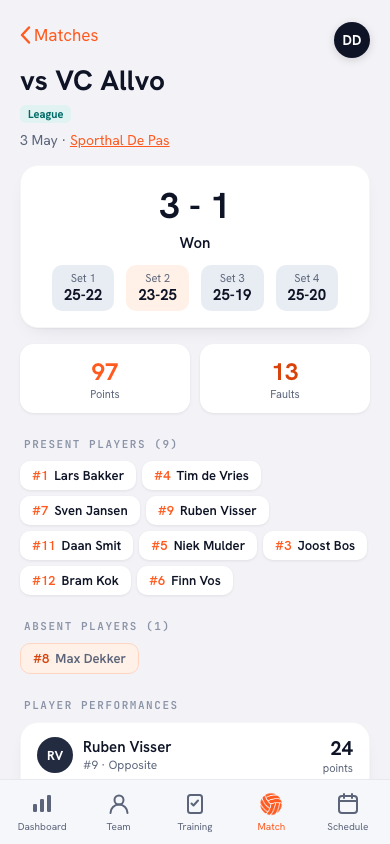
The scoreboard serves along
The same serve is a fine gamble at 12-4 and a capital mistake at 23-23. So tie your serving strategy to the moment in the match. Right after an opponent's timeout, never serve into the net — that is exactly what their timeout was hoping for; go with your most reliable placed ball instead. When a substitute enters the court, serve at them: nobody is colder than the player fresh off the bench. And think about your serving order in advance: whoever starts at position 1 opens every one of your service turns — putting your best server there is the cheapest serve pressure there is, and you arrange it when picking your starting lineup.
Making agreements and training them
Serving strategy only works when the team speaks the same language. Number the zones (1 through 6, like the positions) and set a target for each service turn — via a signal from the bench or a fixed agreement per set. Train it weekly: ten serves per player at a designated zone, with a mat or hoop as the target, and count the hits. And if you also track what each serve produced in matches — check your serving statistics for that — within a few weeks you'll see which targets suit which server.
Finally, make aiming a habit, not an extra: have every serving drill end at a target zone, including the pre-match warm-up. A player who serves 'just into the court' a hundred times in practice will do the same in the match — and a player who always serves with a target needs no extra instruction when it counts.
Never serve at the libero 'just because'. The libero is usually the opponent's best passer. If you do serve into their zone, do it with a reason: short, into the seam, or to keep an attacker next to them out of their approach.
Frequently asked questions
Is a hard serve always better than a placed one?
No. A hard serve that misses the court twice a turn earns less than a placed float at the weakest passer. The best serve is the toughest ball you can land nine times out of ten.
Where do I serve when I don't know the opponent?
Start deep to zone 5 or into the seam between the passers — that is uncomfortable against nearly any team. Watch the first few points to see who wobbles on the pass, then adjust your target.
Should every player be able to place a serve on command?
Aim for everyone to hit at least two zones deliberately, say deep-left and short-middle. Perfection isn't required: a serve that lands roughly in the intended zone already does the tactical work.
What do I do with a server who suddenly misses three in a row?
Lower the target, not the confidence: have them serve one turn safe-and-placed to find the rhythm again. Structurally missing in the same spot is a technique question for practice, not a match problem.


Try it yourself in Koach
Less admin, more coaching.
Get started with KoachOr read first what the volleyball coaching app does.