
Serve-receive formations: passing with 3, 4 or 5 players?
Every opponent's rally starts with your serve receive. The first tactical question isn't how you pass but with how many: three, four or five players? Every formation is a trade-off between court coverage and freed-up attackers.
The trade-off: coverage versus specialization
More passers means smaller zones per player — but also that your weaker passers and your attackers get involved with the ball. Fewer passers means bigger zones, but for your best passers, while the rest are free to attack. So the choice hinges on two things: how good are your best passers, and how badly do you need your attackers in the quick first-tempo attack?
Five passers: the beginner formation
The classic W formation — three players in front, two behind — is what you see with beginning teams and in youth volleyball. Strengths: small zones, little debate about who takes the ball, everyone learns to pass. Weaknesses: your worst passer is by definition passing too, and your attackers start their approach late because they pass first. A fine starting point, but grow out of it deliberately once the passing stabilizes — stay at five too long and you actively slow down your team's attacking development.
Four passers: the middle step
With four passers in a half-moon you pull one player out of the pass — usually the attacker you want to free up, or your weakest passer. The zones stay manageable and you gain a free attacker. For many mid-level teams this is the practical standard.
Three passers: the specialist formation
Higher-level volleyball almost always passes with three: the libero and the two outside hitters. Middles and the opposite stay out of serve receive entirely and can go straight into their approach — the precondition for fast attack tempos. The price: each passer covers a third of the court and has to handle the tough serves too. Choose this only once you have three passers who can deliver. At the very highest level you even see two-player serve receive — an extreme that is rarely wise for amateur teams, but it shows where the logic ends: as few passers as possible, as many free attackers as possible.
The picture shifts every rotation
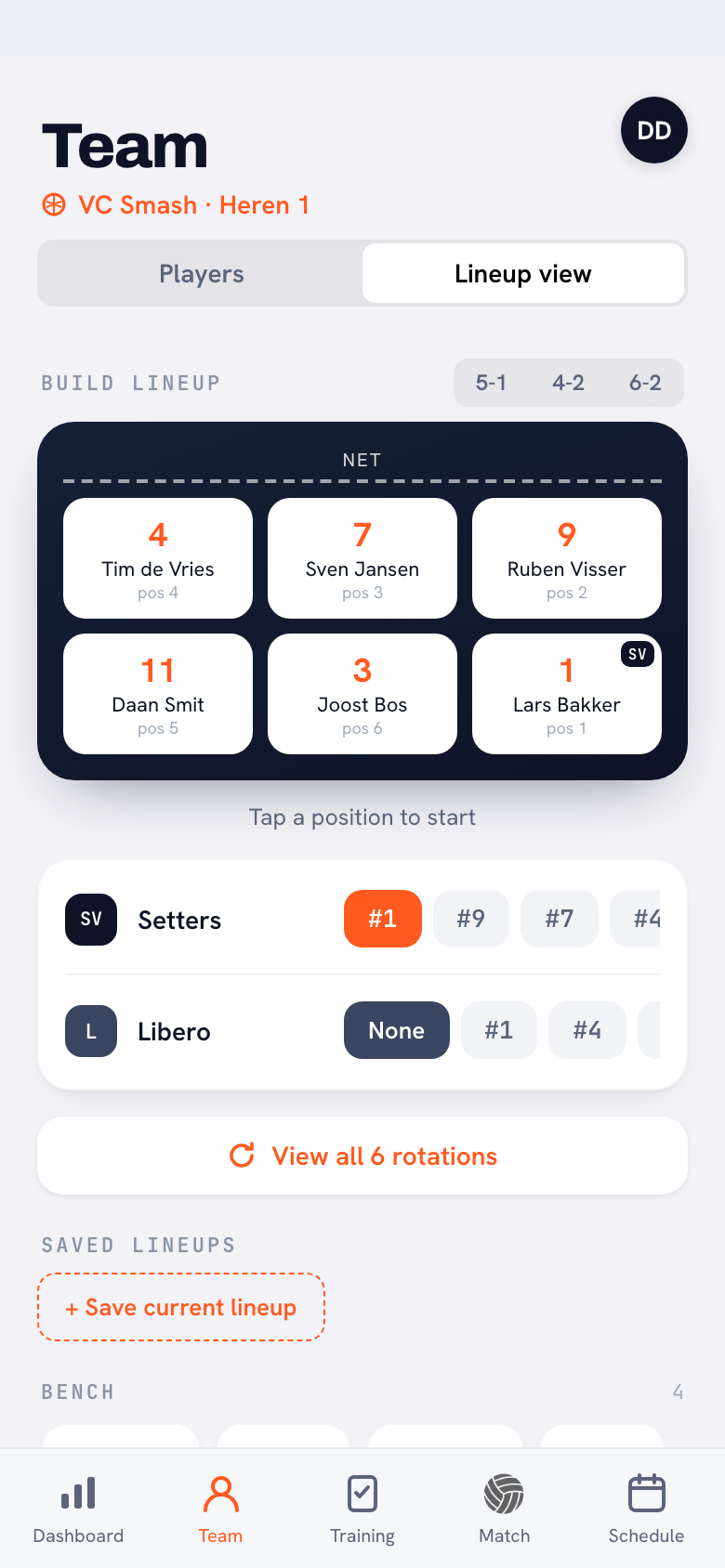
A serve-receive formation is not one fixed photo but six variants: in every rotation different players are in the front row, and your passing assignments shift with them. The outside hitter in the front row should pass as close as possible to their approach zone — on the side, with a short turn to their attacking position. The setter in the back row must be able to penetrate freely without crossing the passing line. So walk through your six rotations in advance and map out who passes where in each one; the rotations where your weakest passer and your most important attacker are both in serve receive are the ones the opponent will serve at.
Communication: who calls, who stays quiet
The best formation fails without claiming rules. Two agreements solve nine out of ten collisions. One: the player who has the ball in front of them and is moving toward the target has priority over the player who has to backpedal — so the seam ball belongs to whoever has the better direction of movement. Two: calling is mandatory and early — 'out!' or 'mine!' before the ball crosses the net, not after. Silence in serve receive isn't calm, it's risk: in practice, have every pass preceded by a call, even when the choice seems obvious.
Who do you pull out of the pass — and how?
By default you pull the middle blockers and the setter out of serve receive, then your opposite. You 'hide' a weak passer by placing them close to a strong passer who claims in advance: everything between us is mine. Mind the alignment rules as you do — shifting is allowed, but at the moment of the serve everyone has to stand legally, or you concede a positional fault.
Measuring and adjusting
The formation choice is not a dogma but a hypothesis. Track per match how serve receive actually goes: which player handles the most balls, where are you giving up the aces? If one passer structurally falls through the ice, shrink their zone or switch formations — and work on it with targeted serve-receive drills.
Never divide the court into exactly equal parts. Deliberately give your best passer the biggest zone and have them claim it out loud. One good passer with a lot of court beats three hesitant passers with tidy little boxes.
Frequently asked questions
Which serve-receive formation fits my team?
Count your reliable passers. If you have three who handle tough serves too, pass with three and free up your attackers. In doubt, start with four — the safest middle ground for most amateur teams.
Should the setter take part in serve receive?
Preferably not: the setter has to be free to run to the setter zone and play every second ball. Only in emergencies — or in youth volleyball, where everyone learns to pass — do they take a ball.
Who takes the short ball in a three-player serve receive?
Agree on it in advance: usually the libero or the passer on the side where the short ball drops, while the outside hitter stays deep. Without that agreement, the short serve is the hole in every three-player formation.



Try it yourself in Koach
Less admin, more coaching.
Get started with KoachOr read first what the volleyball coaching app does.