
How to improve serve receive in volleyball when it falls apart in matches
At practice the passing holds up. Then the opponent gets a few serves in a row during a match, serve receive falls apart, and for a whole set you never get a good ball to attack from. Running more passing drills is the first reflex and rarely the answer. If you want to know how to improve serve receive in volleyball, start from this: reception that collapses leaks in four different places, and each place needs a different repair. This piece is not about which drill to run, but about the question that comes before it — which of the four leaks do you have?
How to improve serve receive in volleyball: why more passing drills won't fix it
At practice the ball almost always comes from close by, out of a hand you can see, in a direction you know, to a player who is already in position. In a match it comes from behind the end line, after a run-up, and the passer first has to decide whether it is their ball. Those are two different skills, and you do not train the second one by doing more of the first.
That is why "we pass badly" is not a conclusion but an observation. The real question is where the leak is. It is almost always one of these four:
- One passer who drags the team average down, and whom the opponent has found.
- The seam between two passers, where the ball drops between two people.
- The formation, which does not suit the number and the level of your passers.
- The opponent's serve type, which your team has no answer to.
If you want to know which drills to run afterwards and how to build them up over a number of weeks, that is covered in reception drills with a progression. Below, for each leak, you will find the signal that gives it away from the sideline, what you do about it, and where the fix is worked out in more detail.
Leak 1: one passer drags the average down
The signal is simple and it comes from across the net: the opponent serves three or four balls in a row at the same player. A team that finds a weak passer keeps serving there until you do something about it. If you notice the ball keeps going to the same corner, the diagnosis has already been made — just not by you.
The second signal is in the ball that comes back: not long and wild, but each time just too short or just too far off the net, so the setter has to run and only one attacker is left. That is the expensive version, because a ball like that does not count as an error and still costs you the rally.
You only get hard evidence by tracking it. How to do that during a match without missing the game is explained in tracking reception on a scale of 0 to 3. If you score live in Koach, you tap that rating on every opponent serve and then who received the ball; the match detail then shows the average reception per player. After a few matches you can see whether it really is one player, or whether you only thought it was.
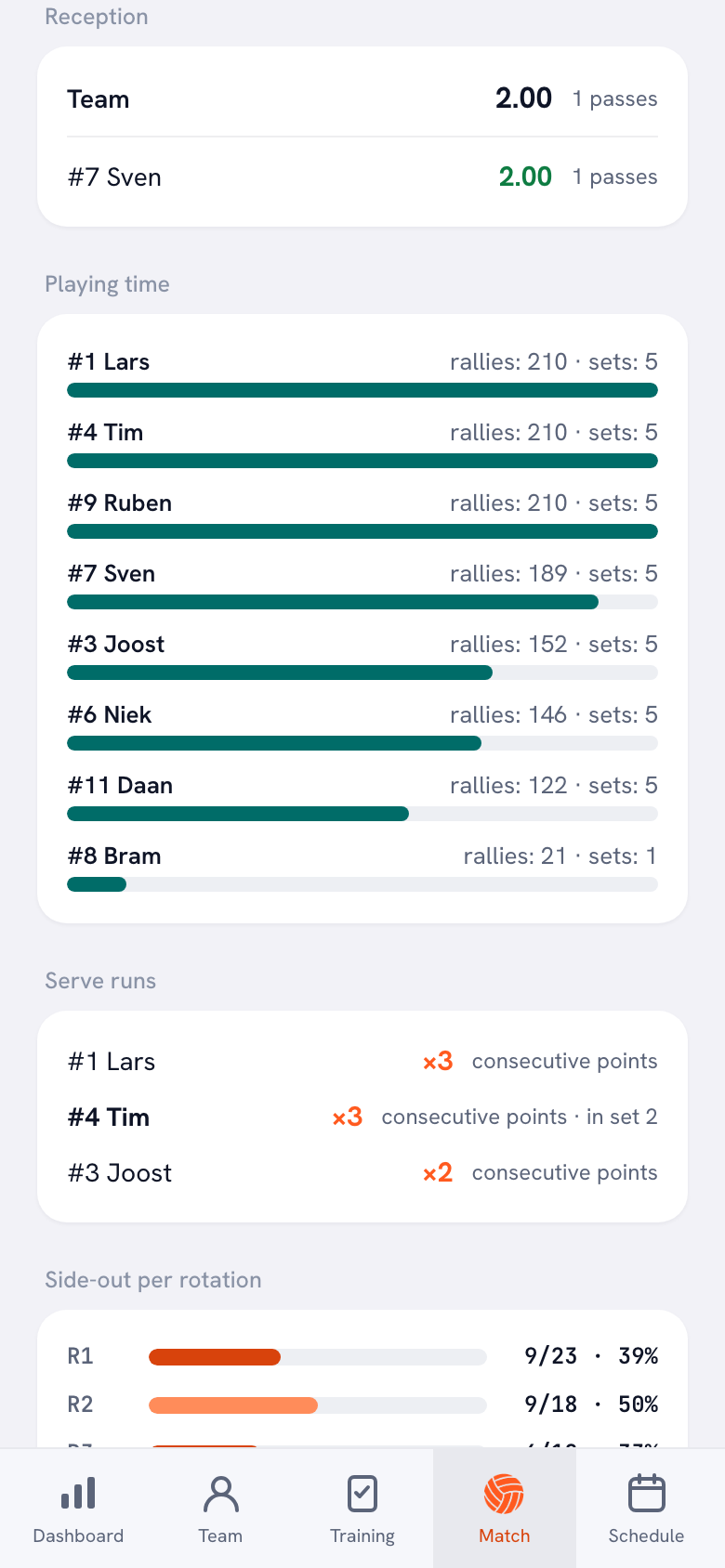
Pay attention to the number of balls next to the rating. A player who handled twenty serves with a mediocre average is a different problem from a player who received four. The first is being targeted and cannot hold up; the second is probably hidden so well that the ball hardly ever reaches them.
What you do about it, in this order: make their zone smaller instead of taking them out, let the passer next to them take the in-between balls, and in practice give them the balls they also get in matches — from behind the end line, not from a toss. Taking a player out of serve receive is a formation change, and that is leak 3.
Leak 2: the ball drops between two passers
The signal of a seam leak is that nobody gets to the ball. Two players each take half a step, look at each other, and the ball lands on the floor between them. Nobody made an error you could tally on a sheet, and that is exactly why this leak often goes unnoticed for a long time.
In a match the seam is also far more pronounced than in practice. A coach tosses or serves at a person; an opponent deliberately serves at the space between two people, and a floating serve can still change direction there at the last moment. Ask your team afterwards who should have taken that ball and you will get two different answers — that, quite literally, is the leak.
The agreement that fixes it is one sentence long, and it is set out, with the calling and shifting that go with it, in the seam in serve receive. All you need to do here is establish that it is the seam. That takes two rallies: do not watch the ball, watch the feet of the two passers. If both move half a step and then one stops, the agreement is not clear. If one stays completely still while the ball lands on their side, it is a question of responsibility, not technique.
If you want to recreate the seam leak in practice, the drills for volleyball coaches include, under Serving, the form "Float serve at the seams", in which the servers deliberately aim between two passers.
Leak 3: the formation does not suit your players
A formation is not a drawing but a division of floor space. With many passers everyone has a small zone, but there are more seams and your weakest passers have to pass too. With few passers there are fewer seams, but every passer has to cover more floor. Which division is better does not depend on what stronger teams do, but on who is on court for you.
Two signals point to this leak. First: your passers move a lot and arrive late, without the serve being particularly sharp. Second: a ball keeps landing in the same open space — short in front of the setter, or deep in the corner behind the attacker who does not pass. That space is a design flaw, not a misjudgement, and it will not go away by shouting louder.
How many players you pass with, how the picture shifts per rotation and whom you take out of the pass is covered in serve receive formations. Important for the match itself: you only change a formation between rallies, and you give it time until your team has gone through all six rotations before you judge it. The first balls after a change are often messy, even when the change is right.
Never change two things at once. If in the same time-out you swap a passer, change the formation and also make a new seam agreement, you will not know afterwards what helped. One intervention per time-out, and you keep sight of what works.
Leak 4: the opponent's serve type
The telltale sign of this leak is that it does not hang on one player. All your passers struggle against the same server and are fine against the rest. Then the problem is not your team but a ball flight your team has no answer to.
A hard jump serve takes away reaction time and demands a low, wide stance and a step back. A float does the opposite: it comes in slower, does not spin and only moves late, up or down. Teams that mostly receive hard balls in practice often stand too deep against a good float, and then the ball drops away in front of them. How to read that flight and which footwork goes with it is in passing a float serve.
What you can do during the match is limited and therefore concrete: move your passers a step forward against a float and a step back against a jump serve, have them set the platform early instead of swinging at the ball, and accept that the pass will not be perfect against this server. If it is the stance itself, the forearm pass is the place to start. And because this leak gives you bad balls anyway, it pays to give out-of-system play a fixed place in your practices: a team that can still score from a scramble ball does not automatically lose these serves.
Which leak is it? The order in which you look
Go through the four leaks in a fixed order, from the numbers you have to the watching you have to do yourself. That usually gets you an answer within one or two matches:
- First look at the spread across your passers. If one is clearly below the rest, with enough balls behind the number, it is leak 1 and you start there.
- Then check whether it hangs on one rotation. If the ratings per player are fairly even but you keep losing the rally in the same lineup, reception is the symptom and not the cause.
- Look at the balls that hit the floor. If they dropped between two players, it is leak 2.
- Look at the space. If they landed in the same open zone, it is leak 3.
- Look at the server. If it only went wrong against one type of ball, it is leak 4.
Step 2 deserves a closer look, because from the sideline a leak in one rotation looks exactly like a reception problem. The measuring method and the repairs are in finding your weakest rotation; what the number behind it means is in side-out percentage.
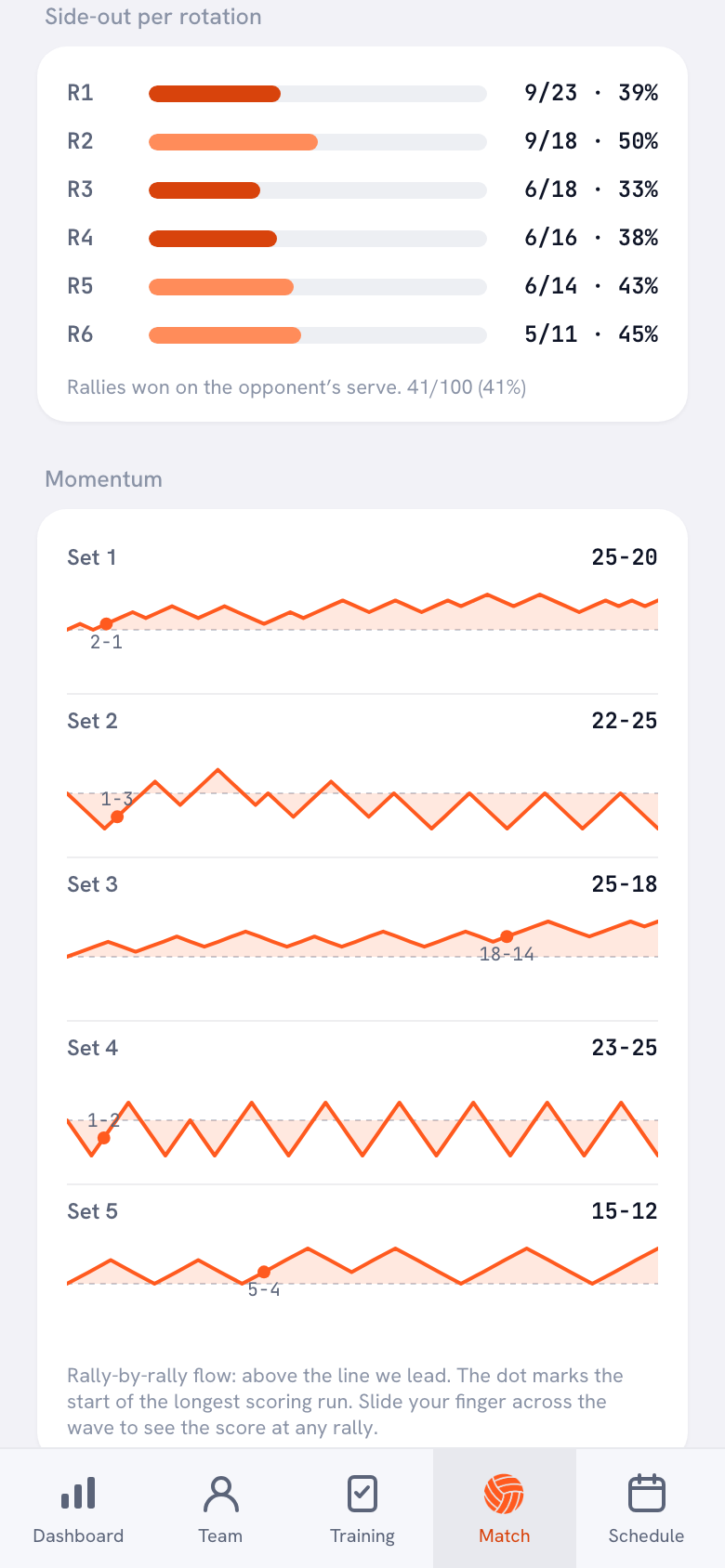
During the match itself you rarely get through that whole sequence. Use the time-out for one question instead of four: which ball hit the floor in the last few points, and between whom? Which numbers you can read between two time-outs is covered in looking back during a time-out.
What you change in practice depends on the leak you found — but one thing applies to all four: the ball has to come from far away, from behind the end line, with a server who is trying to score. A reception drill without a real serve trains something other than what breaks down in the match; why that is so is explained in game-like drills.
If you no longer want to rely on memory afterwards, track one match live. In Koach you tap the reception rating and the receiver while scoring, and the average per player and, if you have set a setter, the side-out per rotation are ready right after the last ball. Then the conversation at the next practice is no longer "we pass badly" but "this is where it leaks".
Frequently asked questions
Why is serve receive good in practice but not in matches?
Because at most practices it is a different skill. The ball comes from close by, out of a hand you can see, to a player who is already in position, and nobody is trying to score. In a match it comes from behind the end line, changes direction, and the passer first has to decide whether it is their ball. So have someone genuinely serve in every reception drill, even if that means fewer balls per minute.
Can you judge serve receive without a statistician on the sideline?
Yes, as long as you pick one thing. For one set, tally only who received the ball and whether the setter could set it, nothing more. An injured player or a parent on the sideline can easily keep that up. If you already score the match live in an app, the reception rating per serve costs you one extra tap and you get the average per player automatically afterwards.
What if all passers are equally bad?
Then it is almost never leak 1, and you look at the formation and the serve type. Check whether the balls landed in the same open zone — then the division of the court is wrong — or whether they all came from the same server. If it stays bad across all servers and all zones, look at the rotation in which it happens before you change anything about the pass.
What if it mainly goes wrong against one type of serve?
Then you have your practice assignment for the coming weeks. Against a float a team often stands too deep; against a jump serve too high and too close to the ball. Have the servers at your own practice deliberately hit that type, even if it means a few players mostly serve instead of pass. A team that never faces a float never learns to read one.
How long do you give a new formation before switching back?
At least until your team has gone through all six rotations and is back in the same lineup. The first balls after a change are often messy, even when the change is a good one, and if you switch back on the strength of that you will keep swapping back and forth. If it still does not work after that full cycle, go back to the old formation and work on it in practice rather than during the match.


Try it yourself in Koach
Less admin, more coaching.
Get started with KoachOr read first what the volleyball coaching app does.