
Point scoring percentage in volleyball: why your team doesn't score on its own serve, and what to train
Your team does fine on the opponent's serve. The pass is there, the attack goes down, the serve is yours again. But as soon as you serve yourselves, the other side wins the rally and the score stays stuck. That is a low point scoring percentage, and in volleyball this is the part of the game in which a team can pull away. The cause is almost never one thing: there are three links between your serve and a point, and usually exactly one of them breaks.
Point scoring percentage in volleyball: why points on your own serve decide the set
Every rally starts with a serve. When the opponent serves, you play to win the serve back: that is side-out. When you serve yourself, you play for a point that really changes the score. That point is often called a break point, and the phase in which you win it is the break phase.
Work it through once and you will see why this part weighs more than it feels. Suppose the serving team always loses the rally: you score, they score, you score. The points then alternate and the score stays within one point, whoever started. Pulling away on the scoreboard is only possible by winning two rallies in a row — and the second of those two is, by definition, played on your own serve.
So a team that can only side out does not lose its sets through bad luck but through arithmetic. It hangs in until the opponent wins two points in a row a few times, and then the gap is there. That is the picture of a set in which you are level for a long time and still lose by five points.
Counting in one match: points on your own serve per rotation
Before you start training anything, you want to know how big the gap is. You do not need a statistician for that: two tally lists on one sheet of paper are enough. Give them to a substitute who is not playing this set.
- List 1 — serve won back. One mark every time the serve comes to your team. Those are your side-out points, one by one.
- List 2 — point while we serve. One mark for every point your team scores on its own serve. Those are your break points.
Together the two lists always equal your score, so a forgotten mark shows up immediately. An example you can check for yourself: your team loses 20-25 and started by receiving. List 1 is on fourteen, list 2 on six. Those fourteen serving turns all ended with a lost rally, because your team did not score the last point of the set. So you served fourteen plus six, twenty rallies, and won six of them: thirty per cent. Finding your weakest rotation gives the benchmark for this number — around thirty-five to forty-five per cent at amateur level — and the full tally sheet per rotation.
If you want to know it per rotation, write the rotation number next to every mark on list 2, and also note every lost rally on your own serve with its rotation. Do not draw conclusions from one match: per rotation that is too few rallies. Look mainly at the pattern: if there is one rotation in which you almost never score two points in a row, you know where the repair has to land. How long those runs get when things do go well, and what you can see from that, is in serving runs: points in a row on your own serve.
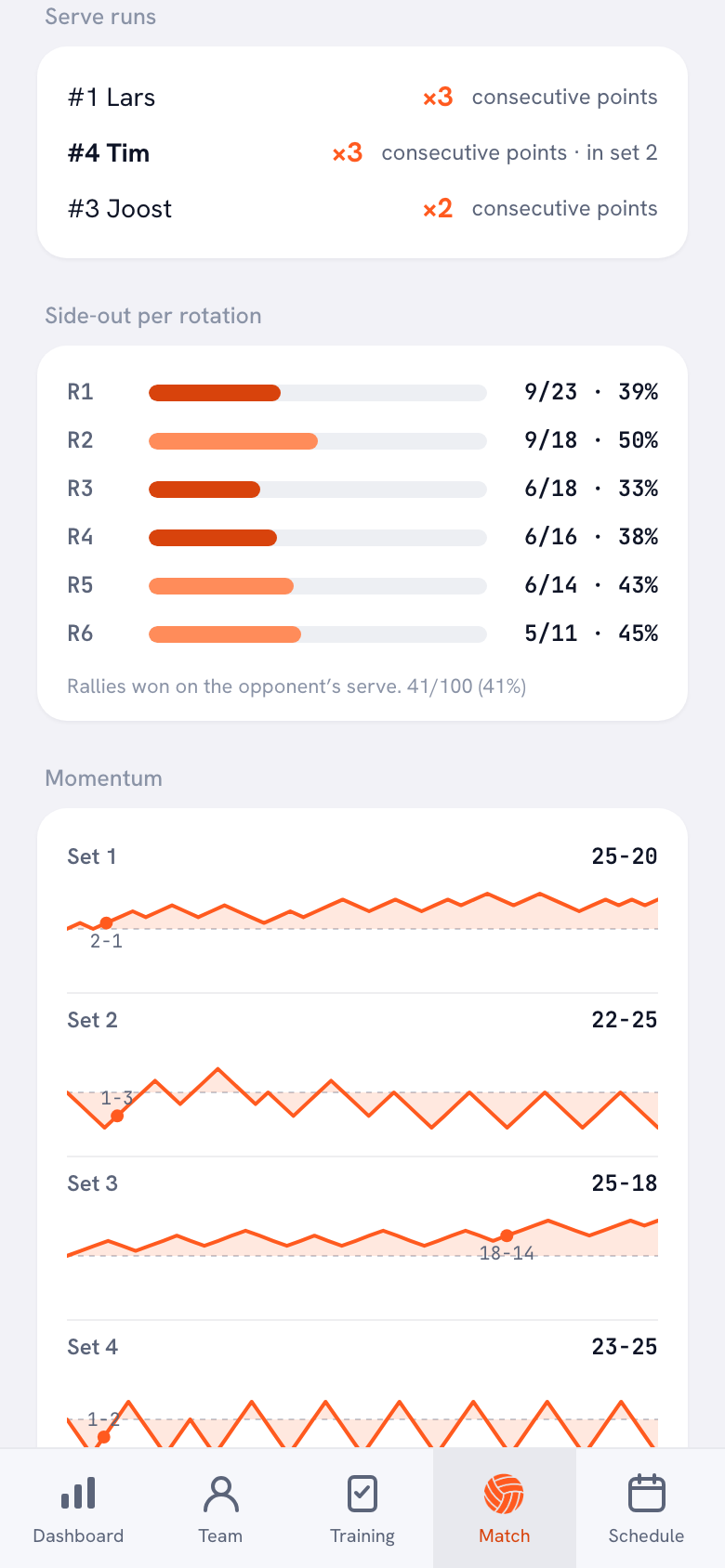
That is also the limit of this screen: the side-out figure per rotation is there, a point scoring percentage is not. The momentum line does show where a set tipped. A kink like that is a run of consecutive points, and after the first point of such a run a team only scores on its own serve — yours or the opponent's. How to read that line is in momentum in a volleyball match. So the two tally lists remain manual work. That costs one substitute per set, and you can keep that up for a few matches.
Link 1: serving with a target, not just into the court
The first link is the serve itself, and that is where the most common leak is: players serve to get the ball in. A serve that lands safely in the middle of the court lets the opponent do what they like doing best. The passer stands still, the setter gets the ball in the right place and all the hitters are available. Your block then has nothing left to choose.
So the assignment is not "harder" but "somewhere". Every server has one target per turn: a player, a zone or a seam. Which targets there are and how much risk goes with them is in targeted serving; how many errors are acceptable in return is in serving stats and aces. If the ball structurally ends up in the net, that is a technical problem, not a tactical one. You fix that with the causes of a serve into the net, not with a new target.
Drill: serving with an assignment (15 min). Two servers at a time from the end line, the rest catch on the other side and roll the balls back. For each series of five balls the server gets one assignment: the right back corner, the player who has just come on, or the seam between two passers. Scoring: ball in the target area two points, ball in the court one, error minus one. Three series per player. With ten players that is a hundred and fifty serves; two at a time, that fits into a quarter of an hour, provided there are enough balls so nobody has to fetch them.
Link 2: block and defence that slow down the first attack
The second link starts as soon as the ball is over the net. The opponent gets a first attack, and that is where it goes wrong for many amateur teams: that first attack does not come back up. Not because the defence is poor, but because nobody has agreed who stands where when the ball is hit.
The goal of this link is more modest than it looks. You do not have to block the attack. You only have to slow it down enough for someone to reach it. Two agreements do most of the work: the block chooses one side and really closes it, and the defence stands behind the other side, not in the shadow of the block. How to set up that block and who decides is in organising the block; the choice between defensive formations is in defensive systems. Here it is only about whether the ball comes up.
Drill: serve and keep it up (12 min). Six players on court, on the other side a group that builds up the ball and attacks. There is a real serve, no toss. The scoring is only about that first attack: if it stays up and playable on your side, that is a point for the serving team, regardless of what happens afterwards. First to ten. That feels strange and it is the core: as long as you count the outcome of the whole rally, this error stays invisible among everything else that happens.
Link 3: the transition to a counter-attack
The third link is the most expensive, because this is where you lose points you almost had. The ball comes up, and then it turns out nobody has moved on. The front-row players who did not block are still at the net, the setter is at their defensive spot and the only one who can do anything is the player who just dug the ball.
Three agreements help directly here, and they do not cost any extra practice time:
- Off the net if you don't block. A front-row player who sees they are not needed in the block immediately steps back to their approach spot. Whoever stays glued to the net cannot approach.
- One fixed route for the setter. The setter knows where they come from and which ball they leave. A setter who has to think about the route is late to the ball.
- One agreed emergency option. If the dug ball is poor, it always goes high to the same place, for example outside in position 4. Do not pick the spot of your best hitter, but the spot where someone is available in every rotation.
The footwork and the separate forms you use to build this up belong to transition drills. When you are serving, it is about something else: that the three agreements still hold when the rally has been going for a long time and legs are tired.
Drill: attack after the dig (12 min). Six against six, but only the serving team can score, and only with an attack after a ball it has dug itself. A direct point from the block or an error from the other side earns nothing. That way all the attention is on the transition itself. Five points, then the serve switches.
Change one link at a time. If in the same weeks you move the serving targets, set up the block differently and change the transition, after three matches you will not know what worked. Pick the link where your tally list shows the clearest gap, stick with it for three weeks and then count again.
Drills in which the serving team has to score
The three forms above each train one link. The two below connect them again, and that is necessary: in a match, scoring on your own serve comes past in one piece.
Five break points, count the serves (15 min). Team A always serves. If A wins the rally, that is a break point. If B wins the rally, nothing happens except that A serves again. A plays on until five break points and B counts out loud how many serves that took. Then switch. With the benchmark of thirty-five to forty-five per cent you end up at roughly eleven to fourteen serves for those five points; if your team is well above that, you have your answer. The opponents counting out loud is half the drill.
Points on your own serve only (15 min). Normal six against six, with one extra rule: a rally won only counts if you win it on your own serve. A side-out wins you the serve, but not a point. That turns the arithmetic from the start of this piece into a game rule: whoever does not win two rallies in a row does not get anywhere. First to eight. Why consequences like that deliver more than an extra repetition is in game-like drills.
Both forms have the same side effect: you see straight away who still dares to serve under pressure. That is useful for match day, because your serving order is fixed as soon as you choose your starting lineup. During the match you can spend your time-out on one link: if your tally list shows that your serving turns keep ending after one ball, give one serving target instead of a story about the attack. Which numbers you want to see during that break is in looking back at your time-out.
If you score live in Koach, you already have half the story: the app tracks the longest serve runs and draws the momentum line of every set. It does not calculate a point scoring percentage, so you keep the two tally lists yourself — but the momentum line does point you to the part of the set you look at first on your tally list. Try Koach free for fourteen days and count your next match this way once.
Frequently asked questions
How do you count points on your own serve without a statistician?
With two tally lists on one sheet. On the first you make a mark every time the serve comes to your team; those are your side-out points. On the second you make a mark for every point you score while serving yourself; those are your break points. Together they always equal your total score, so you notice straight away if a mark is missing.
Should you take more risk on your own serve?
More targeted, not automatically more risk. A serve that lands safely in the middle gives the opponent a free build-up and makes the two links after it much harder. Give each server one target per turn and keep an eye on the errors: if the same player misses twice in a row, give them an easier target for the rest of the set.
Which player do you have serve first?
Usually a server who puts the opponent under pressure and rarely misses. Whoever is first in the serving order gets at least as many serving turns in a set as anyone else, and often one more than the last in line, because the turns go round in a fixed order. That choice is linked to the rest of your lineup, such as where your setter starts and which rotation you want at the start of the set.
Why does our team score on side-out but not on its own serve?
Because the two phases ask for different things. On side-out you need a good pass and an attack, and you can train those separately. When you serve, your serve has to do something, block and defence together have to slow down the first attack, and your team then still has to switch to an attack. Those are three links, and it goes wrong as soon as one breaks.
What is a normal point scoring percentage in volleyball?
At amateur level a healthy average is around thirty-five to forty-five per cent of the rallies you serve yourself. That figure and the way to split it out per rotation are in finding your weakest rotation. If one rotation stays well below that value match after match, you know where to look for the first link.
Does an app calculate the point scoring percentage for you?
Koach does not. The side-out figure per rotation is in the match detail, but it only counts rallies on the opponent's serve. The longest serve runs and the momentum line do tell you how the set went; the percentage itself you count by hand, for a few matches.


Try it yourself in Koach
Less admin, more coaching.
Get started with KoachOr read first what the volleyball coaching app does.