
Side-out and break point by rotation: reading the rotation table
The short answer
Side-out by rotation is the share of rallies you win when the opponent serves, break point the share you win on your own serve, both for each rotation of your team. Read them side by side: a rotation can leak on one and be strong on the other. In Koach they appear after the match in the Rotations table.
Side-out and break point by rotation are the two numbers that show in which rotation your team leaves points on the table. The table is quick to make and quick to misread. Here is how to read it, with a worked example from one match, what to do with a weak rotation and where to find it in Koach.
Side-out and break point: the two sides of every rally
A side-out is a rally you win while the opponent serves: you take over the serve. A break point, or a point won on your own serve, is a rally you win while you serve. So every point you score is exactly one of the two, and together they make up all your points. What side-out is exactly, and why it weighs so heavily, is in side-out percentage explained.
Per rotation it gets interesting, because each rotation is really a different team: other attackers at the front, other passers at the back, a different server. A team average can hide a rotation that gives away points every set. How these two numbers fit in with the other team stats is in understanding volleyball statistics.
How do you read the rotation table?
A rotation table has a percentage and a fraction for each rotation, such as 4/11. That fraction matters more than it looks. The columns:
- Rotation. The usual convention, in Koach too, is that a rotation is named after the setter's spot. R1 is the rotation with the setter in position 1. Rotate once and the setter is at 6, which is R2; R3 has the setter at 5, R4 at 4, R5 at 3 and R6 at 2. That way R3 means the same thing in every match, even with a different starting lineup.
- Side-out. Rallies won on their serve, divided by all rallies on their serve in that rotation.
- Break point. Rallies won on your own serve, divided by all rallies on your own serve in that rotation.
- Errors. The number of your own errors in that rotation, on their serve and yours combined.
Worked example: one match, six rotations
You win 25-21, 22-25 and 25-19: 72 points against 65, in 137 rallies. Of the 66 rallies on their serve you won 41, of the 71 on your own serve 31. Together that makes your 72 points. Per rotation, in this example, it looks like this:
| Rotation | Side-out | Break point |
|---|---|---|
| R1 | 64% (7 of 11) | 46% (6 of 13) |
| R2 | 70% (7 of 10) | 42% (5 of 12) |
| R3 | 44% (7 of 16) | 46% (6 of 13) |
| R4 | 70% (7 of 10) | 50% (6 of 12) |
| R5 | 70% (7 of 10) | 22% (2 of 9) |
| R6 | 67% (6 of 9) | 50% (6 of 12) |
| All | 62% (41 of 66) | 44% (31 of 71) |
Read a table like this in three steps:
- Look for the outlier in each column, not just the lowest number. The team's side-out in this example is 62%; R3 is far below that at 44%. The team's break point is 44%; R5 is at 22%. The other rotations are at most eight percentage points away from the team figure, and with these numbers that is noise.
- Look at the fraction. R5 won 2 of 9: with one more rally won it would be at 33%. With nine rallies, one rally is already eleven percentage points. Look at the count itself too. R3 has 16 rallies on their serve, more than any other rotation, and that is no coincidence: as long as you don't get the side-out, you stay in that rotation and receive again. So a rotation that sides out poorly automatically collects the most receiving rallies. A rotation that breaks poorly has the fewest rallies on its own serve, like R5 with nine.
- Put the two columns side by side. R3 leaks in the side-out, but is simply average on its own serve. R5 is the reverse. Those are two different problems: R3 a problem of reception and first attack, R5 a problem of serve, block and defence.
In Koach, above this table it would say "R5 leaks on our serve: 2 of 9 break points" and "Side-out weakest in R3: 44%". R3 turns red under side-out and R5 red under break point; the other cells stay uncoloured, because they deviate less than ten percentage points from the team figure.
What do you do with a rotation that leaks?
A low side-out asks what happens when they serve: who passes in that rotation, how many attackers do you have at the front, and where does the opponent serve? The first step is often a different serve receive formation in that one rotation. How the quality of the pass carries through into your side-out is in first ball side-out after a good or bad pass.
A low break point asks what happens after your own serve: who serves in that rotation, does that serve put the opponent under pressure, and can your block and defence slow down their first attack? That side of the game is in point scoring on your own serve.
Two moves help with both. A different starting lineup shifts the weak rotation to another moment in the set, and a targeted substitution, such as a stronger passer or a serving specialist, covers it. More fixes, and a way to tally it on paper over three matches, are in how to find your weakest rotation.
14 days free, no credit card. Score Saturday's match live and read your rotation table afterwards, without a tally sheet.
Try Koach with your teamSide-out and break point by rotation in Koach
After the match. Open a played match and choose Stats. The Rotations table has the columns Rot, Side-out, Break pt and Err, with the percentage and the fraction in each cell, and the All row at the bottom. A cell turns green or red when it is at least ten percentage points above or below the team figure in the All row and there are at least four rallies behind it; in the Err column the rotation with the most errors turns red. At the top are two conclusions: the rotation with the lowest break point ("leaks on our serve") and the one with the lowest side-out, both only from four rallies upwards.
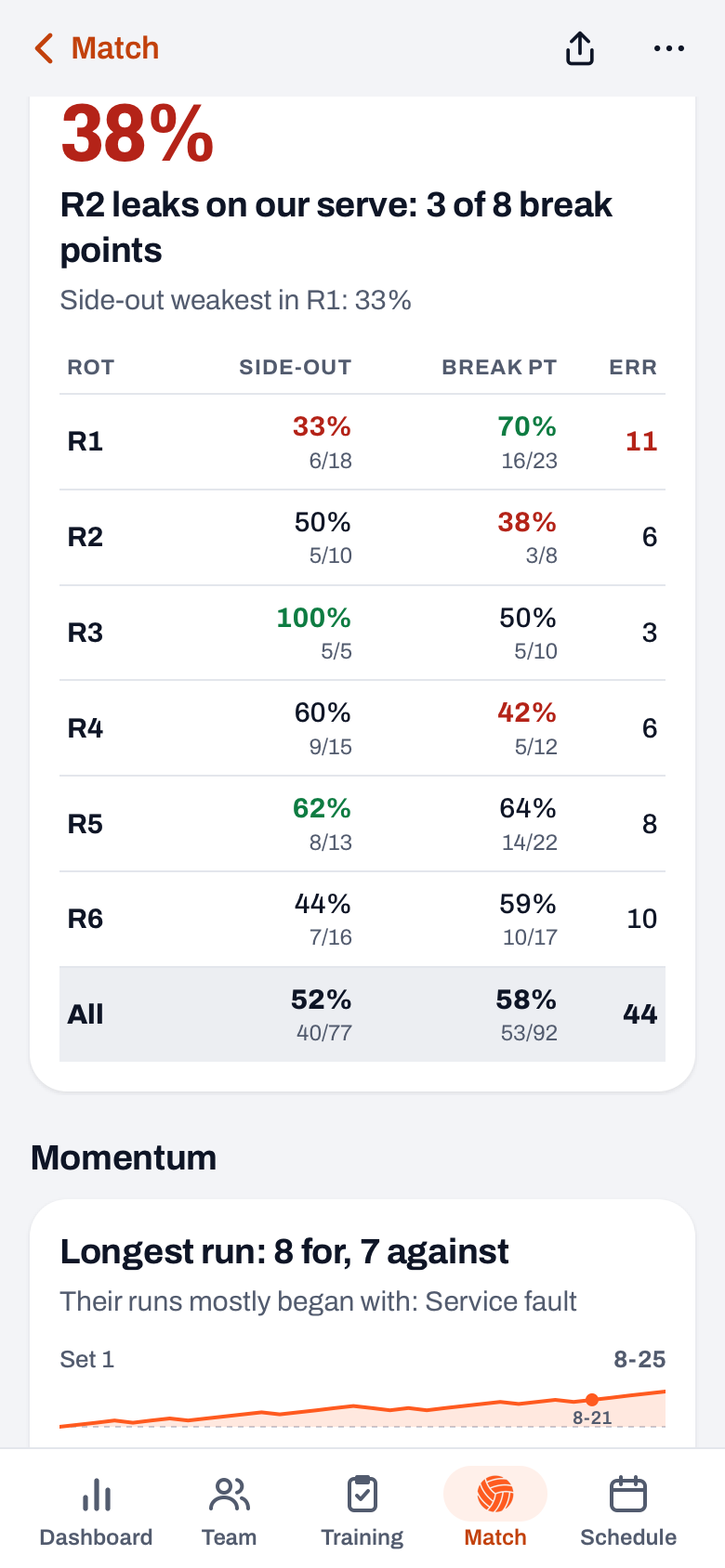
You don't tap anything extra for it: the app knows for every rally who served and where your setter stood. That works in Simple mode and in Expert. If you also rated the reception in Expert, a Pass column is added with the average pass per rotation; in Simple you get the table without that column. The table always covers the whole match: the set chips don't filter it.
During the match. At the set break you see Side-out per rotation for the set that just finished, with the fraction and the percentage for each rotation. The time-out screen names your Weakest rotation of this set on side-out, in the form "R4 · side-out 33%". So live you only see the side-out; the break point per rotation only comes after the match. If you score in Expert, you find the side-out per rotation in the More sheet. What else you can do at the set break is in the set break in your volleyball app.
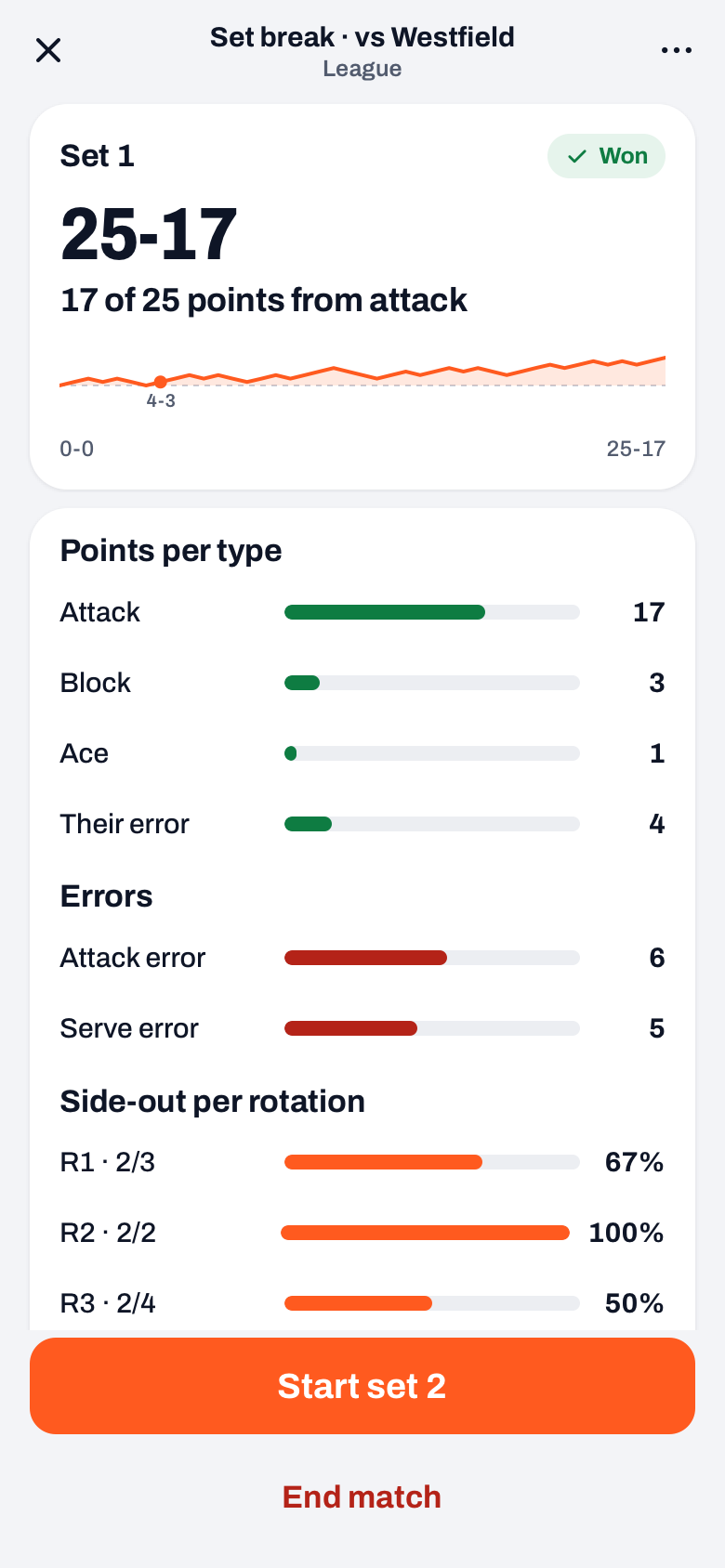
Do you only see side-out per rotation after the match, as bars and without break point? Then the match was finished by a score keeper, or scored with an older version of the app. A result you enter afterwards has no rotations. Note one more difference: the Rotation check when you set up your lineup counts R1 from your starting lineup, not from the setter's spot. If your setter doesn't start at 1, R3 in the Rotation check is a different rotation from R3 in this table.
The rotation table is part of every live-scored match. You can try Koach free for 14 days; what it costs after that is on the pricing page.
Want to see the whole season? Open your setter's profile. In a 5-1 the setter plays almost every rally, so their Rotations and positions block shows per rotation what share of the rallies the team won, across all live matches together. Side-out and break point are combined there in one percentage, but the rotation that turns red there is your first candidate.
Frequently asked questions
What is the difference between side-out and break point?
A side-out is a rally you win while the opponent serves; with it you take over the serve. A break point is a rally you win while you are serving yourself. Every rally you win belongs to one of the two. Together they are all your points, and per rotation they show whether a rotation leaks when receiving or on your own serve.
Why is my break point lower than my side-out?
Because the receiving team gets to attack first. The serving team first has to defend an attack before it can score itself. That is why most teams win fewer rallies on their own serve than on the opponent's. In the youngest age groups it can be the other way round, because the serve often decides the point there. So compare your rotations within a column, not across the columns.
Why don't I see break point per rotation at the set break?
In Koach the set break only shows the side-out per rotation of the set just played, and the time-out screen shows the weakest rotation on side-out. The break point per rotation is in the Rotations table under Stats after the match, together with the side-out and the errors per rotation.
How many rallies per rotation do you need before drawing a conclusion?
More than one match gives you. Per match you have about ten to fifteen rallies per rotation on each side, and then one rally is already seven to ten percentage points. Koach only colours a cell from four rallies and a ten point difference, but that is a minimum. If the same rotation comes back as the weakest in three matches, you have a pattern.
Can I try the rotation table for free?
Yes. You can try Koach free for 14 days, with no credit card and with every feature, so including the rotation table after the match and the side-out per rotation at the set break. After that you choose the Coach or Club plan; the prices are on the pricing page.


Find your leaking rotation on Saturday
14 days free, no credit card. After the match your rotation table is ready.
Get started with KoachOr read first what the volleyball coaching app does.