
First ball side-out in volleyball: what a good pass is worth
The short answer
First ball side-out in volleyball is the share of the opponent's serves you win straight away with the first attack after your reception. Put it next to your side-out after a good, an average and a bad pass, and you see whether points leak in the pass or only later, in the set and the attack.
First ball side-out in volleyball answers the question behind every reception drill: does a better pass really earn more points? Count how often you win the rally for each pass quality, and you see where your side-out leaks. Below you find the calculation with an example, published benchmarks and how Koach shows it.
What does side-out after the pass measure?
A side-out means winning a rally while the opponent serves. The regular side-out percentage puts all of those rallies together; what it tells you and how to read it per rotation is in side-out percentage explained. Side-out after the pass goes one step further: you split the rallies by the quality of your reception and look at how often you win in each group.
You come across two variants:
- Side-out by pass quality: how often you win the rally after a good, an average or a bad pass, even when the point only falls after a second or third attack.
- First ball side-out: how often you score straight away with the first attack after the reception. That is stricter, and it mainly says something about your attack in system.
For both you need a rating for every pass. How to give one, from 0 (error) to 5 (perfect), is in the serve receive rating; the older explanation with the 0-3 scale is in tracking reception quality with pass ratings. How this number relates to the rest of your stats is in understanding volleyball statistics.
Worked example: forty serves by the opponent
Say the opponent serves forty times in a match. Four serves are errors; you win those rallies without having to pass. You receive the other 36, and you rate every pass from 0 to 5:
| Reception | Rallies | Won |
|---|---|---|
| Good (4-5) | 15 | 11 |
| Average (3) | 9 | 5 |
| Bad (0-2) | 12 | 4 |
| Together | 36 | 20 |
Worked out according to the formula won divided by rallies: after a good pass 11 / 15 = 73%, after an average pass 5 / 9 = 56%, after a bad pass 4 / 12 = 33%. Across all received serves together: 20 / 36 = 56%. Count the opponent's four serve errors as well, and your side-out is 24 / 40 = 60%.
The bad group also includes the aces against: a 0 is always a lost rally. Say three of those twelve passes were a 0. Then of the nine passes that were playable you won four, according to the same formula 4 / 9 = 44%. That way you see whether a bad group is mainly down to aces or to rallies you lose after a mediocre ball.
Say also that in thirteen of the 36 rallies you scored straight away with the first attack after the reception. Then your first ball side-out is 13 / 36 = 36%, according to the same formula. The other seven rallies you won came later in the rally.
What does the gap between a good and a bad pass tell you?
What is normal depends on your level. American analyst Joe Trinsey uses as benchmarks for women's college volleyball (NCAA) about 67% side-out after a good pass, 60% after a medium one, 50% after a bad one and 30% after a pass that goes over the net or shanks so far that only a free ball can come back. He works with a 0 to 4 passing scale, and adds himself that you should adjust these to your own level (source, checked in October 2026). His groups don't line up exactly with Koach's: his bad pass and his pass over the net both fall into the 0-2 group in Koach.
More important than the numbers is the pattern. Three pictures come up often:
- A big gap between good and bad. After a good pass you win most rallies, after a bad one far fewer. Then reception is your biggest lever: more good passes earn points directly. Look at who passes, in which formation and in which rotation it goes wrong.
- You win little even after a good pass. Then it is not the pass but what comes after it: the set or the attack. Look at the quality of the set and at your attackers' hitting percentage in system.
- After a bad pass you win almost nothing. Every team gets bad passes; the difference is what you still make of them. Train the play out of a bad pass: a playable high ball, a smart attack against a block that is waiting. How that works is in playing out of system.
Earned side-out: without their serve errors
A serve error by the opponent is a side-out you are given, not one you earn. Take those rallies out and what remains is what your reception, set and attack produce together. In the example: 24 side-outs from 40 serves, minus 4 serve errors, is 20 from 36. An opponent that misses a lot of serves makes your regular side-out look better than it is; the earned side-out leaves that out.
14 days free, no credit card. Have your assistant rate every pass at the next match and see afterwards how many points your reception earns.
Try Koach with your teamHow to see side-out per pass in Koach
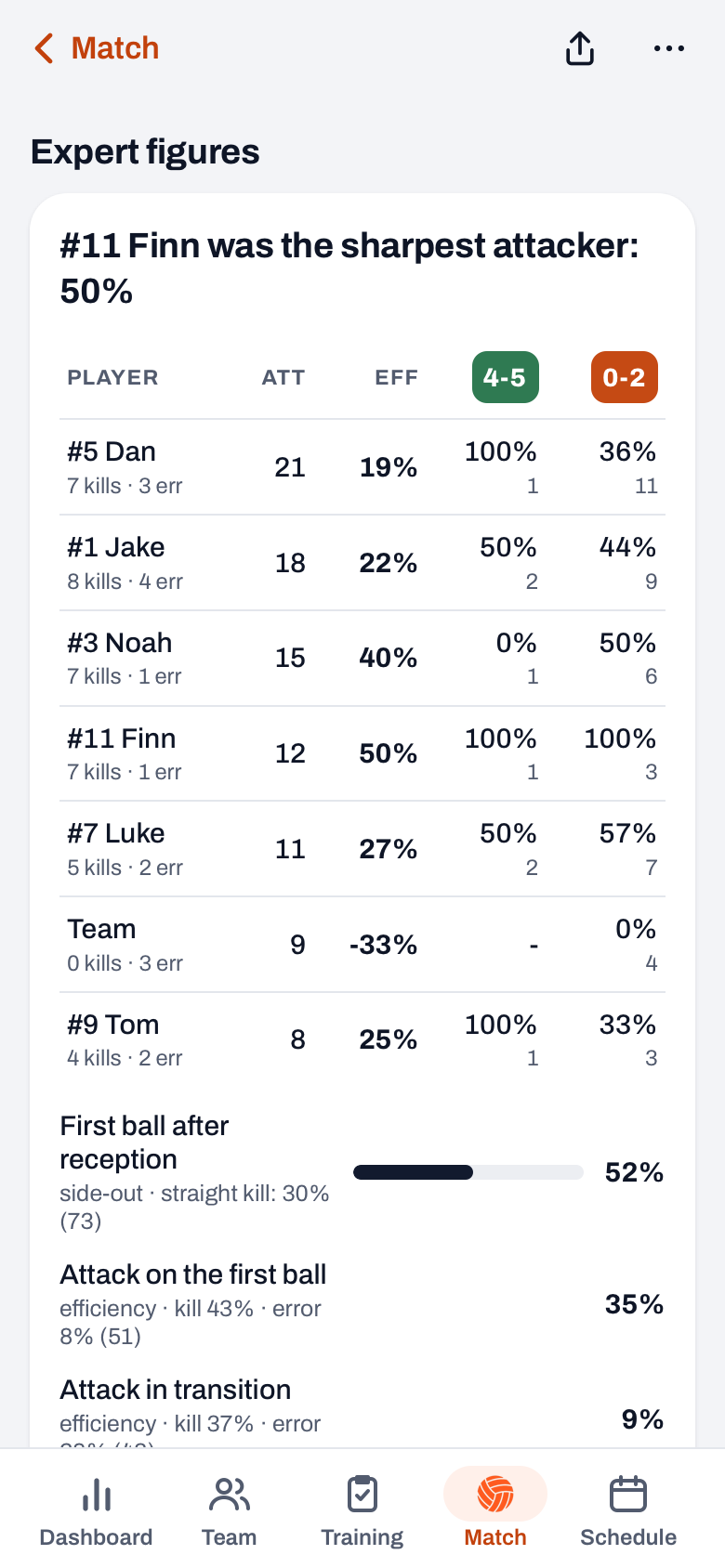
For this you need reception ratings, and you give those in Expert mode. At the Reception step you tap a rating from 0 to 5; if the opponent misses their serve, tap Their error at that step. Koach then knows which side-outs came from their serve errors. After the match you find, under Stats, at the bottom in Expert figures:
- Side-out by pass quality. At the top the line A good pass became a point …% of the time, with three rows below it for 4-5, 3 and 0-2: the number of rallies won, the number of rallies and the percentage. A point here means you won the rally, at whatever moment. For the grouping, the first reception of the rally counts.
- Earned side-out. Your side-out without the opponent's serve errors, with the number of serve errors and your regular side-out next to it.
- First ball after reception. How often you won the rally when you received the serve, followed by how often the first attack was a straight kill: your first ball side-out.
- With the libero on court and Free ball: how often you win with and without the libero, and how often you turn a free ball from the opponent into a point.
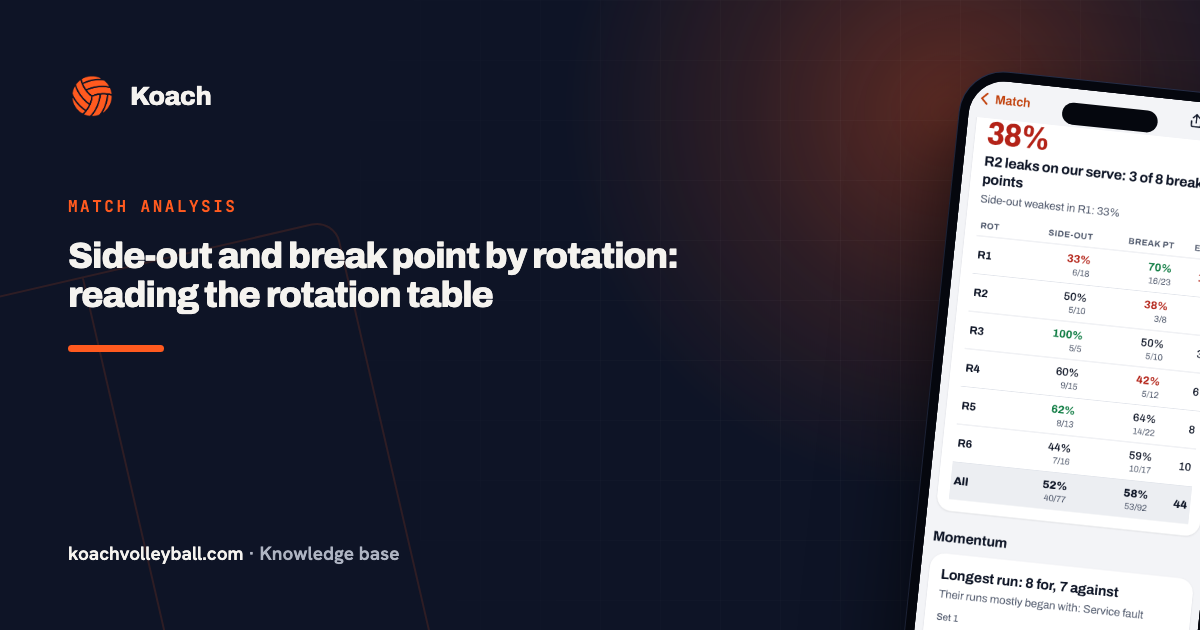
On top of that, the Rotations table shows the side-out and break point per rotation. In an Expert match a Pass column is added, with the average reception rating per rotation and the share of good passes. That way you see whether a rotation leaks because the pass is weak there, or in spite of a good pass. How to read that table is in side-out and break point by rotation.
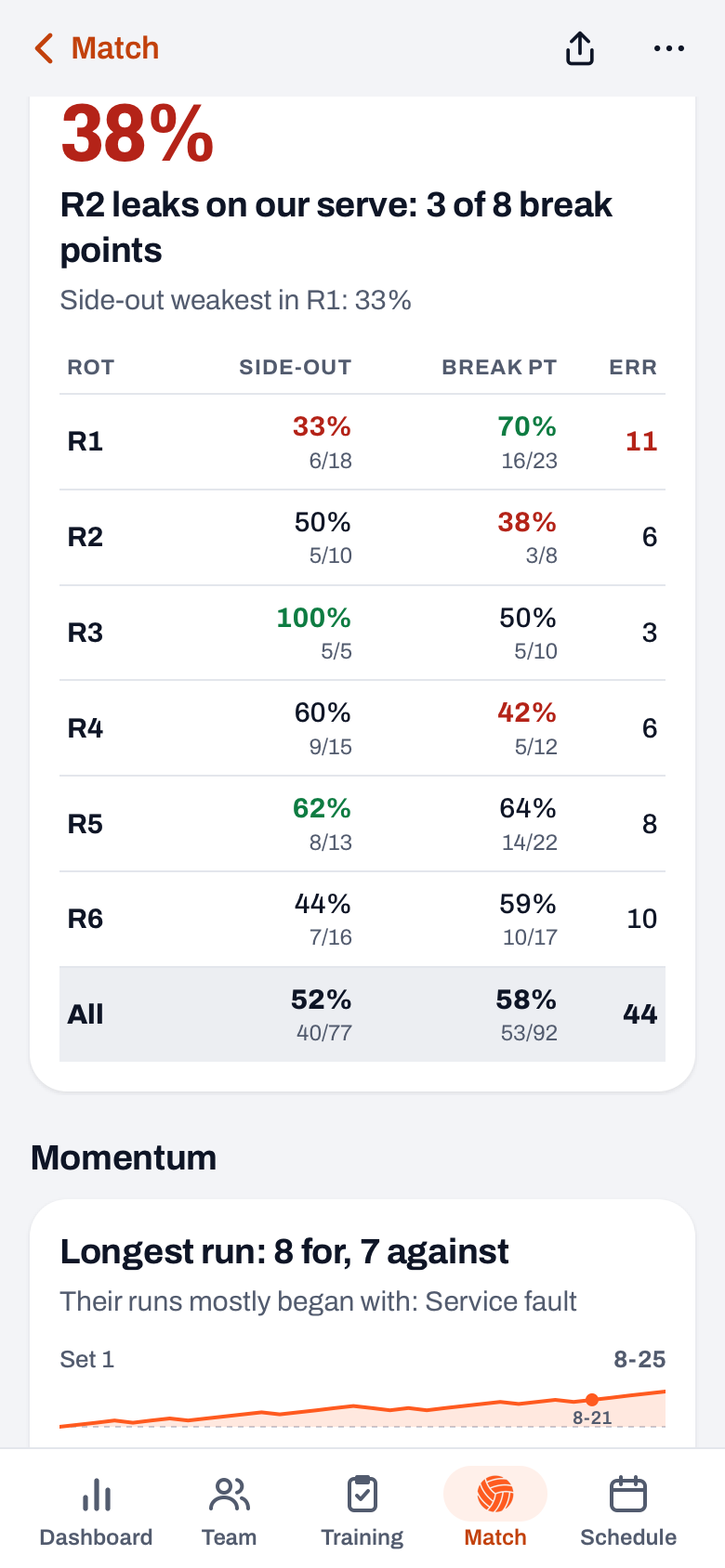
If you score the match in Simple mode, you do get side-out and break point per rotation, but no split by pass: Simple gives no reception ratings. You can switch modes mid-match via the menu at the top right. Expert mode is included in both plans; see the pricing page.
Look at the 4-5 group first, and only then at 0-2. If you win less after a good pass than you would expect, extra reception practice won't help much: then the leak is in the set or the attack. In the debrief, put just that one line next to the attack numbers, and then decide what you train that week.
Frequently asked questions
What is first ball side-out in volleyball?
First ball side-out is the share of the opponent's serves on which you score straight away with the first attack after your reception. If you only win the rally later, for example after a dug attack, it doesn't count. The number mainly says how good your attack in system is. In Koach it is in the Expert figures under First ball after reception, as the share in which the first attack was a straight kill.
What is a good side-out after a good pass?
There is no fixed standard. American analyst Joe Trinsey works, for women's college volleyball, with about two out of three rallies won after a good pass and half after a bad one. At lower levels those numbers are different. So mainly compare your own groups with each other: the bigger the gap between good and bad passes, the more your reception decides your points.
Do the opponent's serve errors count in side-out?
In the regular side-out percentage they do: a serve error by the opponent is a rally you win while they serve. In side-out by pass quality they don't, because there was no pass. If you want to see what your team earns itself, look at the earned side-out: your side-out without their serve errors. Koach calculates it when you tap Their error at the Reception step.
Can I see side-out after the pass without Expert mode?
No. It needs a rating for every pass, and you give those in Expert mode. In Simple mode you do see your side-out and break point per rotation. Expert mode is included in Coach and in Club, and you can try Koach free for 14 days without a credit card.
Measure what your reception earns
14 days free, no credit card. After one Expert match you'll know whether the leak is in the pass.
Get started with KoachOr read first what the volleyball coaching app does.