
Why Your Volleyball Serve Goes Into the Net (and the Fix)
A serve that ends in the net is the most frustrating point of the match: you have the ball completely in your own hands and you give it away anyway. The cause is rarely strength. Four technical details decide whether the ball clears comfortably or comes up half a meter short.
Cause 1: the toss is too low or too close in
Most net serves start while the ball is still in your hand. Toss too low and you have to rush, so you contact with a half-bent arm. Toss too close to your body or behind your head and the only way to reach it is by leaning back, which brings the hand up from underneath. Either way the contact point is too low and the ball leaves on a flat, descending path straight at the net.
The guideline for a standing overhand serve: thirty to fifty centimeters above your extended hand, directly above or just in front of your hitting shoulder. For a float you want the low end of that range; for a topspin serve a little higher. Exactly what applies per serve type is in the serve toss.
Cause 2: you contact the ball too low
Even with a good toss you can still be late. Contact belongs at the highest point you can comfortably reach, with an extended arm - not at ear or forehead height. The difference matters more than it looks: contact thirty centimeters lower means the ball has to travel the same nine meters on a flatter trajectory, and that flatter trajectory is what finds the tape.
A simple check: have someone stand next to you and call out after every serve whether your arm was extended at contact. Players almost never feel this themselves. If the arm is structurally bent, the toss is usually too low - back to cause 1.
Cause 3: you hit the ball with the wrong part of your hand
The ball should be struck with an open, firm hand, dead center, using the middle of the palm and the base of the fingers. Two common variations fail structurally: hitting with the fingers only produces a weak, short ball, and hitting with the heel of the palm sends the ball up without speed, so it lands in front of the net.
One detail almost nobody mentions: contact below the middle of the ball puts backspin on it. A ball with backspin brakes in the air and drops earlier than you expect, often right at the net. Aim for the heart of the ball or slightly above it, depending on whether you are hitting a float or a topspin serve.
Cause 4: the power comes from your arm
Standing still on two feet and swatting the ball over uses maybe a third of the power available to you. A serve is a chain that starts on the floor: weight rolls from the back foot to the front foot, the hip turns, the torso follows, and only then the shoulder and the arm. The arm is the last link, not the engine.
If that sounds like you, exaggerate the step: take a clear step forward with the back foot during the swing and let your weight travel with it. Almost everyone gains meters immediately, without a gram of extra strength. The whole movement from start position to follow-through is in learning the overhand serve.
Aim higher than the net
One detail solves a surprising amount: many players aim at the net. Their eyes look for the band, and the body sends the ball exactly there. Pick a target in the air instead, a meter and a half to two meters above the band, and swing through that. In practice, hang a rope at that height above the net and make it a rule that every serve has to clear it. Players who clear it in practice also clear it when the score gets tight.
The rope does something else that is useful: it shows that a serve with margin is still hard to pass. The extra height costs you almost no pressure as long as the ball keeps its speed.
What a net serve costs you
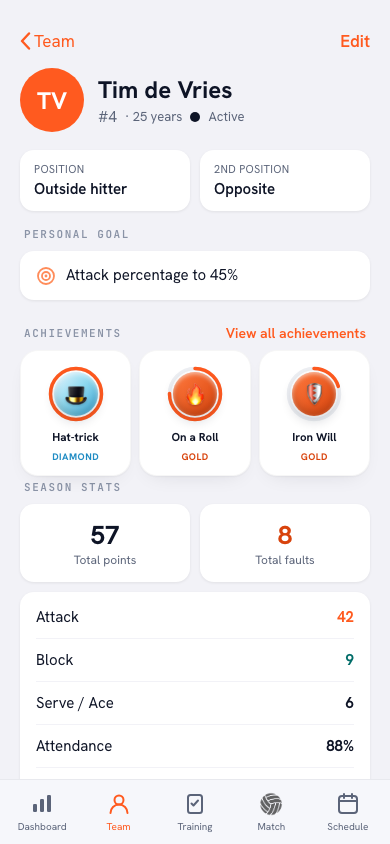
Do the math. A player who averages one serve into the net per set gives away four points over four sets, without the opponent having to do anything at all. At club level the gap between a set won and a set lost is often exactly that many points. Koach counts service errors per player, so you know exactly what a shaky serve is costing your team over a season - and which player has the most to gain from a few weeks of targeted serving work.
The standard to work toward is simple: eight out of ten serves in the court. Hit that and you can add pressure. Miss it and reliability comes before speed - always. More numbers worth tracking are in serving statistics and aces.
The progression that fixes it
- No net, ten meters: toss and high contact only, focused on an extended arm.
- From the three-meter line over the net: full movement, target above the band.
- Back up two meters at a time: only move back at eight out of ten in. Going straight to the end line turns the serve into a throw.
- With consequences: series of three in a row, or serving straight after a sprint - because in a match you never serve rested.
More formats are in the serving drills.
Frequently asked questions
Why does my serve not clear the net even though I hit it hard?
Almost always because you contact too low or catch the ball below its middle. A hard-hit ball with backspin brakes and drops early. Contact with an extended arm at your highest point, dead center on the ball, and let your weight roll forward.
Should I serve softer if the ball keeps going into the net?
Not softer, higher. Pick a target a meter and a half above the band and keep your speed. Serving softer gives you a ball that hangs in the air longer and therefore drops even further.
How many service errors are acceptable?
At club level, eight out of ten serves in the court is a good standard, so roughly two errors per ten. If you are structurally below that, your serve is a net loss and reliability comes before pressure.
Is it the ball or the gym?
Rarely. A heavier or softer ball and a cold gym make contact slightly less crisp, but the difference is small. If your serve suddenly changes, look at your toss first - that is what changes under pressure.



Try it yourself in Koach
Less admin, more coaching.
Get started with KoachOr read first what the volleyball coaching app does.