Overhand Serve Suddenly Not Working: What Changed?
Last month you got five out of six in; tonight three in a row go into the net. Your overhand serve has stopped working, and nobody has changed anything about your technique. This piece is not about how to learn an overhand serve — you can already do that — but about the five things that quietly change and take your serve with them: the toss, your feet, your arm, the ball and your fatigue.
The overhand serve that used to work: look for the change, not the fault
A serve that has never worked and a serve that no longer works look the same from the sideline: the ball goes into the net or far out. Yet they are two different questions. With a serve that has never worked, something is missing, and then you don't start with technique but with the distance, the net and the ball — that order is in what to adjust first when the serve doesn't get over the net.
With a serve that did work, nothing is missing. You have done the movement well often enough to know you can do it. Something has shifted, and chances are it is small and you can't feel it yourself.
That has one practical consequence: don't tear your technique apart. The reflex when a serve falls away is to look at everything again — arm, hip, feet, wrist — and in doing so you change ten things at once in something where perhaps one was off. If you want to go through the whole movement again step by step, you will find it in learning the overhand serve. But start here.
First ask yourself one question: when did it last go well, and what has been different since? A different gym, new shoes, a few weeks without playing, an injury, a different ball, a coach who said something different. The answer lies in that list more often than in your arm. Then go through the five changes below, in this order.
The toss has started to wander (and nobody feels that themselves)
The toss is the first thing to look at, because it shifts without you noticing. A few centimetres further back, a little more inwards, a fraction lower — and your arm adapts without complaining. That goes fine for a while, until the adjustment gets too big and you no longer hit the ball behind and above but somewhere else.
Not feeling it yourself is not a lack of attention. You watch the ball, not your hand, and your body only reports that the contact was "odd". That is why you need someone else, or your phone.
How to check it. Have a teammate watch from the side during a series of normal serves, or film them from the side with your phone. Don't look at the swing but at the ball at the highest point of the toss. You are looking for two things: does it hang in the same place on every serve, and is that the same place as when it still worked? If you no longer have footage from back then, compare with a teammate whose serve is working.
If that spot varies from ball to ball, it is not a serving problem but a toss problem, and then you train the toss separately from the swing for a while. How high and how far forward it should hang, how to toss cleanly and the test to measure it are in the toss for the serve.
You are standing differently from a month ago
The second thing that shifts unnoticed is where and how you stand. Three things change most often here:
- Your starting spot has moved. Closer to the line or further behind it, and often a little more towards the middle. Every shift requires a slightly different arc, and you don't automatically adjust to it.
- You face the net square instead of half turned. Standing square, you can no longer use your trunk and start getting everything from the shoulder.
- Your step has changed. You used to step into the serve with the foot opposite your hitting arm and now you stand still, or you have started taking a little run-up. Both change the moment you contact the ball.
The solution is boring and it works: choose one fixed spot and make it visible. A piece of tape, a line on the floor, two foot-lengths behind the end line — it doesn't matter what, as long as it is the same every time. Do your fixed routine there: bounce the ball, breathe, toss. If you feel rushed, you skip that routine; how much time you really have after the whistle is in the eight-second rule for the serve.
You have started hitting harder since it stopped working
This is the most understandable reaction and the least useful. Three balls in the net and you think: harder. Hitting harder makes the arm stiff and the swing shorter, the hand comes through too early and the contact point shifts. The ball now goes lower into the net or flies far out, and you have two problems instead of one.
The opposite reaction exists too. A player who is afraid of the net starts pushing the ball upwards with an open hand and an arm that no longer swings through. Those balls do get over, but they go long or are easy to pass.
What to look at: does the shoulder stay loose, is the swing still the same as before, and are you balanced after the serve? With a topspin serve the arm should swing through. If someone hits a float, the contact should in fact be short and still; if the ball starts spinning after contact, a follow-through has crept in that takes out the float. See the float serve technique. And if the ball does reach the net but drops into it, that has its own list of causes, which are in serves into the net.
In every case the recovery starts with the same thing: less power, the same movement.
A different ball, a colder gym, a tired body
The last group lies largely outside your technique, and that is why nobody looks at it.
- The ball. A different brand or model feels different on the hand and flies differently. So does a ball that is over- or under-inflated. The recommended pressure is printed on most balls; if your team has a new bag of balls, that is the first place to look.
- The gym. In a cold gym your shoulder is stiffer and the ball feels different. Bright lights above the service line or a busy background make it harder to follow the toss. If you are playing away in an unfamiliar gym, serve a few balls during the warm-up from the spot where you will stand in the match.
- Fatigue. A player who serves at the end of practice, after an evening of jumping and hitting, serves with a different shoulder than at the start. The same applies to weeks in which you train or play more than usual. A serve that falls away while the load is going up may not have a technique problem.
If the serve works in practice but not in matches, it is usually about pressure and routine; that side is covered in mental training for volleyball players. Whether it comes down to nerves or to drills that look too little like a match, you can work out with good in practice, bad in games.
Rebuilding in three steps: closer, half power, only then the line
Whether or not you have found what changed: you build up in three steps. You don't start on the line, and not at full power.
- Step 1 — closer. Stand two to three metres inside the end line and serve at half power. The only goal: over the net and into the court. Ten balls, and a teammate counts.
- Step 2 — half power from the line. Back behind the end line, still at half power. The same ten balls, the same count. Notice that the movement stays the same; only the distance changes.
- Step 3 — the line and a target. Now your normal rhythm, not yet your hardest swing, and a target on the other side: the back half of the court, or one side. Only once that holds does the pressure come in.
The rule for moving on is simple: eight out of ten in the court, then you go up a step. If it then drops below eight, you go back one step instead of hitting harder. End every series with a serve that was good, even if that means hitting the last ball from step 1.
If the next match is just around the corner, an underarm serve for that one match is a sensible choice and not a defeat; see the underarm serve technique. Once step 3 is yours again, build up the pressure with the forms from serving drills.
Change one thing per practice. If you adjust the toss, your starting spot and your power at the same time and the serve comes back, you don't know what it was. The next time it falls away, you start from zero again.
For the coach: when it goes wrong for several players at once
If the serve falls away for one player, it is usually one of the five changes above. If it falls away for several players in the same weeks, first look for something they share: new balls, a different gym or a different practice time, a block of practices in which serving got no attention, or a structure in which serving only happened at the end of the evening, on tired legs.
Then separate the players who have regressed from the players for whom it never really worked. That second group doesn't belong in this build-up; for them the order of distance, net and ball from getting youth players to serve over the net applies. Treat them as one group and you give one group too little and the other too much.
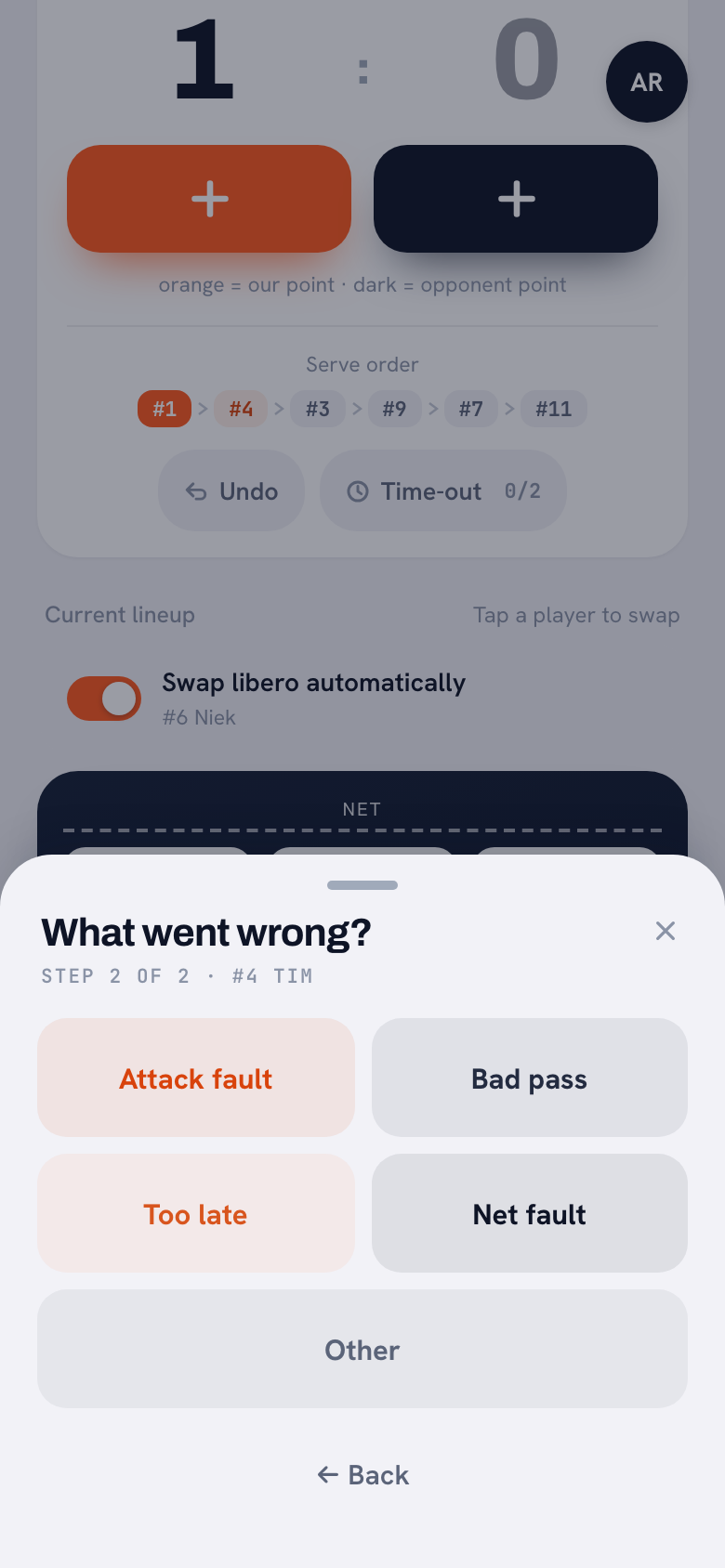
Also look at where it goes wrong in the match, not just in practice. In Koach you choose the error type for a point against, and service fault can only be chosen for the player serving at that moment — never for the libero. That keeps the count per player correct, and after a few matches you see whether it is one player or the group. Service points are tracked per player in the statistics. What the app does not record is the total number of serve attempts: so a "serves in" percentage doesn't exist there. You count that in practice itself, in pairs. What the match numbers do tell you is in serving stats and aces and the types of points in volleyball.
Try it yourself in Koach
Score your next matches live in Koach and record the error type for every point against. When the serve comes back, you see the service faults per player go down — with the caveat that the number of attempts is not shown: fewer faults in a match in which they served little still says little. The trial lasts fourteen days; counting ten balls in practice remains manual work, and that is exactly right.
Frequently asked questions
Why has my overhand serve suddenly stopped working when it used to be fine?
Usually something small has shifted that you can't feel yourself: the toss has started hanging further back or to the side, you are standing differently, you have started hitting harder, or the ball, the gym or your fatigue has changed. Look for what is different since the last good period, and change one thing per practice. Rebuilding your whole technique is rarely necessary.
Should I go back to serving underarm if it no longer works?
For one match that can be a sensible choice: an underarm serve that lands in the court is worth more than an overhand serve in the net. In practice you keep rebuilding the overhand serve, via the three steps of closer, half power and then the line. If you keep serving underarm permanently, the overhand serve won't come back by itself.
Can a growth spurt break my serve?
Not break it, but it can throw it off temporarily. Longer arms and legs change how high you contact the ball and where the toss needs to hang, and the timing you had no longer fits exactly. During a period like that, build up calmly from step 1 and don't expect a fixed timescale. If the player also has lingering pain in the shoulder or back, have it assessed by a doctor or physiotherapist.
How long does it take for a serve that has fallen away to come back?
There is no honest timescale to give, because it depends on what has shifted. A toss that just needs to be reset comes back faster than a serve that has to fit again after a growth spurt. So don't look at the calendar but at the steps: once step 2 is stable, you are on the right track.
Can I keep serving underarm in a match?
Yes. The rules don't prescribe a type of serve: underarm is just as valid as overhand, as long as you hit the ball with one hand or arm after tossing or releasing it. Some youth competitions have their own arrangements, so check if in doubt. Tactically: a serve that lands in the court is always better than one that doesn't.


Try it yourself in Koach
Less admin, more coaching.
Get started with KoachOr read first what the volleyball coaching app does.