
How Many Seconds Do You Have to Serve in Volleyball?
The referee whistles, the server bounces the ball a couple more times, wipes their hands — and then the referee whistles again. Point against. The eight-second rule is one of the very few volleyball rules with a hard clock in it, and that is exactly why somebody runs into it every single season.
The rule: eight seconds from the whistle
The official FIVB rule (12.4.4) is short: after the first referee's whistle, the server must strike the ball within eight seconds. Those eight seconds start at the whistle, not at the moment you toss the ball. The end point is contact with the ball — not the toss, not the approach.
Take longer and it is a service fault: the rally never even starts, the opponent gets the point and the serve. No warning, no second chance. Until the rally-point system arrived around 2000 the limit was five seconds; it was widened because players needed more room to run in and set up the jump serve.
Serving before the whistle
The reverse mistake is far more common, especially in youth volleyball and with players who have a tight pre-serve ritual. Here the rule (12.5) is actually lenient: a serve struck before the whistle is cancelled and replayed. You do not lose a point — but you have just thrown away a perfectly good ace, because it does not count.
Why does the referee not whistle straight away? Because they first check that both teams are ready and that the server has the ball (rule 12.3). A server who strikes while an opponent is still tying a shoe hands that opponent a free do-over. So teach your players one thing: the ball does not go up until you have heard the whistle, not when you personally feel ready.
The toss you let drop
Toss the ball and let it fall without touching it and that is not a fault. The serve is retaken, but only once per service turn (rule 12.4.4). The second time the ball lands untouched, it is a service fault. Whatever else you do with the ball inside those eight seconds — bouncing it, switching hands, spinning it — is completely allowed; only one toss or release is permitted.
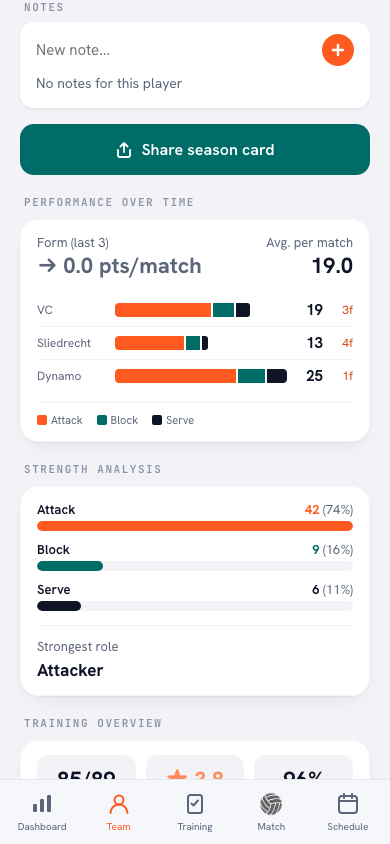
Serving before the whistle costs you a rally for nothing — exactly the kind of habit worth writing down in a player note in Koach, so you can deal with it in training next week instead of forgetting it by Monday.
What referees actually do
Eight seconds is generous. An average serving routine takes four to six seconds: take the ball, two bounces, breathe, toss, strike. Referees rarely count out loud and there is no visible clock in the gym; they estimate. In practice they only whistle when it is obviously taking too long — in case of doubt the server gets the benefit. At international level, where a timekeeper or a broadcast clock runs alongside, the line is stricter.
Important for coaches: eight seconds is also an anti-delay rule. A player who deliberately picks the ball up slowly to let the team catch its breath risks a separate delay sanction (a yellow card held against the wrist). You buy rest with one of your two time-outs, not with the serve clock.
Youth, mini volleyball and recreational leagues
From roughly under-15 upwards the eight-second rule simply applies — the rules in those age groups are identical to the senior game. In mini volleyball (up to and including age 12) the rule plays no part: nobody counts and nobody whistles for time, because the whole point is getting the ball into play at all. In recreational and corporate leagues the eight seconds are seldom policed, but the rule exists there too — a referee who applies it is right.
How to train it out
- One routine, one fixed number of bounces. Two bounces, toss, strike. A player who does the same thing every time never gets anywhere near eight seconds.
- Use a whistle in training. Start every serving drill with a whistle, even a plain set of ten serves. That way players link the sound to the action instead of linking it to match day.
- Work on the head, not the clock. Players who wait too long are usually undecided about where the ball is going. Give them a serving target beforehand and there is nothing left to work out in the moment.
- Rehearse the do-over. Have a player deliberately let a toss drop and then serve anyway — then they know it is not a reason to panic.
The eight-second rule is one of a whole series of serving conditions; the foot fault and the service zone are covered in the foot fault on the serve, and the full framework in all the volleyball rules at a glance.
Frequently asked questions
How many seconds do you have to serve in volleyball?
Eight seconds, counted from the first referee's whistle to the moment you strike the ball. Take longer and it is a service fault: the point and the serve go to the opponent.
What happens if you serve before the referee whistles?
The serve is cancelled and replayed. You do not lose a point, but the result of that serve does not count — not even if it was an ace. You simply get your service turn again.
Can you toss the ball and let it drop?
Yes, once per service turn: the serve is then retaken with no penalty. If it happens a second time in the same service turn, it is a service fault.
Does the referee count the eight seconds out loud?
No, there is no visible clock and no audible countdown in the gym. The referee estimates, and in case of doubt the server gets the benefit. Only at international level does official timing run alongside.


Try it yourself in Koach
Less admin, more coaching.
Get started with KoachOr read first what the volleyball coaching app does.