
Can You Step on the Line When Serving in Volleyball?
A foot fault on the serve is the cheapest point you can hand over: no rally, no chance, just a point going the other way. And yet most teams have somebody who runs into it week after week. The rule is precise enough that you never have to argue about it again.
The rule in one sentence
At the moment the server strikes the ball — or, on a jump serve, at the moment of take-off — they may not touch the court or the end line, nor the floor outside the service zone (rule 12.4.3). Immediately after that moment anything goes: step into the court, land in the court, run straight through (rule 12.4.4).
So the end line belongs to the forbidden area. That is not arbitrary: every line is part of the court, as you can read in the dimensions of a volleyball court. Standing with your heel just clipping the line means standing in the court, and that is a service fault: point and serve to the opponent.
How wide and how deep is the service zone?
The service zone runs the full 9 metres of width behind the end line and extends backwards to the end of the free zone. It is marked by two 15-centimetre ticks, 20 centimetres behind the end line, in line with the sidelines — and those ticks are part of the zone. So you may serve anywhere behind the end line, including directly behind position 5, as long as you stay inside the extension of the sidelines.
Stepping sideways outside that extension is a fault. On a jump serve with an angled approach that is the trap: players start their run-up on the floor outside the sideline extension and take off there too. Until the mid-nineties the zone was only 3 metres wide, tucked into the right-hand corner — which is why some older players still line up on the right out of habit.
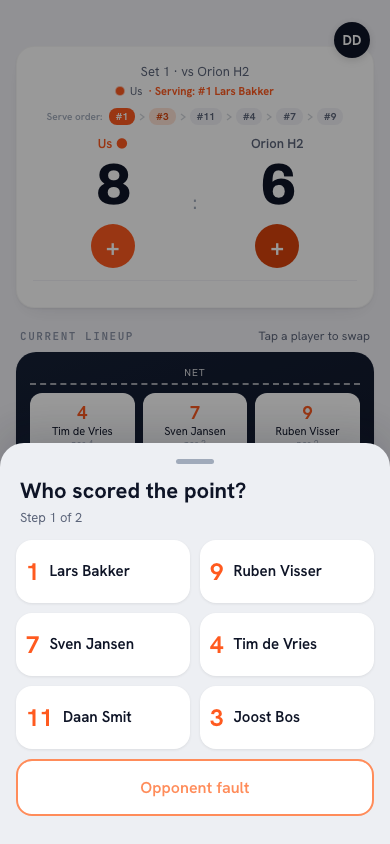
Foot faults are points you hand over for free, and you only really see them once you count them: Koach's serve statistics show per set how many serves your team is actually throwing away.
Jump serve: only the take-off counts
On a jump serve the referee looks purely at the last foot contacts before the jump. Landing in the court is not merely allowed, it is part of the technique — almost every jump server lands a metre inside the end line. What does go wrong: an approach that starts too close, so the take-off foot ends up on the line. The fix is nearly always the same: start your approach half a metre further back. More on the approach and the timing is in learning the jump serve.
On a standing float serve the fault usually comes from the same place: one step forward as you strike, and the front foot catches the line. Set up about twenty centimetres behind the line and you never need that margin.
Who sees it, and how is it signalled?
In matches with line judges, the line judge on the serving side watches the feet and waves the flag along the end line when there is a fault. Without line judges the first referee judges it alone — and they stand on the other side of the net looking across at an angle, which explains why small foot faults slip through more often in regional competition. The matching signals are in all the referee hand signals.
One thing to note: a foot fault is whistled at the moment of contact with the ball, not afterwards. The rally is not played out — the referee stops it immediately.
Youth, mini volleyball and recreational leagues
From under-15 upwards exactly the same rule applies as for seniors, including the full-width service zone. In mini volleyball you serve from closer in: each level has its own service line, which may sit in front of the end line, and that line is then the boundary. In recreational and corporate leagues the foot fault is rarely called, but the rule is no different — a referee who applies it is right.
How to get it out of your team
- Lay down a marker. In serving drills, put a ribbon 30 centimetres behind the end line and make players start behind it. After two weeks their legs know it.
- Look at the approach, not at the foot. A player who finishes on the line started too close. Move the starting point rather than asking the player to hold back — holding back costs you serving pressure.
- Count them separately. Log foot faults apart from serves into the net and serves long. It is the one service error you can train away completely, and that makes the progress visible.
The other side of the serving rules — how much time you get — is in the 8-second rule.
Frequently asked questions
Can you step on the line when serving in volleyball?
No. The line is part of the court, so having a foot on the end line at the moment of contact is a foot fault. The point and the serve go to the opponent.
Can you step into the court after serving?
Yes. Only the moment of contact counts, and on a jump serve the moment of take-off. After that you may step into the court or land in it, which is what virtually every jump server does.
How wide is the service zone?
Nine metres: the full width of the court, behind the end line, bounded by the extension of the sidelines. Backwards it runs all the way to the end of the free zone.
Is a foot fault called after the rally?
No, the referee whistles immediately at contact and the rally is not played out. Without line judges the first referee judges it alone, looking across at an angle from the other side of the net.



Try it yourself in Koach
Less admin, more coaching.
Get started with KoachOr read first what the volleyball coaching app does.