
Volleyball line judge: duties, position and flag signals
The short answer
A volleyball line judge stands at a corner of the court and uses a flag to show whether the ball is in or out near his line, whether it was touched, whether it crosses the net outside the antenna and whether the server commits a foot fault. There are two or four, and the first referee decides.
A volleyball line judge has a clear-cut job: one or two lines, one flag and five signals. Yet it often goes wrong for people doing it for the first time, because they watch the ball instead of their line. This is what the FIVB rules ask of a line judge, and this is how you do it in practice.
What does a line judge do?
Line judges are part of the refereeing corps, alongside the first and second referee and the scorer (rule 22.1). They do not whistle: only the referees may blow the whistle during the match (rule 22.2.1). The line judge shows what he saw with a flag of 40 by 40 centimetres, and the first referee decides. The first referee may also overrule a line judge if he sees that the line judge got it wrong (rule 23.2.1). According to rule 29.2.1, you signal:
- whether the ball is in or out when it lands near your line;
- whether a ball going out was first touched by the team receiving it, for example by the block;
- whether the ball touches the antenna, and whether the serve or a team's second or third ball crosses the net outside the antennae;
- whether a player, apart from the server, is outside his court at the moment of the service;
- whether the server commits a foot fault;
- whether a player touches the top part of the antenna, the 80 centimetres above the net, on your side of the court while playing the ball.
How the duties are split across the whole crew, from first referee to scorer, is in the refereeing team in volleyball. Whether a match has line judges, and who provides them, differs by country and by competition. In many lower leagues there are none, and the first referee also judges the lines.
Where you stand: two or four line judges
The rules know two set-ups (rule 29.1):
| Set-up | Where you stand | What you judge |
|---|---|---|
| Two line judges | At the corners closest to the right hand of each referee, diagonally behind the corner at 1 to 2 metres. That puts you diagonally opposite each other. | The end line and the sideline on your side |
| Four line judges | In the free zone, 1 to 3 metres from a corner, on the imaginary extension of the line you judge | One line |
The rules describe the set-up with four line judges for FIVB matches and world and official competitions. Standing on the extension of your line has a reason: you look along the line, and a ball that lands a few centimetres beside it, you see as a ball next to the line and not as one on it. If there are two of you diagonally behind a corner, you see along both lines at once. Stand still with the flag in your hand, and stay out of the path of players chasing a ball.
The five flag signals
The official signals are in diagram 12 of the rules. You hold each signal for a moment, so the first referee sees it (rule 30.2).
| Signal | Meaning |
|---|---|
| Point the flag down | Ball in |
| Flag straight up | Ball out |
| Flag up and touch the top of the flag with the palm of your free hand | Ball touched: the ball is out, but first touched a player of the team it went to |
| Wave the flag above your head and point to the antenna or the line concerned | Ball over the net outside the antennae or touching the antenna, a player touching the top part of the antenna, ball touching an object outside the court, or a foot fault at the service (by the server or by a player outside his court) |
| Both arms up, arms and hands crossed in front of the chest | Judgement impossible: you could not see it |
The fourth signal is the same for several faults. Where you point makes the difference: at the antenna if the ball crossed the net outside it or someone touched the antenna, at the end line for a foot fault by the server, at the line concerned for a player who was outside his court at the service. All the gestures of the referees themselves are in referee hand signals in volleyball.
Where you look, moment by moment
- Before the serve. Check that your line is clear and that you are not in the way yourself. If your end line is the serving team's, you watch the server's feet. If at the hit, or at the takeoff for a jump serve, he touches the court or the end line, or the floor outside the service zone, it is a foot fault (rule 12.4.3). More on that in the foot fault on the serve.
- At the service hit. Check that all players, apart from the server, are inside their court at the moment of the hit; that applies to both teams. Then follow the serve: if it crosses the net outside the antenna on your side or touches the antenna, you signal it.
- During the rally, you watch your line, not the ball. Follow the ball until it comes your way, and then look at the spot where it lands. Your call is about the moment the ball touches the floor: if any part of the ball touches the line, it is in (rule 8.3). Why that is and where the contact area is, is in ball on the line: in or out.
- On an attack towards your line, watch the block. If the ball goes out, check whether it touched the hand of a blocker or a defender on the way. From your corner you often see that better than the first referee on his stand.
- At the antenna, wait one beat. A ball that goes outside the antenna into the opponent's free zone after a team's first contact may still be played back, provided it also comes back outside the antenna (rule 10.1.2). So do not wave too early. After the second or third contact, such a ball is out straight away. The explanation is in ball outside the antenna.
- After your signal, look at the first referee. If he asks you to repeat the signal, you do (rule 29.2.2). Do not argue with players or the bench. A coach walking along the line may not block your view, by the way (rule 5.2.3.4).
Practise it at training. During a scrimmage, put two subs on the corners with a flag or a bib, and have them give a signal on every ball near their line. After twenty minutes the five signals are second nature, and your players understand better why the referee sometimes decides differently from what they thought.
Five mistakes new line judges make
- Watching the ball instead of the line. If you follow the ball in the air, you do not see where it lands.
- Signalling on a ball far from your line. You only signal when the ball lands near your line. A ball in the middle of the court is for the referee.
- Guessing. If you did not see it, for example because a player was in front of you, give the judgement impossible signal. An honest "did not see it" helps the referee more than a guess.
- Too late or half-hearted. Give your signal straight away and clearly, with the flag all the way up or all the way down. A flag left halfway says nothing.
- Getting carried away. A line judge who cheers along with the stands or looks at one bench has lost his neutrality, even if his signal is right.
The full rules are in the FIVB Official Volleyball Rules 2025-2028, and an overview of all the rules of the game is in volleyball rules at a glance. National federations may add their own arrangements about line judges for their competitions.
Organising line judges at your club
Koach has no separate role for line judges. In the club section, in Match day, you assign a referee, a scorer and hall duty to each home match with Add duty, and when choosing you see who is playing that day themselves. Match day is part of the Club plan; what else that includes is on the page for clubs.
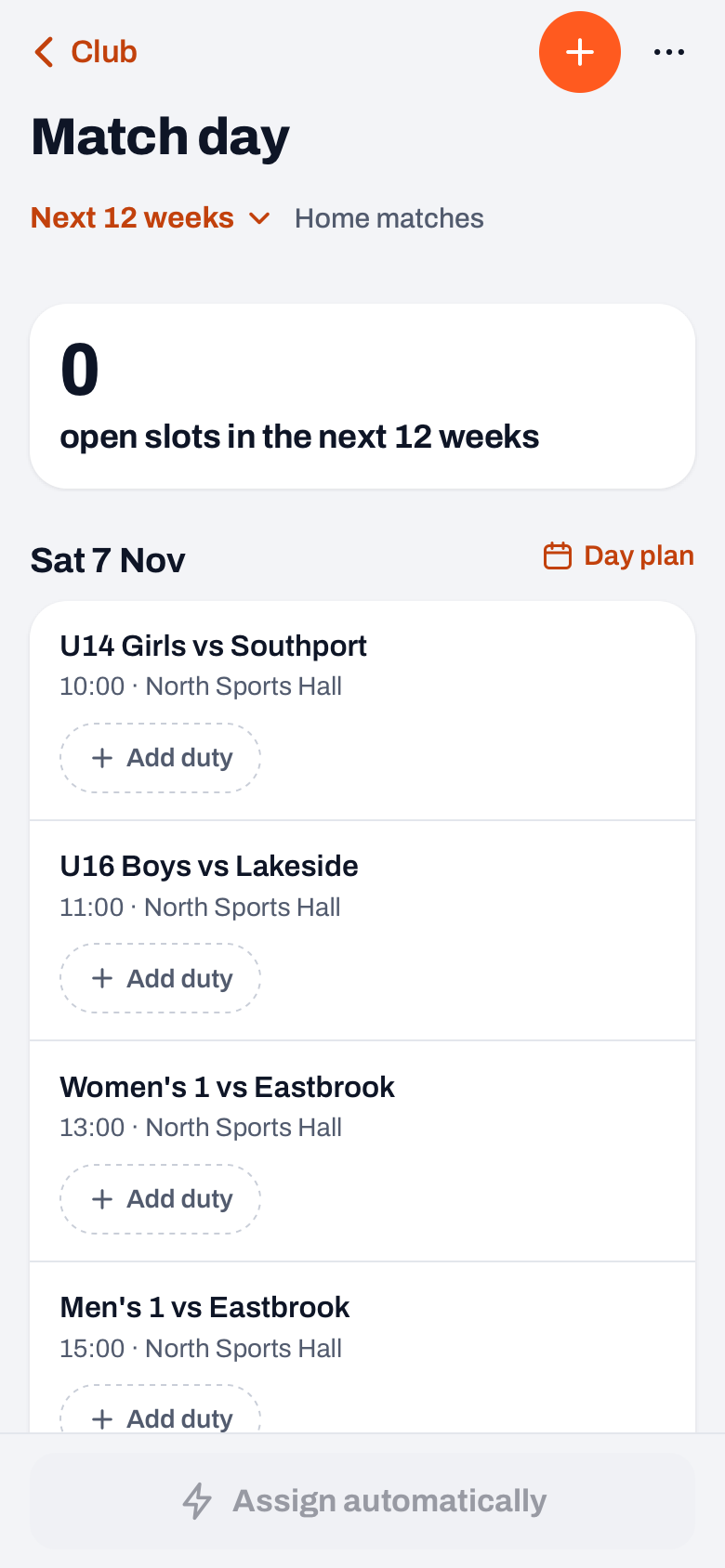
If a team also has to provide two line judges for a home match, post that as a Task in the announcements on that team's dashboard. Whoever takes it taps I’ll do it, and you see at a glance whether two names are already there. What Koach costs after the 14 free days is on the pricing page.
14 days free, no credit card. Post the line judges for your next home match as a task for your team and see who picks it up.
Try Koach with your teamFrequently asked questions
How many line judges are there in volleyball?
The FIVB rules know two or four line judges. With two, they stand at two diagonally opposite corners and each judges the end line and the sideline on his side. With four, there is one at each corner, judging one line. In many lower competitions there are no line judges and the first referee also judges the lines.
What does it mean when the line judge waves his flag?
If the line judge waves the flag above his head and points at the antenna, the ball crossed the net outside the antennae or touched the antenna. If he points at a line, it was a foot fault at the service: by the server on the end line, or by a player who was outside his court at the service. The same signal applies to a ball that touched an object outside the court.
What does it mean when the line judge touches the top of his flag?
If the line judge holds the flag up and touches the top with his free hand, the ball was out, but it first touched a player of the team it went to, usually a blocker. The point then goes to the team that hit the ball. The first referee makes the final decision.
Who can be a line judge in volleyball?
The rules set no requirements for who is a line judge; that is up to the federation or the competition organiser. At high levels federations work with trained officials. If your club is asked to provide line judges, pick people who know the rules for in and out, the antenna and the foot fault, and let them practise the five flag signals beforehand.

Organise your line judges without a group chat
14 days free, no credit card. After one home match you know whether it works.
Get started with KoachOr read first what the volleyball coaching app does.