
What If the Ball Goes Outside the Antenna in Volleyball?
The pass overshoots, the ball sails well outside the antenna and out of the court, and everybody lets it go. A waste — because in one of the two possible situations that ball is not dead at all and you were perfectly entitled to bring it back. The difference lies in which side of the net the ball is on.
What the antenna marks
The two antennas are flexible rods 1.80 metres long, fastened to the net exactly above the outer edge of the sidelines, with 80 centimetres sticking up above the net. Together with the top of the net, the imaginary upward extension of the antennas and the ceiling, they bound the crossing space: the space through which the ball must cross the net to enter the opponent's court (rule 10.1.1).
Everything outside that crossing space — left and right of the antennas, and under the net — is called the external space. That distinction is the key to this entire rule. Where exactly the antennas sit is covered in the dimensions of a volleyball court.
When the ball really is out
The ball is out as soon as it (rule 8.4):
- touches an antenna — even if it then drops neatly into the court;
- touches the net outside the side bands, or a post or a guy wire;
- crosses the vertical plane of the net wholly or partly outside the crossing space and so ends up on the far side;
- touches the floor outside the court, the ceiling, or a person out of play.
Note that third point: partly outside the crossing space is already enough. A ball that shaves past the antenna and goes half behind it is out — even though from the side it looks like it went through. And if it touches the antenna, that is the end of it regardless.
The exception: bringing it back around the outside
Now the rule that rescues rallies (10.1.2.2). If the ball travels into the opponent's free zone, wholly or partly through the external space, it is not dead yet. Your team may bring it back within your remaining touches, on one condition: the ball must re-cross the plane of the net through the same external space, on the same side of the court. If it left on the left of the antenna, it has to come back on the left.
Two things are regularly misunderstood. First: there is no height requirement. The ball may come back below net height, skimming the floor, straight through the external space — as long as it returns on the same side. Second: once you have retrieved it, it still has to cross the net properly through the crossing space within your three touches. The rescue costs you a contact.
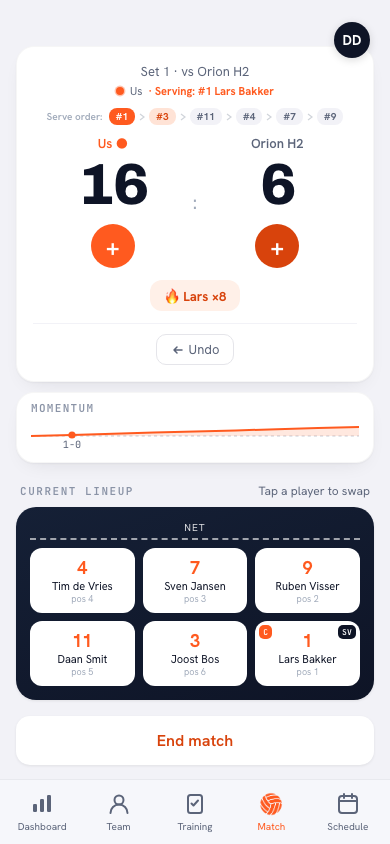
Rallies you rescue like this swing a set — and afterwards Koach's momentum line shows you exactly where the turn happened.
What the opponent may and may not do
The opponent may not obstruct this action. They may not swat or block the ball in their own free zone to make your rescue impossible; if they do, the fault is theirs. What they may do is play the ball themselves as long as it has not yet touched their side — at that point it has simply become their ball, and the contact counts as their first touch.
And you are allowed into the opponent's free zone to fetch the ball, provided you do not interfere with them (rule 11.2.4). Running under the net is fine as long as nobody is inconvenienced; what else is and is not allowed at the net is in the net-fault rules.
One rule, two match situations
- Overpass outside the antenna. A hard serve deflects off the receiver and sails outside the antenna into your free zone. That is the mirror image: now they may bring it back around the outside. So keep your defenders playing until the ball hits the floor.
- The pass that overshoots. Your passer sends the ball outside the antenna towards the far side. Your outside hitter sprints after it, plays it back through the same side in the opponent's free zone, and your setter still has something to work with. That is legal and spectacular — and exactly why teams who train out-of-system play win more rallies.
How to train it
The reason this ball gets abandoned is almost never ignorance on the coach's part and almost always hesitation on the player's part. So build a fixed drill: throw balls deliberately outside the antenna towards the far side and make the team turn them into three touches. Agree who chases (usually the outside hitter on that side) and who keeps the net clear. Ten minutes twice a season is enough to get the hesitation out. The rest of the rule framework is in all the volleyball rules at a glance.
Frequently asked questions
Is a ball that touches the antenna always out?
Yes. Touching the antenna makes the ball out immediately, even if it then lands inside the lines. The same goes for the net outside the side bands, the posts and the guy wires.
Can you bring a ball back around the outside of the antenna?
Yes, if the ball has gone into the opponent's free zone. You may retrieve it within your remaining touches, provided it re-crosses the plane of the net through the same external space, on the same side of the court.
Can that ball come back below net height?
Yes. There is no height requirement on the retrieval: the ball may travel back past the antenna just above the floor, as long as it stays on the same side. After that it still has to cross the net through the crossing space within your three touches.
Can the opponent stop that rescue?
No. The opponent may not swat or block the returning ball to make your action impossible; that is a fault on them. They may, however, simply play the ball if they want to take it over on their own side.



Try it yourself in Koach
Less admin, more coaching.
Get started with KoachOr read first what the volleyball coaching app does.