
Volleyball officials: who whistles, who keeps score and who flags
The short answer
Volleyball officials work as a crew: a first referee on the stand, a second referee on the floor, a scorer at the table and two or four line judges with flags. Only the two referees blow the whistle, and the first referee has the final say.
Volleyball officials at an official match are a whole crew, not one person with a whistle. This overview follows the FIVB Official Volleyball Rules 2025-2028: who is on the refereeing crew, where each official stands, who judges which fault and what your club arranges on an ordinary match day.
Who is on the refereeing crew
Under Rule 22.1 the refereeing corps consists of a first and a second referee, a challenge referee, a reserve referee, the scorer and four or two line judges. In FIVB competitions and in world and official competitions, an assistant scorer, a reserve referee and, when the video challenge system is used, a challenge referee are compulsory. Lower down the pyramid the crew is smaller.
| Official | Position | Main job |
|---|---|---|
| First referee | On the stand at one end of the net, eyes about 50 cm above the top of the net | Runs the match, has the final say |
| Second referee | On the floor by the post on the other side, facing the first referee | Net and center line, positions of the receiving team, substitutions and timeouts |
| Scorer | At the scorer's table, facing the first referee | The scoresheet and the service order |
| Assistant scorer | Next to the scorer | Libero replacements, the scoreboard at the table |
| Line judges | At the corners of the court | In or out, antenna, foot fault on the serve |
| Challenge and reserve referee | In their own booth or position | Video challenge, replacing the second referee |
How many officials work your match is decided by the competition, and that differs by country and by level. In many club leagues one referee works with a scorer alongside, sometimes with a second referee as well, and you mostly see line judges at higher levels. For your own matches, check the regulations of your federation or league.
Who may whistle and how a decision works
Only the first and second referees may blow the whistle during the match (Rule 22.2.1). The first referee whistles for every serve. Either referee may whistle the end of a rally, but only when they are sure a fault was committed and know which fault it was. The whistle is followed by hand signals in a fixed order. If the first referee whistles, they first indicate the team to serve next, then the fault and, if needed, the player. If the second referee whistles, they show the fault and the player, and then point to the serving team as the first referee indicates it. What each signal means is in all the referee hand signals.
The first referee: in charge from start to finish
The first referee works from a referee's stand at one end of the net, on the side opposite the scorer's table (Rule 23). They have authority over the whole refereeing crew and over the players and the bench. During the match their decisions are final: they may overrule a decision of another crew member if they think it is wrong, and they also decide on matters the rules do not cover. They do not allow any discussion of their decisions, but the game captain may ask for an explanation of how a rule was applied.
Before the match the first referee inspects the playing area, the balls and the equipment, holds the coin toss with the captains and supervises the warm-up. During the match they issue warnings and sanctions, and they judge, among other things:
- faults of the server and of the serving team's positions, including the screen;
- faults in playing the ball, such as a caught ball or a double contact;
- faults above the net and net contact, mainly on the attacker's side;
- attack and block faults by the libero and by back-row players;
- a ball that passes completely under the net, and a ball that crosses the net outside the antenna on their side.
After the match they check the scoresheet and sign it.
The second referee: the net, the receiving team and the bench
The second referee stands outside the court near the post, facing the first referee (Rule 24). They assist the first referee but also have decisions of their own. Under Rule 24.3.2 the second referee whistles:
- penetration into the opponent's court or the space under the net;
- positional faults of the receiving team;
- net contact, mainly on the blocker's side, and contact with the antenna on their side;
- a block or attack by a back-row player or libero that is not allowed;
- a ball touching an outside object, or touching the floor where the first referee cannot see it;
- a ball crossing the net outside the antenna on their side, or touching that antenna.
The second referee also handles the interruptions: they authorize substitutions and timeouts, control how long they last, count them and report the second timeout and the fifth and sixth substitution to the first referee and the coach. They supervise the bench and the warm-up area, check the work of the scorer, the floor and the balls, and in case of injury they authorize an exceptional substitution or three minutes of recovery time. They may signal faults outside their own list without whistling, but they do not insist. How to work through a match as second referee, step by step, is in the duties of the second referee.
Scorer and assistant scorer: the scoresheet is the record
The scorer sits at the scorer's table facing the first referee and keeps the scoresheet, working with the second referee (Rule 27). Before the match the scorer records the match and team details, including the liberos, collects the signatures of the captains and coaches and takes down the starting lineup for each set. During the match the scorer records every point, checks the service order and reports a fault immediately after the serve, records substitutions, timeouts and sanctions, and signals the end of each set and the 8th point in the deciding set, the moment the teams change courts. The scorer uses a buzzer or another sound device to alert the referees.
Where there is an assistant scorer, they record the libero replacements, operate the manual scoreboard at the table and check that the scoreboards agree (Rule 28). What you do as scorer before, during and after the match is in the duties of the scorer.
Line judges: two or four flags
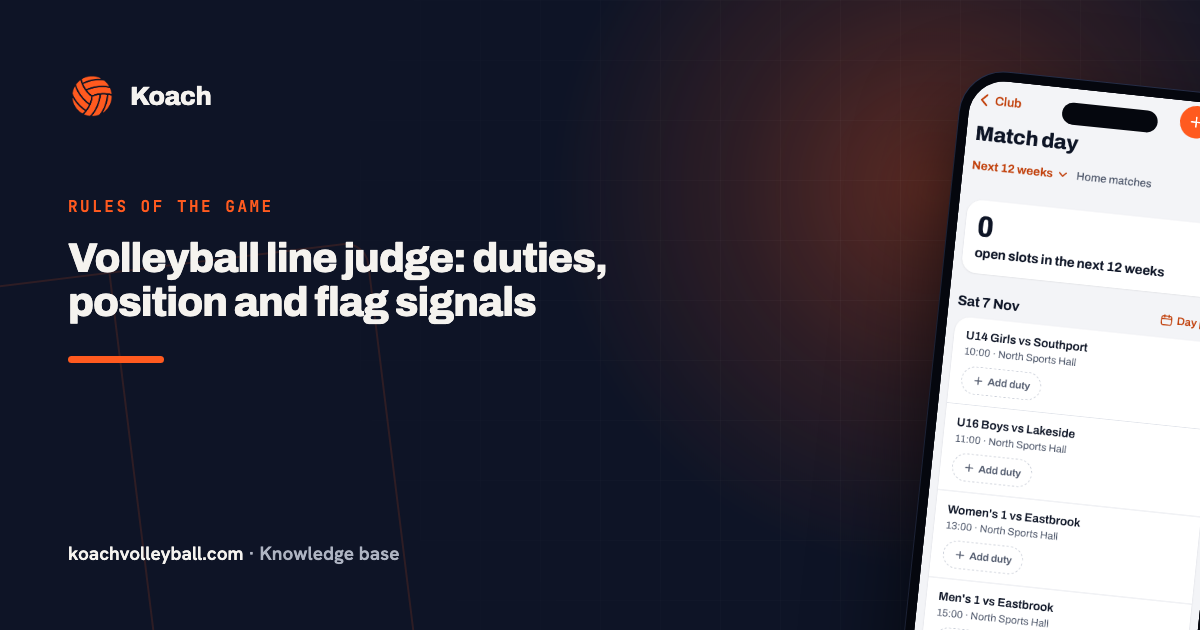
With two line judges, they stand at the corners closest to the right hand of each referee, diagonally 1 to 2 meters from the corner; each one watches the end line and the sideline on their side. With four, they stand 1 to 3 meters from each corner, on the extension of the line they watch (Rule 29.1). With a flag of 40 by 40 centimeters they signal whether a ball is in or out, whether the receiving team touched a ball that went out, whether the ball touched the antenna or crossed the net outside it, and whether a player other than the server was outside their court at the serve or the server committed a foot fault. How that works in practice is in the line judge in volleyball.
At the top level two more roles are added. The challenge referee runs the video challenge from a booth of their own and tells the first referee which fault occurred. The reserve referee replaces the second referee if needed, checks the substitution paddles and helps the second referee keep the free zone clear.
Take one minute before the first serve. As first and second referee, agree how the second will show a fault outside their own list, and go through the scoresheet and the starting lineups with the scorer. That minute prevents the argument in the second set about who should have been serving.
Scheduling referees and scorers as a club
On a match day with four home matches you quickly have eight duties to fill, a referee and a scorer per match, often from your own members. Three things make it workable: a list of who can referee and who can keep score, a schedule that takes into account who is playing themselves, and a fair spread over the season. A player who plays at 13:00 does not go on the 12:00 match.
In the Koach club section this lives in Match day: for each home match you set up a duty as Referee, Scorer or Hall duty. For each official you note whether they can referee, keep score or both. With Assign automatically Koach fills the open slots: whoever had the fewest duties this season comes first, anyone playing around that time is skipped, and nobody gets more than two duties in a day. Match day has no separate duty for a second referee or for line judges. How it works step by step is in assigning a referee and scorer for each home match.
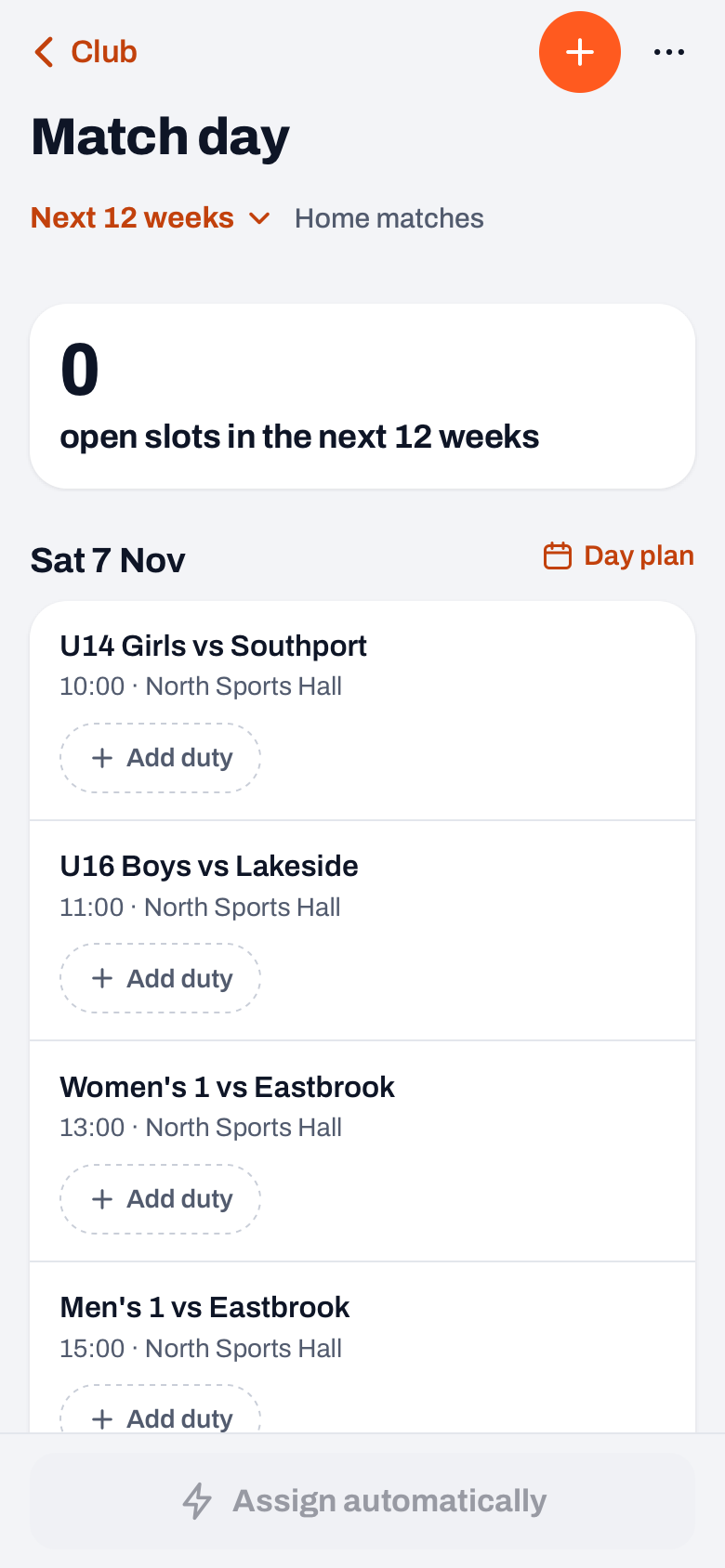
Match day is part of the Club plan; what that means for your club is on the page for clubs and the prices are on the pricing page. All the playing rules themselves are in volleyball rules at a glance, and the full text is in the FIVB Official Volleyball Rules 2025-2028.
14 days free, no credit card. Put your next home match day in Match day and let Koach assign the referees and scorers.
Try Koach with your clubFrequently asked questions
How many referees are there in a volleyball match?
At an official match under FIVB rules, two referees blow the whistle: a first referee on the stand and a second referee on the floor. There is also a scorer and two or four line judges, and at the top level an assistant scorer, a reserve referee and a challenge referee. In many club leagues the crew is smaller; what your match needs is in the regulations of your federation or league.
What is the difference between the first and second referee?
The first referee stands on the stand, runs the match and has the final say; among other things, they judge the serve, ball handling and faults above the net. The second referee stands on the floor on the opposite side and whistles, among other things, net contact on the blocker's side, penetration under the net and positional faults of the receiving team. They also handle substitutions and timeouts.
Can the scorer blow the whistle in volleyball?
No. Only the first and second referees may whistle. The scorer alerts the referees with a buzzer or another sound, for example for a service order fault, a substitution request or a request that is not allowed. The referees then decide what happens.
What does a line judge do in volleyball?
A line judge stands at a corner of the court and uses a flag to signal whether a ball is in or out, whether the receiving team touched a ball that went out, whether the ball touched the antenna or crossed the net outside it, and whether the server committed a foot fault. At the first referee's request, the line judge repeats the signal.
Schedule your referees and scorers fairly
14 days free, no credit card. After one match day you know whether the scheduling saves you work.
Get started with KoachOr read first what the volleyball coaching app does.