
Second referee duties in volleyball: step by step
You are working as second referee at the net tonight because nobody else was available. No course behind you, just a whistle and two and a half hours in which you would rather not stand out. The good news: your job is a fixed sequence you only have to walk through once. This is that sequence, from the net check to the last substitution.
Your shift starts half an hour before the first serve
Be in the hall thirty minutes before the start and find the first referee straight away. You are not his assistant: you have a number of decisions that are yours alone, and it saves you the whole evening if you settle three things beforehand. One: who runs the toss and who takes in the team lists. Two: how he wants you to flag faults that fall outside your authority — usually a small hand signal, no whistle and no insisting. Three: what he expects from you if there is an injury or an argument that starts to build.
Bring your own whistle (you don't share one), a pen, and a tape measure or net height gauge if the hall doesn't have one. During the match you stand on the floor on the opposite side of the net from the first referee, with the scorer's table within two steps. You move along the net with the play; agree with the first referee which way you shift when an attack comes, so the two of you are not standing in each other's line of sight. The rule of thumb that works everywhere: you want to keep sight of the block and of the centre line on the side the attack is coming from.
The court check: nine things in five minutes
Work through this list before the teams start warming up, not afterwards. Whatever you find then is usually solved in two minutes; whatever you discover during the first set is an interruption.
- Net height. Measure in the middle of the net, from the floor to the top of the band. The two ends must be level, and above the sidelines they may hang at most two centimetres higher than the middle. Which height applies to this age group differs from federation to federation and sometimes even from division to division — check your own federation's rules and use the net height overview as a memory aid.
- Net tension. Tight enough that a ball rebounds instead of dying in the mesh. Check the side bands and the bottom cord as well: a slack bottom cord makes contact low in the net impossible to judge.
- Antennae. On the outer side of both side bands, exactly above the sidelines, and firmly fixed. They stick out eighty centimetres above the net.
- Posts and stand. No sharp edges, the tensioning handle tucked away, the referee stand stable.
- Floor. Dry and clean, especially in the attack zone. Put a mop somewhere you can grab it without crossing the court.
- Free zone. Bags, bottles, ball carts and benches out of the free space. If there are obstacles that cannot be moved, point them out to both captains.
- Balls. Same type, properly inflated, and enough of them for the ball-retrieval system you are using. Keep watching them during the match: a ball that goes soft comes out.
- Benches and warm-up area. Who is allowed on the bench and where players may warm up differs per competition. Know it before somebody is stretching behind you.
- Scorer's table. Does the scoreboard work, is there a scorer, and has he done it before? If not, take one minute to walk through the scoresheet together. You get that minute back twice over in the second set.
If something isn't right and can't be repaired, report it to the first referee and have it recorded factually in the remarks section of the sheet. Deciding for yourself that it's near enough is the only thing you can really get wrong here.
Team lists, lineup sheets and the toss
The coaches hand in their team list: shirt numbers, names, the captain and the libero or liberos. Take it, check that the numbers are legible and bring it to the scorer. Never invent a number yourself because a shirt doesn't match the list — have the coach correct it before anyone serves.
The toss is run by the first referee. Your job is to make sure the outcome — who serves, who takes which side — goes straight onto the sheet with the scorer. Then comes the part that is explicitly yours: before every set, and at the change of sides in a deciding set, you check that the six players on court match the lineup sheet. Walk through the positions in rotation order, silently out loud to yourself, and look at the shirt numbers rather than the faces.
If there is a discrepancy and the first serve has not been made yet, the lineup is corrected to what the sheet says, with no penalty. Notice it later and it becomes a positional fault with everything that comes with it — and that is exactly the scenario your ten-second check prevents.
During the rally: watch the net, not the ball
This is the mistake almost every new second referee makes: following the ball. It feels logical, because that is where the game is happening. But everything that happens to that ball — held, double contact, out, touched by the block — is judged by the first referee. Follow the ball and you are watching for faults that are not yours to call, while missing the faults only you can see, because those happen low in the net and on the centre line.
So use a fixed looking routine every rally:
- Before the whistle: run through the six players of the receiving team. Their positions are your responsibility; the serving team is the first referee's.
- At the serve: eyes off the ball, onto the net and the centre line.
- During the build-up and the attack: hands at the block, the net band, and the feet under the net.
- After the rally: look at the first referee before you do anything.
What you whistle yourself is a short, concrete list: penetration into the opponent's court and into the space under the net, net contact at the lower part of the net or with the antenna on your side, positional faults of the receiving team, a ball that passes outside the crossing space or touches the antenna on your side, and a ball that hits the floor or an object at a moment when nobody else can see it. The details of that first category are in the net fault rules.
What is not yours: ball handling, attack and block faults above the net, and the time the server gets. If you do see something there, you may flag it without a whistle using a small gesture — but you don't insist and you don't repeat it.
Key point: your eyes belong on the net and on the receiving six, not on the ball. Follow the ball and you spend the whole evening watching decisions you are not allowed to take, while missing the only faults nobody else can see.
Substitutions: you authorise them, you count them
Substitutions are where an inexperienced second referee gets stuck, because four things happen at once. Stick to this order.
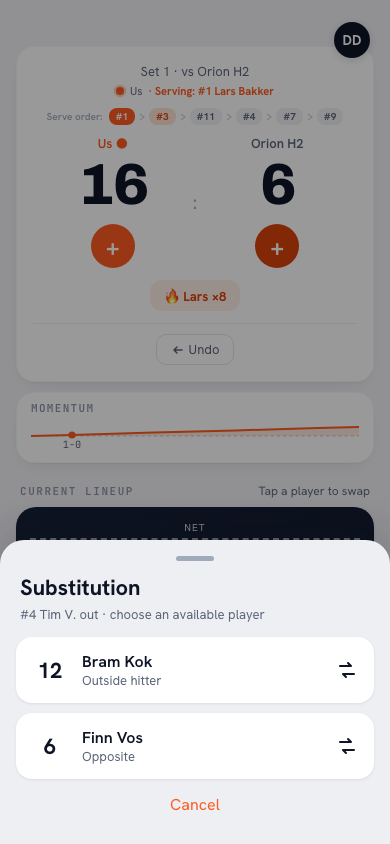
- The request. Only the coach or the game captain on court may request a substitution, with the hand signal, while the ball is out of play and before the whistle for service.
- The substitution zone. The substitute waits in the free zone between the extensions of the two attack lines, on the scorer's table side, with his numbered paddle if that is what you use. A player who is still pulling off a tracksuit top doesn't get to come on yet.
- Authorising. You give the substitution signal and let the players pass each other at the sideline.
- Waiting for the scorer. Only once the substitution is on the sheet do you indicate that play may continue. Those two seconds are not politeness; they are half the point of the paperwork.
You also count along. The official rules give each team six substitutions per set; some federations use a different number in certain divisions, so check that beforehand. A duty that is often forgotten: you actively announce the fifth and the sixth substitution to the first referee and to the coach concerned. Do the same at the second time-out. That way nobody finds out when it is already too late. The rules behind the pairs and the return substitution are in the substitution rules.
If a request comes that isn't allowed — during the rally, after the whistle for service, from someone who isn't entitled to ask, or when the maximum has already been reached — you reject it. If it doesn't delay play and it is the first time, there is no sanction, but it is noted on the sheet. If it happens again, it becomes a delay of game.
The libero replacement falls completely outside this. It is not requested and not authorised by you: it runs through the libero replacement zone by the team's own bench, there must be at least one completed rally between two libero replacements, and it doesn't count towards the six. Your role is to watch and to help the scorer when the tempo is high; the exact conditions are in the libero replacement rules. If somebody gets injured, you are the one who authorises an exceptional substitution or grants recovery time.
Time-outs, the bench and the clock
A time-out is requested the same way as a substitution: by the coach or the game captain on court, with the T signal, on a dead ball and before the whistle for service. You whistle, give the signal, point to the team that requested it and keep the time. Thirty seconds is short: start whistling and signalling the teams back after roughly twenty-five seconds, otherwise you structurally run over. Each team gets two per set, and unused time-outs are not carried over. Whatever happens tactically in those thirty seconds is none of your business: your job is the time and the paperwork.
Between rallies you also keep an eye on the floor and the bench. Sweat patches get mopped at a moment when play is stopped anyway. And you supervise the team benches and the warm-up area: behaviour that crosses a line goes to the first referee. You don't hand out cards yourself — that is his authority alone.
When the scoresheet and the court disagree
Sooner or later the scorer will raise a hand. Never interrupt a rally in progress: wait for the dead ball, walk to the table and ask three questions in this order.
- Does the scoreboard match the sheet? If they differ, the board goes back to the sheet. The sheet is the official record of the match; the board is an aid for the spectators.
- Does the server match the service order on the sheet? If the wrong player has already served, this is no longer a bookkeeping question but a serving order fault, and the first referee deals with it.
- Does the lineup on court match this set's lineup sheet? This is the check from the start of the set, once again.
If the scorer is unsure about the score itself — a point not crossed off — that is the hardest case. Reconstruct from the last score everyone is certain about, call the first referee over, and have both captains confirm what the score becomes before anyone serves again. The golden rule: never repair anything quietly. A correction four people watched happen never comes back afterwards; a correction you made on your own does.
What you whistle, what you repeat and what you never do
When you whistle a fault from your own list, the order is: whistle, make the fault signal, point at the player. You leave awarding the service to the first referee. When he whistles a fault, you repeat his signal, so that both benches can see the decision from their side of the net. Which signals go with what is set out in full in all the referee signals; before your first match, learn four of them properly: net fault, positional fault, substitution and time-out.
Three things you never do. You don't whistle over something the first referee has already judged. You don't press a second time on a fault outside your authority. And you don't get into a discussion with a coach: politely refer him to the game captain on court, because only the captain may ask for an explanation of how a rule is being applied.
If you and the first referee still disagree, the hierarchy is clear: only he may overrule a decision by another member of the refereeing crew. If you don't agree with something, walk over to him at a dead ball and say in one sentence what you saw — for example: from where I stood, the foot was completely across the centre line. He decides. Never two different signals at once, never a visible debate across the net. The rest you discuss afterwards over a coffee, and you will learn more there than from any rulebook.
And then the real secret of this job: ninety percent of your evening is standing still, watching the net and counting on time. Do that calmly and you won't stand out — which, for a second referee, is exactly the compliment you want.
Frequently asked questions
Is the second referee the first referee's assistant?
No. He does assist, but he also has decisions that are his alone: contact with the lower part of the net, penetration under the net, the positional fault of the receiving team, and authorising and counting substitutions and time-outs. If they disagree, the first referee decides, because only he may overrule other officials' decisions.
What should I be watching as second referee during the rally?
The net, the centre line and the antenna on your side, and before every whistle for service, the positions of the receiving team. Following the ball is the classic beginner's mistake: everything that happens to the ball is judged by the first referee.
How many substitutions do I have to track, and when do I announce them?
The official rules give each team six substitutions per set; some federations use a different number in certain divisions, so check beforehand. Actively announce the fifth and the sixth substitution to the first referee and to the coach concerned, and do the same at a team's second time-out.
What do I do if a coach requests a substitution too late?
A request after the whistle for service is rejected. If it doesn't delay play and it is the first time, there is no sanction, but it is noted on the match sheet. If the same team does it again, it becomes a delay of game.
May I give a yellow or red card as second referee?
No. You do supervise the benches and the warm-up area and report misconduct to the first referee, but handing out cards and sanctions is his authority alone.
What do I do when the scoreboard doesn't match the sheet?
Wait for a dead ball, go to the scorer's table and adjust the board to the sheet: the sheet is the official record of the match. If the sheet itself is wrong, reconstruct from the last certain score, bring in the first referee and have both captains confirm the correction before play restarts.


Try it yourself in Koach
Less admin, more coaching.
Get started with KoachOr read first what the volleyball coaching app does.