
Becoming a volleyball referee: the three routes
Somewhere in September the message lands: our team has to referee six times this season. After that, usually nothing happens until the Friday before the first duty. The question that comes up then is always the same — am I actually allowed to do that without any qualification? The answer is yes more often than coaches think, but there are three clearly different routes underneath it.
Why your club is asking you to referee at all
League volleyball runs on referees the clubs supply themselves. Federations only appoint their own designated referee from a certain level upwards; below that level it is the home club that puts someone on the stand. A club with ten teams therefore quickly organises more than a hundred matches a year where one of its own members has to referee. That is the whole explanation behind the refereeing obligation your team was handed: it is not the competition secretary being difficult, it is a sum that has to land somewhere.
What happens if a club does not fill those duties differs by federation: some charge a fine per unfilled match, others work with league points or with an obligation to train up extra members. Ask your own competition secretary once and put the answer on paper, because it determines how firm the agreements inside your club need to be.
More important for you as a coach or player: there is almost never one answer to "am I allowed to referee". It depends on the level of the match. That is why three routes run alongside each other, and most people go through them in this order.
Route 1: refereeing without a qualification
For a large part of what happens in a sports hall on a Saturday you need no paperwork at all. Think of internal matches, friendlies, club tournaments, practice matches between two teams and — with most federations — the lowest youth competitions and the mini volleyball formats. The rule of thumb: the lower the level and the less that hangs on the result, the more often the club may decide for itself who referees.
Exactly where the line runs between "the club fills that in itself" and "this needs a trained referee" differs by federation and even by division within the same federation. That is one question to your competition secretary, with one answer that lasts a whole season. Ask it in August, not in November.
This route is also the most useful way to find out whether it suits you. Referee three internal matches or a club tournament before you sign up for a course. Within two sets you know whether you enjoy making decisions that thirty people have an opinion about — and that is ultimately what the job comes down to.
What you need to know before you get on the stand
Refereeing without a qualification does not mean refereeing without preparation. Four topics together cover the vast majority of what you meet in an amateur match, and you can go through them in an evening:
- Serving order and positions. Who may stand where at the moment of the serve, and when is that a fault? It is the most common decision beginners miss; the explanation is in the positional fault.
- Substitution rules. How many substitutions per set, how a player comes back on, and why a libero replacement is something else entirely. Fully worked out in the substitution rules.
- Net, centre line and number of contacts. The three fault types that come up most often per rally, with their borderline cases.
- The signals. Your decision is only a decision once the hall can see it. The twelve signals you need are explained in all the referee signals.
If you want to take it in more broadly in one go, start with the rules overview and then read only the parts that apply at your level. You don't need back-row attack rules at your fingertips if you are refereeing a group of twelve-year-olds.
Route 2: your federation's entry course
Every federation has an entry course for club referees. The name differs by country, the set-up is strikingly similar and almost everywhere consists of four parts:
- Theory. Usually one evening or half-day on the rules, the signals and working with the scorer's table. Count on a few hours, sometimes spread over two evenings, sometimes partly online.
- A rules test. With most federations a short test with case studies. Failing is generally without consequence: you simply take it again.
- Supervised matches. One to three matches with an experienced referee standing next to you or going through afterwards what happened. This is by far the most valuable part.
- Registration. You get entered into your federation's system, usually with a card or an entry in the club account, so the club can put you down for matches.
All together that is a one-off investment of a few evenings, not a training programme lasting months. Exactly how many hours it is, what the course costs, from what age you may take part and how long the qualification stays valid: that differs by federation and changes regularly. Check those four things on your own federation's website or with your refereeing coordinator, and don't adopt a figure someone from another club mentioned.
Two practical tips. First: go with two people from the same team. You then have someone to swap with, someone to talk to after a strange match, and your team supplies two qualified people in one go instead of one. Second: schedule your first real match within three weeks of the course. Wait six months and you have lost half of it and start with shaking knees anyway.
Route 3: when a licence really does become compulsory
Above a certain competition level the club no longer decides who referees. The federation or the region then appoints a referee with a valid licence, and that referee receives an assignment. That is the moment the job changes from a club duty into a role: you have a level, you get assessed, with most federations there is a travel or match allowance attached, and you move around the region instead of around your own sports hall.
What such a licence additionally demands is broadly the same everywhere: a follow-up course on top of the entry course, a minimum number of matches per season to keep the licence active, and periodic refresher training. The numbers and the deadlines differ by federation, so here too: look it up once with your own federation, and don't rely on what is circulating in a group chat.
For most readers of this article that level is not the goal, and that is fine. There are clubs with twenty members who did one entry course and nobody with a higher licence, and they run their refereeing perfectly well. The licence route becomes interesting once you notice you enjoy it and want to referee more matches than your club can offer you.
What it costs in time, per season
This is the question people drop out on, usually because they overestimate it. The sum per duty:
- 30 minutes on site beforehand — net check, scorer's table, line-up sheets, toss.
- 75 to 100 minutes of match — three to five sets, including interruptions.
- 10 minutes afterwards — checking and signing the scoresheet.
- Travel time — none for a home match in your own hall, which is what most club duties are.
That is about two to two and a half hours per duty. At four duties a season you are therefore talking about eight to ten hours, plus the course once. For comparison: in many clubs that is less than a member does in bar duties. That comparison is not a rhetorical trick but a usable argument in the team meeting where nobody is putting a hand up.
There is also something in return that is hard to measure but is mentioned by almost every coach: you start seeing the game differently. Someone who has had to judge ten times whether a ball was lifted coaches more calmly on the sideline afterwards and argues less. It also shows in your team: players who have refereed themselves protest noticeably less.
The rota: sharing duties without the same three people doing everything
This is where it goes wrong at most clubs, not with the training. Take a club with ten teams each playing around eleven home matches: that is roughly 110 duties a season. Spread over ten teams that is eleven duties per team — with a group of twelve members, not even one duty per person. On paper there is nothing wrong.
In practice three or four people per team are qualified, and those four cover those eleven duties between them. Almost three each, while the rest of the team does none. That is exactly the pattern people drop out of after two seasons. The solution is not stricter rota-ing but a bigger pool: have every team put two members through the entry course each year. After three seasons your qualified group has tripled and the average drops to one duty per person per year. That is a recruitment and training question, not a planning question — the same logic that applies to recruiting coaches.
Alongside that, seven rota rules help, and you set them before the first match day:
- Work out the club total first. Number of home matches times the number of roles you need per match (referee, scorer, sometimes a second referee). Without that figure, every discussion about fairness is a matter of feeling.
- Allocate at team level, not at person level. Team 4 is responsible for eleven duties and divides them up itself. That saves the coordinator a hundred separate emails and puts the pressure where the social control is.
- Publish the whole season at once. Before the first match day, all the dates together. A rota that appears month by month produces the same discussion every month.
- Swapping is allowed without permission, provided the replacement is qualified and the change is in the rota. The duty belongs to the team, not to the person.
- Record the exemptions in advance. Anyone playing or coaching at that time, and anyone below your federation's age limit, is out. Making exceptions afterwards costs you the whole rota.
- An empty slot escalates 72 hours in advance to the refereeing coordinator — not on Saturday morning to whoever happens to be on hall duty.
- Keep one visible counter of who did how many duties, and publish the standings in January. Nothing works as well as a list where everyone can look up their own name.
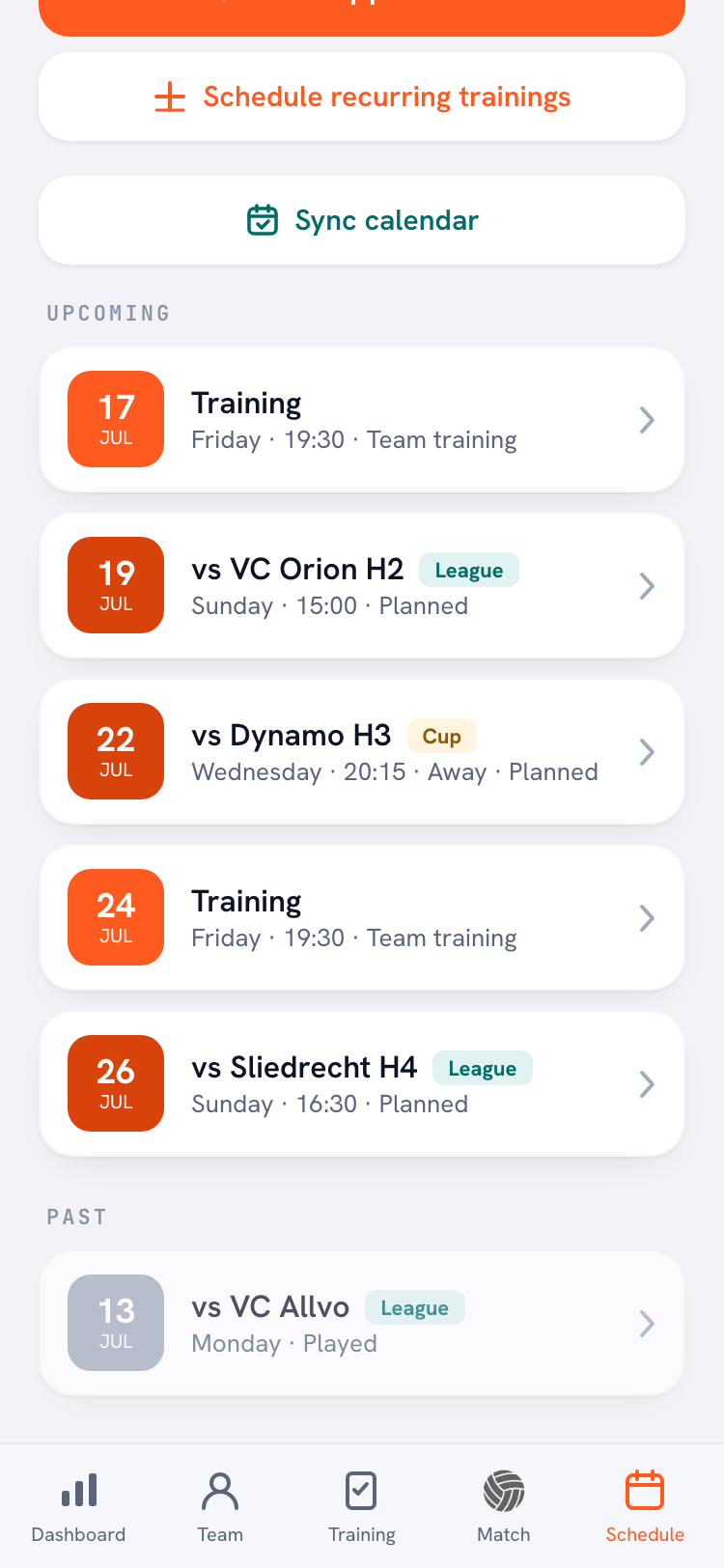
Practically speaking, a refereeing duty is simply a duty with a date, a time and a number of slots. In Koach you put it in the club calendar as a duty: members see it among their practices and matches, can sign up for an open slot and get a notification about it. For bar duties that even runs automatically across the whole year — see scheduling bar duties — and the refereeing rota hangs off the same calendar, so nobody has to open a separate list.
Key point: a refereeing rota does not collapse through bad planning but through too small a pool. First count how many duties your club has per season and divide that by the number of qualified members. If the answer is more than two, training people is your solution, not tighter rota-ing.
What the club should arrange for you
Anyone who says yes to refereeing is doing the club a favour. The least in return is that the club takes the hassle away. Six things should be in place before anyone does their first match:
- Registration and payment for the course. The club enrols you and pays; you supply your time. A club that makes the member front the course fee structurally gets too few sign-ups.
- Equipment. Whistle, cards and if needed a referee's shirt live at the club, not at your house. The same goes for the stand or the chair.
- One point of contact. A refereeing coordinator with a name, a number and stated availability. Without that name every question goes to the board and therefore to nobody.
- Support for the first three matches. Someone sitting in, naming two things afterwards that went well and one thing that could be better. This is the difference between someone who stays and someone who drops out after a single Saturday.
- Exemption from other duties. A refereeing duty counts as a club duty. Anyone who referees and does bar duty and drives is, in the rest of the club's perception, doing nothing special — and stops.
- Allowances recorded in one place. Whether there is an allowance and how much differs by federation, by country and by club. Put what applies at your club in the club handbook, with the date next to it, instead of explaining it by email every time.
If your scorer's table also runs on volunteers, sort those two things in one movement. A scorer who knows the sheet makes a beginning referee's job considerably lighter; the step-by-step guide is in filling in the scoresheet.
Going further — or saying honestly that it isn't for you
If you find it suits you, the next step is rarely a big leap. After three or four matches, ask whether an experienced referee can come and watch, or go and sit next to someone who referees a level higher. Anyone who then wants to move up registers with their regional refereeing committee; what the next step is called and which course goes with it is on your federation's website.
And if it is not for you: say so, and say it in September. A club can cope perfectly well with "I'll do the scorer's table and the driving, but I don't want to referee" — a rota can be adjusted for that. What a club cannot absorb is someone pulling out on Friday evening for the next morning's match. The most unpleasant Saturdays in a sports hall almost never come from a referee making a mistake, but from a referee who isn't there.
Frequently asked questions
Am I allowed to referee without a qualification?
For internal matches, friendlies, club tournaments and, with most federations, the lowest youth levels, the club may decide for itself who referees. From a certain division upwards the federation requires a trained or appointed referee. Exactly where that line runs differs by federation: ask your competition secretary once.
What does a referee course cost and who pays for it?
The price differs by federation and by country, so check your own federation's website. At the vast majority of clubs the club pays for the course, because it needs the trained members to fill its own refereeing obligation. If you have to front the cost yourself, ask for that to be confirmed in writing beforehand.
From what age can you become a volleyball referee?
The minimum age for the entry course differs by federation and usually sits somewhere in the teenage years. Refereeing younger is possible almost everywhere for internal matches and club tournaments, under adult supervision. Check the exact age limit with your own federation.
How much time does one refereeing duty take?
Count on two to two and a half hours: half an hour on site beforehand, 75 to 100 minutes of match and ten minutes afterwards for the scoresheet. For a home match in your own hall there is no travel time on top.
What do we do if nobody in our team is qualified?
Report it to the refereeing coordinator straight away and swap the duty with a team that does have qualified members, in exchange for another club duty. Beyond that this is a training problem: have every team put two members through the entry course each year and it is structurally solved after three seasons.
Do I have to know all the rules by heart?
No. Four topics cover the vast majority of an amateur match: serving order and positions, substitution rules, net and centre-line faults with the number of contacts, and the signals. Rare situations you look up or ask the second referee about; nobody expects you to quote the rulebook.


Try it yourself in Koach
Less admin, more coaching.
Get started with KoachOr read first what the volleyball coaching app does.