
Mixed volleyball rules: three men and three women, alternating
You have played fifteen years of league volleyball and get it wrong three times in your first two sets of mixed: a substitution that is not allowed, a rally you win but lose anyway, and a net hanging higher than you expected. Mixed is not indoor volleyball with a different line-up — there are three rules on top that touch everything you are used to. Here they are, plus what you have to check for your own competition.
Mixed is not an official discipline, and you notice that in the rulebook
Internationally, volleyball exists in two forms with a rulebook of their own: six against six indoors and two against two on sand. Mixed is not among them. It is a competition format that federations, regions and tournament organisers have set up themselves: the ordinary indoor rules with a handful of extra rules on top. That explains why two mixed teams from different regions look at each other blankly at a tournament over something they are both quite sure about.
Three things come back almost everywhere. Men and women stand alternately in the rotation. On multiple contacts, at least one woman must have touched the ball. And the net height sits somewhere between the women's and the men's measurement. How each of those three is worked out differs per competition, so everything below is phrased as "usually" and not as "this is how it is". The rulebook of your own competition always wins. Read it through once before you make your first line-up: ten minutes of work, and it saves you the argument at 22-22.
What does not change is the basis: three contacts per team, rotating on winning the serve, the same net and line faults. Below is only what comes on top of that.
Alternating: what the mixed rotation does to your front row
The core rule is small: in the serving order, men and women alternate. If you are on court with three and three, positions 1, 3 and 5 are from one group and positions 2, 4 and 6 from the other. You need remember no more than that, because everything else follows from it inescapably.
And more follows from it than most coaches realise. Your front row consists of positions 4, 3 and 2. Because the order alternates, positions 4 and 2 always hold two players from the same group, with someone from the other group at 3. Your front row is therefore always two men with a woman between them, or two women with a man between them. Never three of the same, never divided any other way. And it flips on every rotation: for three rotations there are two men at the pins with a woman in the middle, for the next three exactly the other way round.
That is not a piece of trivia but planning work. Your middle block changes group every rotation, so your strongest blocker is at position 3 in at most three of the six rotations, and whoever handles serve receive rotates with it for the same reason. So write out your six rotations in full once before the season starts. How the rotating itself works is in the rotation order; what happens if somebody is in the wrong place at the moment of the serve is in the positional fault. Those apply in full in mixed, with the alternating requirement on top: if two women or two men stand next to each other in the order, the line-up is wrong, even if everyone else is standing correctly.
Your system half chooses itself
Players who stand diagonally opposite each other are three places apart in the rotation: 1 opposite 4, 2 opposite 5, 3 opposite 6. Three is odd, and in a row that alternates that means: every diagonal pair consists of one man and one woman. Without exception. Half your system choice is settled by that, and that is more pleasant than it sounds.
- 4-2. Two setters standing diagonally opposite each other, so that one of them is always in the front row. In mixed those are automatically a man and a woman. This is the most played mixed form, simply because you have to construct nothing for it — the rotation does the work. The build-up is in the 4-2 system.
- 5-1. One fixed setter. Put a woman there and her diagonal is automatically a man, one of your two middles sits in each group and the same goes for your two outside hitters. The system divides itself, and you have the same setter on the second ball in all six rotations.
- 6-2. Here too the two setters stand diagonally, so here too they are a man and a woman. The only difference is that the setter comes from the back, which keeps three hitters in the front row — heavier, and rarely necessary in a recreational mixed team.
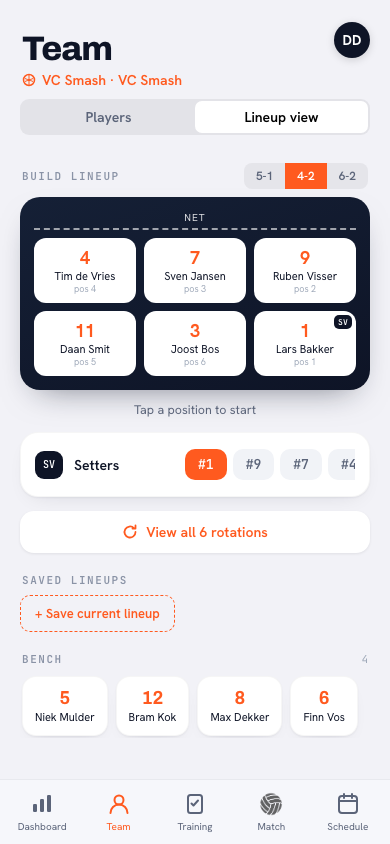
Practical: fix your line-up once instead of thinking it out again before every match. In Koach you set the system to 4-2, 5-1 or 6-2, place the players in their positions and save that as the preferred line-up. One thing the app does not do: it does not know mixed rules. It rotates the line-up, but whether your front row alternates stays a human job.
The women's touch: at least one woman on the ball
This is the rule that costs the most points, and the only one that is genuinely new. In its most common wording: if your team plays the ball twice or more, at least one of those contacts must have been made by a woman. If the ball goes back over the net in one contact, the requirement does not apply.
Two things that go wrong as standard:
- A block does not count. In virtually every rulebook a block touch is not a team contact; exactly how that works is in does a block count as a touch. The consequence: a woman who touches the ball on the block, after which two men dig it and finish it, gives away a fault. According to the count you have had two contacts, both by men.
- The threshold is not two everywhere. Some competitions only require the women's touch once you play the ball three times. The difference sits exactly where you often play: man passes, man finishes it off the second ball. In one competition that is a perfectly good point, in another it is a fault.
The solution is a system choice and not a coaching cue. Put a woman in the setter position and the second ball is automatically the women's touch in every built rally, so nobody has to think about it during the point. That is the main reason why mixed teams that run well almost all have a woman as setter. Shouting about it during the rally does not work: by the time someone yells "woman!", the ball is already on its way.
If you play with a male setter, you arrange it at the edges. Two agreements that work: on a free ball a woman always takes the first ball, and an attack off the second ball is only allowed if the first ball was played by a woman.
The net height: the rule with the most variants
You will meet three heights in mixed. Some competitions simply play at men's height, a large share at an intermediate height that often sits around 2.35 metres, and the odd recreational league at women's height. Which one applies to you is in the competition rules and nowhere else; all the official measurements per category are in all net heights.
The difference of eleven centimetres between an intermediate height and the men's measurement sounds small and changes your match completely. On a lower net, balls arrive flatter and faster, a taller hitter blocks more effectively, and your defence has less time. In practice that means: on a lower net put your back-court players half a metre deeper than you are used to, and expect the short ball behind the block to become more important than the hard ball past it.
More practical still: check the net before the warm-up and not after it. In a sports hall it is usually still at the height of the group who were in before you, and on a mixed evening that is almost never your measurement. Measure in the middle, because that is where the net hangs lowest.
Substituting, the libero and being short of players
The alternating order has to stay intact for the whole set. That has one hard consequence which surprises many coaches on the first evening: you substitute a man for a man and a woman for a woman. A woman replacing a man puts two women next to each other in the order and breaks the rotation. The number of substitutions per set and the question of who may come back simply follow the regular substitution rules.
For your bench that means: seven players are only really seven if your reserve is in the right group. If you turn up with four men and three women, you effectively only have a men's substitution. So for a long tournament day, bring a reserve on both sides.
If a libero is used, the same logic applies: the libero replaces a back-row player from his own group, otherwise the order no longer works. Many mixed competitions leave the libero out altogether, precisely because it gains little in a team of six with a fixed ratio. If yours does allow one, the ordinary libero rules apply beyond that.
And then the evening when somebody is ill. How a competition deals with an incomplete team differs a great deal: one lets you play with five and a hole in the rotation, another allows a stand-in from a different team, a third awards the match to the opponent. What is nearly always the same is that you may never field more men than the format allows; more women usually is fine. Look this up before it happens, because at quarter past eight in the hall nobody knows the answer.
Six questions to ask before the first match
Almost every dispute is about the same six points. Look them up once, write them on the back of your line-up card and you are done with it for the season.
- What height is the net — including at away matches?
- Does the women's touch apply from two or from three contacts? The question that costs a point most often.
- Does a block touch count as the women's touch? Usually not, but not everywhere.
- Are there extra rules for men, such as a restriction on attacking from the back court?
- What are you allowed to do with an incomplete team — play with five, use a stand-in, or neither?
- Is a libero used, and which group may he come from?
Coaching a mixed team: the level difference, not the split
The biggest trap in mixed is that coaches build their tactics on the split rather than on what players can do. In a mixed team somebody who played league volleyball until last year stands next to somebody who started three years ago, and that difference does not run along the line between men and women. So judge per player and divide the jobs on that.
Concretely: decide per rotation who takes serve receive instead of sticking to three receivers, give the second ball to one person and keep that up for the whole set even after a miss, and serve at the zone where you have watched the build-up stall for two rallies.
At tournaments the mixed format is also often four against four, with two men and two women. Everything above still applies, but the line-up and the division of roles are fundamentally different: those are in the four-against-four line-up. Ask about the women's touch there as well, because in four against four in particular it is worked out differently by each organiser.
In short: men and women alternate, so your front row is always two of one with one of the other, and every diagonal pair is mixed. On two or more contacts a woman must have touched the ball — a block does not count. So put a woman in the setter position and that rule solves itself. And only substitute within the same group.
Frequently asked questions
How many men and women are on court in mixed volleyball?
The usual line-up is three men and three women, standing alternately in the serving order. That means your front row always holds two players from the same group with one from the other between them. Most competitions allow you to play with more women than men, but never with more men than the format allows. There are also mixed formats with four players a side, usually two and two.
Does a block by a woman count as the compulsory women's touch?
In virtually every rulebook it does not. A block touch is not a team contact, so after the block your team still has three contacts and the women's touch has not yet been made. The classic mistake: a woman touches the ball on the block, two men then play it and the attack does not count. Do check this in your own competition rules, because the odd recreational league does count the block.
What height is the net in mixed volleyball?
That differs per competition and it is the rule with the most variants. You will meet men's height, women's height, and very often an intermediate height around 2.35 metres. There is no international standard for it, so the only reliable source is the rulebook of your own competition or tournament. At an away match, always check for yourself that the net is at the right height before you warm up.
May I substitute a man for a woman in mixed?
No. Men and women stand alternately in the serving order, and a substitution between the groups would put two players from the same group next to each other. So you always substitute within the same group. The same goes for a libero: he replaces a back-row player from his own group. Bear that in mind when putting your bench together, because a reserve in the wrong group cannot be used.
What do you do if only two women or two men turn up?
That depends entirely on your competition. One lets you play with five players, with a hole in the rotation that is handled as a service error; another allows a stand-in from a different team; a third simply awards the match to the opponent. Look this up before it happens and put the answer in your team group, so you do not have to work it out on the morning itself.
Is mixed volleyball an official discipline?
No. The international volleyball federation recognises two disciplines with a rulebook of their own: indoor volleyball six against six and beach volleyball two against two. Mixed grew up alongside them as a recreational competition format, set up by national federations, regions and tournament organisers. That gives it a recognisable shared core, but not a single rule you can be certain is the same everywhere.


Try it yourself in Koach
Less admin, more coaching.
Get started with KoachOr read first what the volleyball coaching app does.