
How many substitutions in volleyball? 6 per set: the rules
Six substitutions sounds generous — until you are in the fourth set juggling a cramp, an off day and a tactical plan all at once. Coaches who truly know the substitution rules keep options where others run out.
The basic rules
- Six substitutions per team per set under the FIVB rules used internationally. In the United States the limit is higher: 15 under USA Volleyball and 18 under NFHS high school rules.
- Fixed pairs: a substituted player may only return in the spot of the player who replaced them — and that counts as the pair's second substitution.
- One substitution moment at a time: multiple subs are allowed in the same stoppage, but report them all at once.
- Libero exchanges do not count — they follow their own regime, see the libero exchange.
Good to know: a substitution never changes the rotation order; the replacement takes over exactly their pair partner's spot. Prefer tracking subs, rotation and playing time automatically? See the best volleyball apps for coaches.
What does that mean tactically?
The pair system is the rule coaches forget most often: substitute your opposite for the bench player in set three, and you are locked into that pair. You cannot later use the same bench player for your outside hitter as well. So think in pairs before the match: who is the first sub for whom? That plan is part of preparing your lineup.
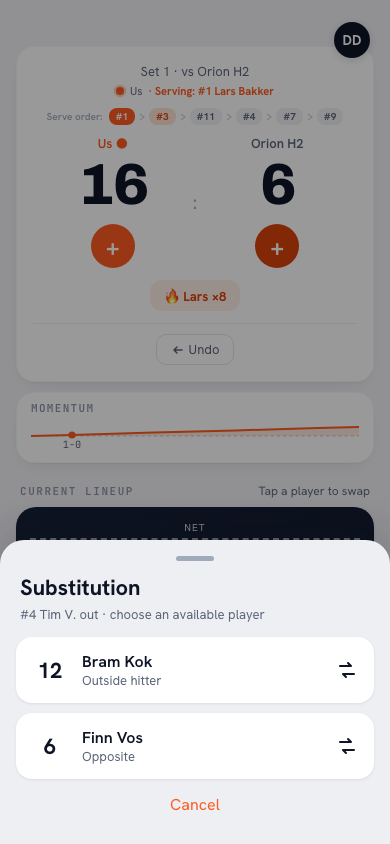
The mistakes that cost points
- Requesting a seventh substitution: delay of game, yellow card on repetition. So keep count yourself, along with the scorer at the officials' table.
- The wrong return sub: player A back in the spot of player C — not allowed, costs a timeout's worth of explaining and sometimes a sanction.
- Substituting after the whistle for serve: too late is too late; wait for the next stoppage.
Always keep two in reserve. Never enter the closing stages of a set with fewer than two substitutions left: one for an injury, one for the tactical emergency at 23-23. Subs four and five are luxury, six is insurance.
Frequently asked questions
How many substitutions do I have per match?
Six per set, and the counter resets every set. The pairs reset per set as well: a new set means new combinations.
May a substituted player come back in the same set?
Only in their own spot, in exchange for the player who replaced them — that is the second and final substitution of that pair in that set.
What happens with an injury when my substitutions are used up?
Then, as a rare exception, an 'exceptional substitution' with any non-participating player is allowed. The injured player may not return that match. Prevention is better: keep subs in reserve.
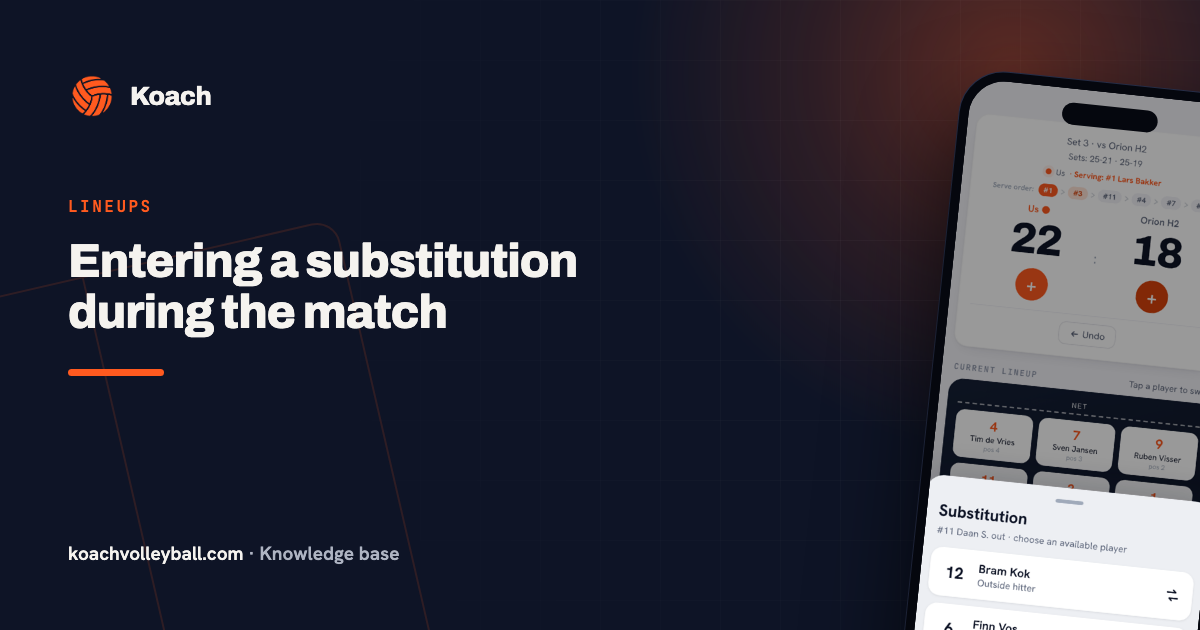 Entering a substitution during the match
 Who can the libero replace? Libero exchange rules explained
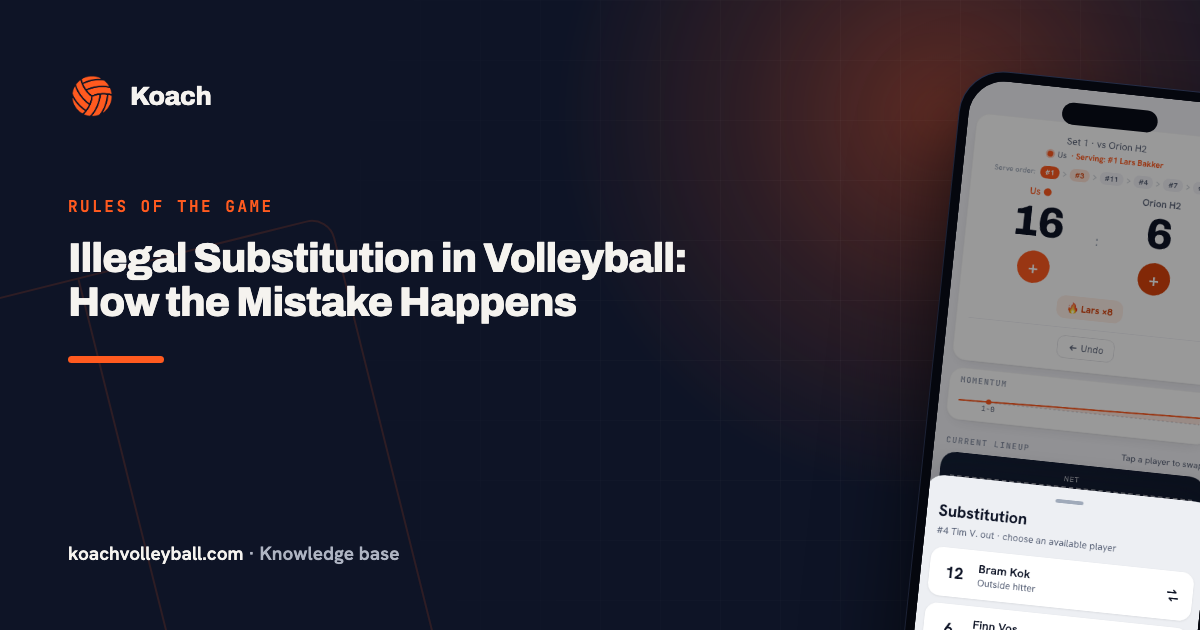 Illegal Substitution in Volleyball: How the Mistake Happens
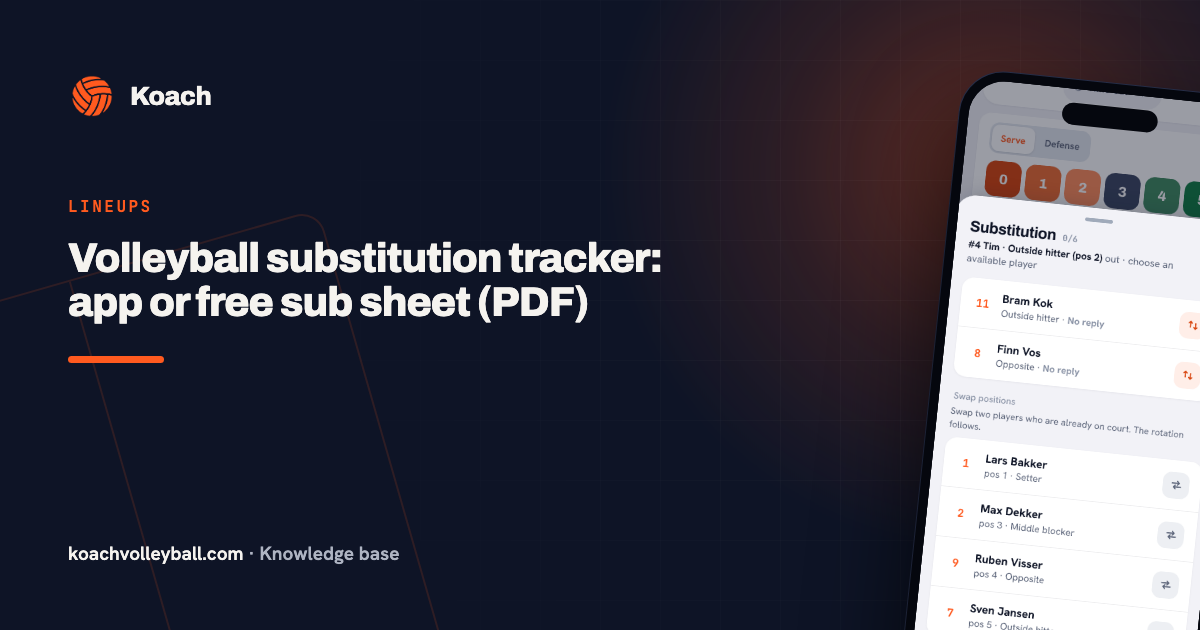 Volleyball substitution tracker: app or free sub sheet (PDF)
 Volleyball rotation with 8 players: a fair sub plan
 Volleyball substitution chart: fair playing time, with an example
Try it yourself in Koach
Less admin, more coaching — starting at your next practice.
Get started with KoachOr read first what the volleyball coaching app does.