
Volleyball rotation with 8 players: a fair sub plan
The short answer
With 8 players, four play the whole set and four share the other two spots: you swap two of them at the halfway point. That uses 2 of your 6 substitutions per set, and after two sets everyone has played the same amount. In Koach you set up each set's lineup during the set break and see afterwards how many rallies each player played.
A volleyball rotation with 8 players means two players on the bench every set, and without a plan it tends to be the same two. Below are sub rotations for 7, 8 and 9 players that stay within six substitutions per set, and how to check after the match whether playing time really came out even.
Volleyball rotation with 8 players: why playing time drifts without a plan
With eight players and six spots, two sit out every set. That is enough to give everyone plenty of court time, but only if you sort it out beforehand. Sub on gut feeling and you start your strongest six, wait for a quiet moment that never comes, and send in your bench players at 22-15 for a handful of rallies. You remember making the sub. You forget it was only a few balls.
Two rules box you in: six substitutions per set, and a sub can only be swapped back out for the player they replaced. The details are in volleyball substitution rules; some youth and recreational leagues, and US school and club rules, allow more. A third rule works in your favor: a new lineup at the start of a set is not a substitution. Whoever sat out the last set can simply start the next one. So a good rotation comes down to two choices per set: who starts, and who comes in halfway. (Rotation here means who plays and who sits, not the six-spot rotation on court. That one does not change.)
The 8-player sub rotation, set by set
The idea: each set, four players play the whole set and four share two spots. Two of them start, two come in halfway. Whoever played half a set this time plays the whole set next time. Give your players a number from 1 to 8 (it does not have to be their jersey number):
| Set | Whole set | First half | Second half |
|---|---|---|---|
| 1 | 1, 2, 3, 4 | 5, 6 | 7, 8 |
| 2 | 5, 6, 7, 8 | 1, 2 | 3, 4 |
| 3 | 1, 2, 3, 4 | 7, 8 | 5, 6 |
| 4 | 5, 6, 7, 8 | 3, 4 | 1, 2 |
At the halfway point you sub within fixed pairs. In set 1, 7 comes in for 5 and 8 for 6; in set 2, 3 comes in for 1 and 4 for 2. That makes 1 and 3, 2 and 4, 5 and 7, and 6 and 8 partners all match long. Build each pair from two players who can play the same position.
- Subs. Two per set. That leaves four for an injury or a tactical change.
- Playing time. After two sets everyone has played one and a half sets; after four sets, three. In sets 3 and 4 the halves flip, so it is not always the same two who close out the set.
- The moment. Pick a fixed moment around halfway, for example as soon as either team reaches 13 points; in a deciding set to 15, make it 8. It will rarely be exactly half the rallies. That is what the count afterwards is for.
- Fewer or more sets. If the match ends after two or three sets, start the next match at the set where you left off. Play a fifth set as set 1.
The plan assumes players who can play more than one position, as on most youth and many rec teams. If you run a 5-1 with one setter and no backup, keep the setter on court all match and rotate the other seven: each set, three play the whole set and four share two spots.
Rotating 7 or 9 players: same idea, different math
Seven players. The bench player comes in at the halfway point. Whoever went out starts the next set on the bench and comes in halfway for the next player: in set 1, 7 comes in for 6; in set 2, 6 comes in for 5; in set 3, 5 comes in for 4. That costs one sub per set. Carry the sequence into the next match where it left off; after seven sets everyone has played six. If one of your eight is a libero, you are sharing six court spots among seven players, so use this plan.
Nine players. Work in three groups: 1 to 3, 4 to 6 and 7 to 9. In set 1 the first group plays the whole set, 4 to 6 the first half and 7 to 9 the second. In set 2, 4 to 6 play the whole set, 7 to 9 the first half and 1 to 3 the second; in set 3 everything shifts once more. That costs three subs per set, and after three sets everyone has played two. At the halfway point you always sub within the same trio (1, 4 and 7; 2, 5 and 8; 3, 6 and 9), so build each trio from players for the same position.
The three plans side by side:
| Roster | How a set splits | Subs per set | Everyone even after |
|---|---|---|---|
| 7 players | 5 whole set, 2 share one spot | 1 | 7 sets |
| 8 players | 4 whole set, 4 share two spots | 2 | 2 sets |
| 9 players | 3 whole set, 6 share three spots | 3 | 3 sets |
Running your sub rotation in Koach
Koach does not build the plan for you: who plays when is your call. On match day the app helps you stick to it in two places, without scraps of paper.
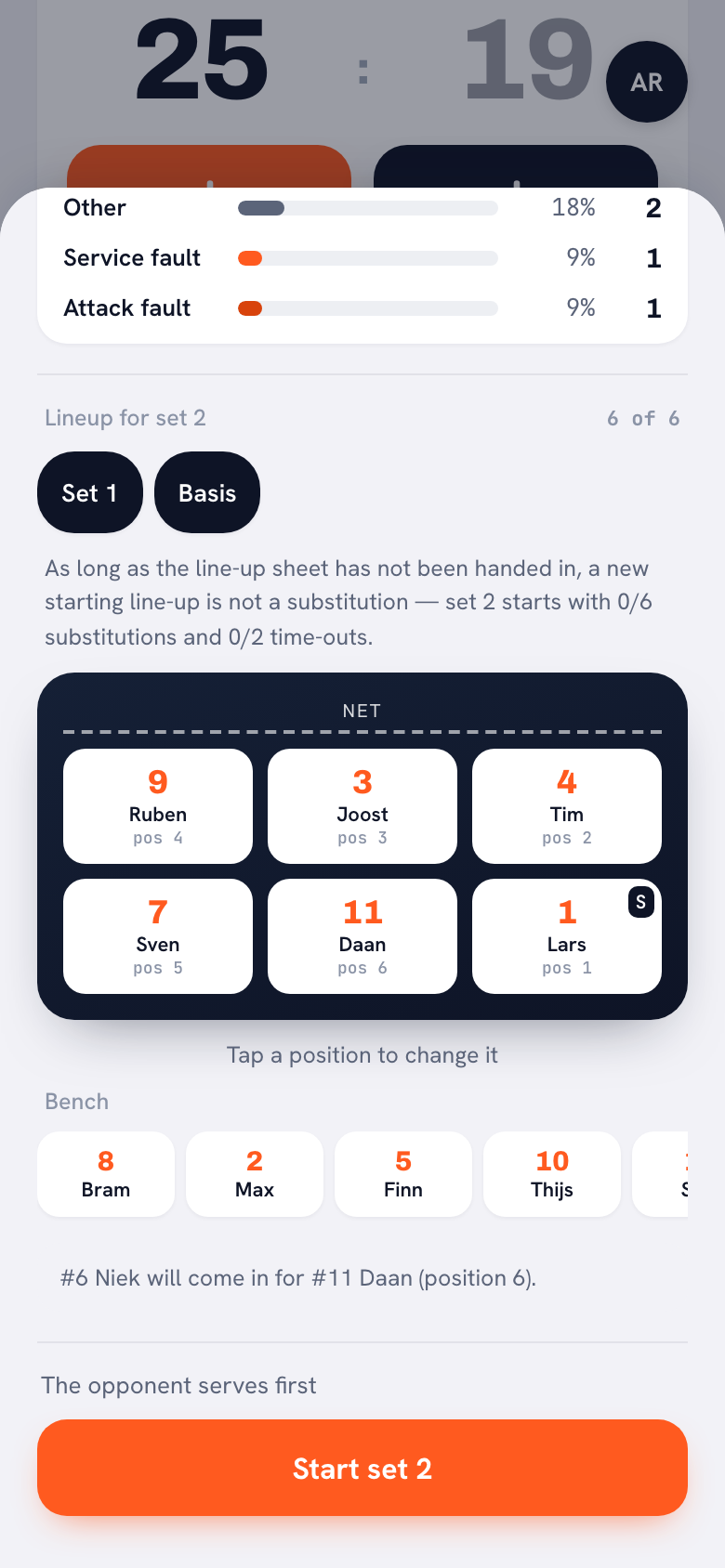
Between sets: the set break. After set 1 the set break opens on its own with Lineup for set 2, and the same happens after every set. Tap a spot and pick who goes in from the Bench row. The app reminds you that a new lineup at the start of a set is not a substitution: the set starts with 0/6 substitutions. Along the top are buttons with the lineups from earlier sets and your saved lineups. Save the four starting lineups from your plan ahead of time in the Lineup view on the Team tab with Save current lineup, and each one is a single tap away during the set break. More about this screen in the set break between sets.
14 days free, no credit card. Put your plan in Koach and see after your first match how many rallies everyone actually played.
Try your sub rotation in KoachDuring the set: the substitution sheet. At the agreed moment, tap the player coming off in the live screen and choose who goes in. Next to the Substitution heading you see how many subs you have made this set, for example 2/6. On a seventh, the app stops you with You have already made 6 substitutions this set. If a sub breaks the re-entry rule, for example because a player comes back for someone other than their own replacement, the app asks Is this substitution allowed? Tap Substitute anyway to go ahead when you know what you are doing. A step-by-step walkthrough is in entering a substitution during a match.
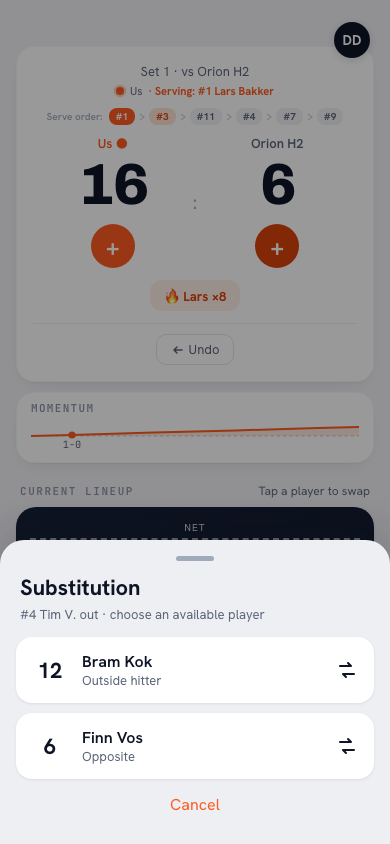
If you play with a libero, turn on Swap libero automatically. The libero then comes in for the middle in the back row by itself, and those swaps do not count toward your six.
Checking afterwards whether it was fair: playing time in rallies
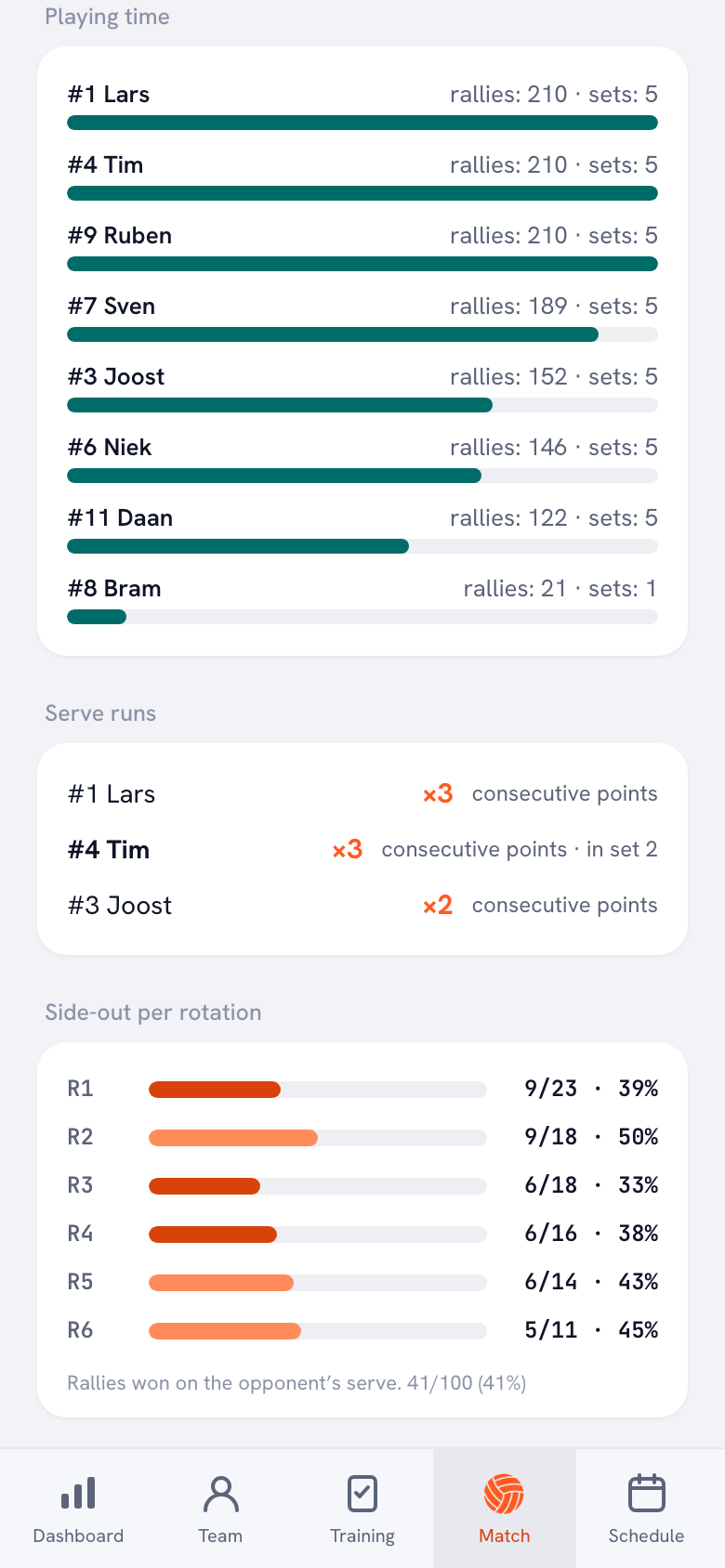
A plan is only a plan. Whether it worked out that way shows after the match, because a 25-23 set has different halves from a 25-12 set. That is why Koach measures playing time in rallies: every rally a player is on court counts as one for them. Every rally produces exactly one point, so a 25-20 set is 45 rallies.
In the match details, under Playing time, each player has a bar with their number of rallies and sets. A set counts as soon as a player was on court for one rally, so look at both: a player who subbed in at 22-15 in four sets has four sets next to their name and still saw only a fraction of the balls. With the plan above, the bars sit close together after four sets. If one is far behind, have that player start a whole set next match.
Two things to know before you compare the bars:
- Live scoring only. The app knows who was on court because you score the match live with your lineup in it. If you enter the result and the stats afterwards, there is no playing time for that match.
- The libero counts. When the libero comes in for a middle, the libero gets those rallies and the middle does not. So a middle ranks lower in the list without ever having sat on the bench. Compare middles with middles.
Across the season, the Playing time this season card on the dashboard keeps counting, with whoever played least at the top. How that tracker works is in tracking playing time, and why the count often differs from your gut feeling is in the interview on fair playing time. Whether equal is also fair is a different question; that is covered in dividing playing time fairly.
Clipboard or app: what suits your team?
We make Koach, so read this with that in mind. You do not need an app for a sub rotation: a sheet on your clipboard works, costs nothing and never crashes. The difference is in what you have to keep track of yourself during the match.
| What you need | Sheet on a clipboard | Koach |
|---|---|---|
| Coming up with the plan | You | You, the app does not make a plan |
| Lineup per set | A new sheet per set | Set break, with saved lineups |
| Counting subs per set | Tally marks | Counter in the substitution sheet, stops at 6 |
| Checking re-entry | Your memory | The question Is this substitution allowed? |
| Playing time afterwards | An estimate | Rallies and sets played per player |
| Cost | Free | 14 days free, then €2.99 per month |
A clipboard sheet suits you if you only want to plan your subs and do not keep stats, or you would rather not hold a phone on the sideline. You can print a blank lineup sheet, with one sheet per set and an overview for your subs, from the free volleyball rotation generator, no account needed.
Koach suits you if you want to score the match live anyway: the sub counter, the set break and playing time come along at no extra effort. Koach does not suit 4v4 or mini volleyball, because lineup, subs and playing time all assume six players on court. It is also a poor fit if your league allows more than six subs per set, because the counter stops at six. How to build a lineup for six is in making a volleyball lineup.
What does an app for your sub rotation cost?
You can try Koach free for 14 days, with no credit card and every feature. After that you choose Coach for €2.99 per month (one team, two coaches) or Club for €9.99 per month (unlimited teams). With a yearly plan you pay €2.49 or €8.33 per month. In the App Store and Google Play you pay the store price in your own currency. Your players and their parents use the app for free. All prices are on the pricing page.
Share the plan in advance. Tell your players before the match which set they play half of. A player who knows they play all of set 2 sits calmly on the bench in set 1 instead of waiting for a sub that never comes.
Frequently asked questions
How do you rotate 8 players in volleyball so everyone plays equally?
Have four players play the whole set and split the other two spots among four players: two start, two come in halfway, for example as soon as either team reaches 13 points. The next set, the four who played half a set play the whole set. That uses two subs per set, and after two sets everyone has played one and a half sets.
Can you play volleyball with 7 players?
Yes. You play six on the court with one sub. Have that player come in at the halfway point of each set for someone else, and have whoever went out start the next set on the bench and come in halfway for the next player. That costs one sub per set, and after seven sets everyone has played six.
How do you rotate in volleyball with 9 players?
Make three groups of three. Each set, one group plays the whole set, the second the first half and the third the second half; the next set, everything shifts one group along. That uses three of your six subs per set, and after three sets everyone has played two. At the halfway point, always sub within the same trio, with players for the same position.
Does a new lineup at the start of a set count as a substitution?
No. You hand in a new lineup before every set, and whoever is on it simply starts. A player who sat out the last set can start without using one of your six subs. In Koach you see this in the set break: the new set starts with 0/6 substitutions.
Is there a free app to track a volleyball sub rotation?
Not permanently in Koach. You can try the app free for 14 days, with no credit card and every feature, including the sub counter, the set break and playing time per player; after that Coach costs €2.99 per month for one team. Completely free options are a sheet on your clipboard and the rotation generator on the Koach site, with a blank lineup sheet. Your players use the app for free.


Put your sub rotation in Koach
14 days free, no credit card. After one match you see the rallies played per player.
Get started with KoachOr read first what the volleyball coaching app does.