
Creating a volleyball lineup: the 5-1 and 4-2 systems explained
A good lineup is half the game plan. Yet at every level you still see coaches shuffling names around on a beer coaster five minutes before the first serve. This article covers the basics — positions, rotation, 5-1 versus 4-2 — and shows how to set it all up digitally.
The six positions and the rotation
Every volleyball team fields six players, numbered counter-clockwise starting from the serving spot:
- Position 1 — right back, the player who serves
- Position 2 — right front
- Position 3 — middle front
- Position 4 — left front
- Position 5 — left back
- Position 6 — middle back
As soon as your team wins the serve back from the opponent, everyone rotates one spot clockwise. That is why your starting lineup matters so much: it determines in which rotations your strongest attacker is in the front row and when your setter serves from the back.
The 5-1 system: one setter, five attackers
In a 5-1, one dedicated setter plays all six rotations. The advantages:
- Consistency. Attackers get the same kind of set every rally.
- More attacking power. In three rotations the setter is in the back row, giving you three attackers at the net.
- Clear roles. The opposite, outside hitters, middle blockers and libero know exactly what their job is.
The downside: everything leans on one player. If your setter gets injured or has an off day, you feel it immediately.
The 4-2 system: two setters
In a 4-2, two setters play opposite each other in the lineup. Whoever is in the front row does the setting. That is simpler — the set always comes from the front — which is why it is popular with youth and recreational teams. The trade-off is one fewer attacker at the net. For teams still learning to rotate, or without a clear-cut first setter, 4-2 is often the smartest choice.
Rule of thumb: switch to 5-1 once one setter is clearly better and the team is ready for fixed patterns. Not sure? Start the season in a 4-2 and switch once the rotation game is solid.
Setting up your lineup digitally
In Koach you build your lineup on a visual court: six cards around the net, exactly the way your team will stand. You pick the system at the top (5-1, 4-2 or 6-2) and tap players onto their position. Setter and libero roles are assigned separately, so the app tracks the rotation correctly during the match.
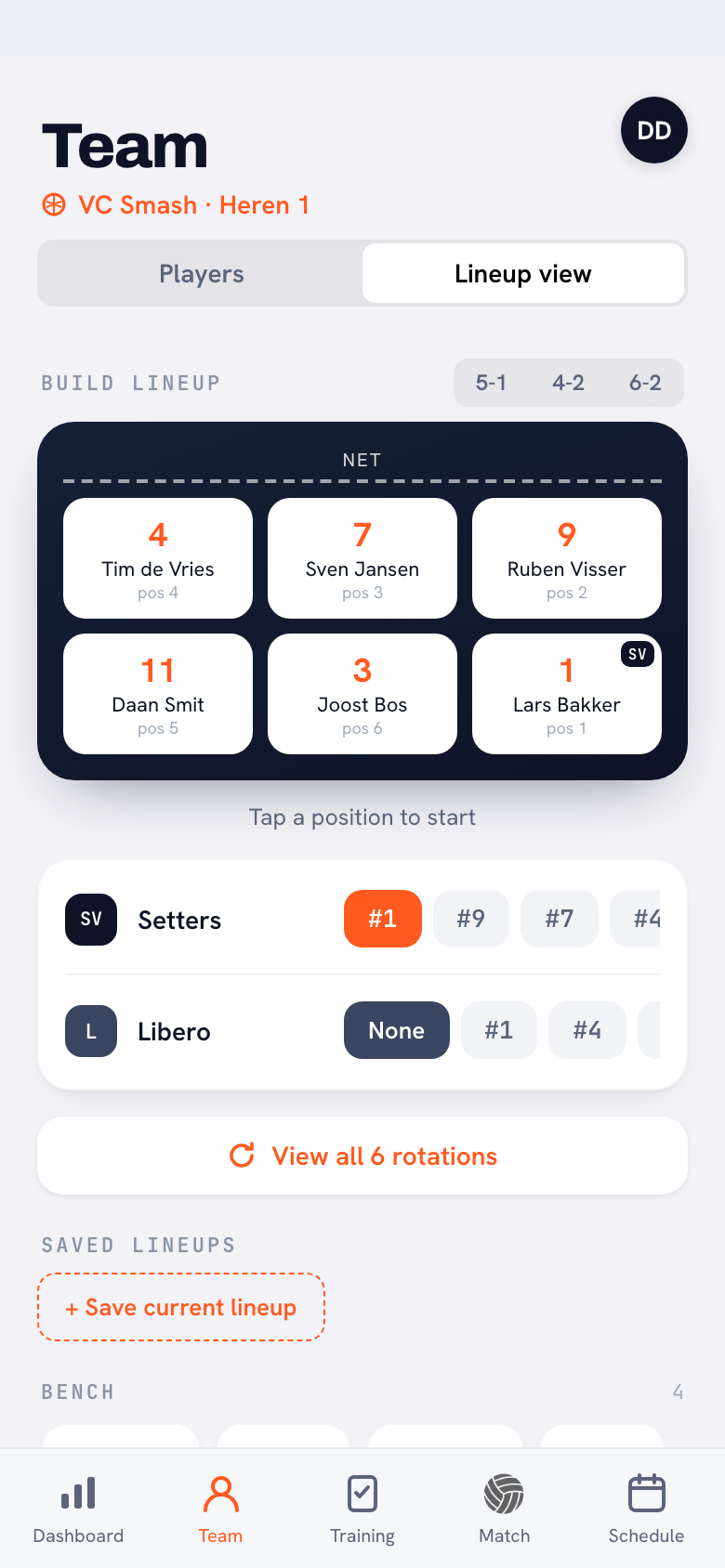
The big advantage: this lineup is your instant starting point for tracking the match live. The app knows who stands where, who serves and how the rotation works.
Substituting during the match
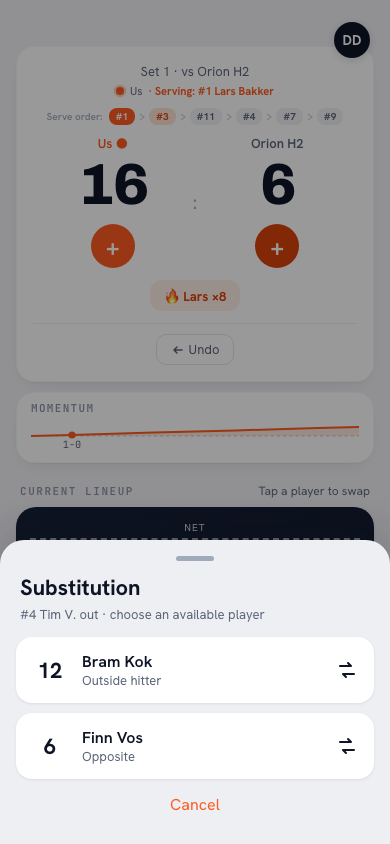
Making a substitution has to be faster than the referee's whistle. Tap the outgoing player on the live screen and the app shows only the available substitutes with their position. Two taps, and your statistics keep running — for the substitute too.
Three tips for your starting lineup
- Start with your best rotation. Arrange the lineup so your strongest attacking rotation comes up as often as possible in a set.
- Think about the serving order. Your best server early in the rotation means more serving turns per set.
- Look at the opponent. Put your best blocker opposite their best attacker where possible.
Frequently asked questions
What is the difference between a 5-1 and a 4-2?
In a 5-1, one dedicated setter plays every rotation; in a 4-2, two setters play and whoever is in the front row sets. A 5-1 gives more attacking power and consistency, a 4-2 is simpler and well suited to youth and recreational teams.
Which positions are there in a volleyball lineup?
Six: position 1 (right back, serves), 2 (right front), 3 (middle front), 4 (left front), 5 (left back) and 6 (middle back). When the team wins the serve back, everyone rotates one spot clockwise.
When should I choose a 4-2?
When you do not have a clear-cut first setter, your team is still learning to rotate, or you want to give two setters playing time. Switch to a 5-1 once one setter stands out.
 Tracking a volleyball match live: scores and per-player statistics
 Tracking attendance at volleyball practice without the hassle
 Volleyball lineup app: 5-1, 4-2 and 6-2 rotations, subs and libero on your phone
 From paper lineup card to digital lineup
 Share your volleyball lineup with players before the match
Try it yourself in Koach
Less admin, more coaching.
Get started with KoachOr read first what the volleyball coaching app does.