
“I thought I was sharing playing time fairly, until I added it up”
Volleyball coach Dennis Boekhout spent a season holding his instinct about substitutions up against the count in rallies and sets, and came off badly.
Ask a coach whether they share playing time fairly and the answer is almost always yes. Dennis Boekhout thought so too, until he laid a whole season of his own matches side by side. The order that came out was not the order in his head, and the gap leaned the same way every single time.
A conversation about counting in rallies rather than minutes, about the player who only comes on in lost sets, and about the line between sharing the court and simply putting your best six on it.
You say a coach’s instinct is usually off. How did you find that out yourself?
“By writing it down once. At the end of a season I had every match in front of me, and for fun I wrote out my own ranking first: who played the most this year, who played the least. Only then did I look at the count.”
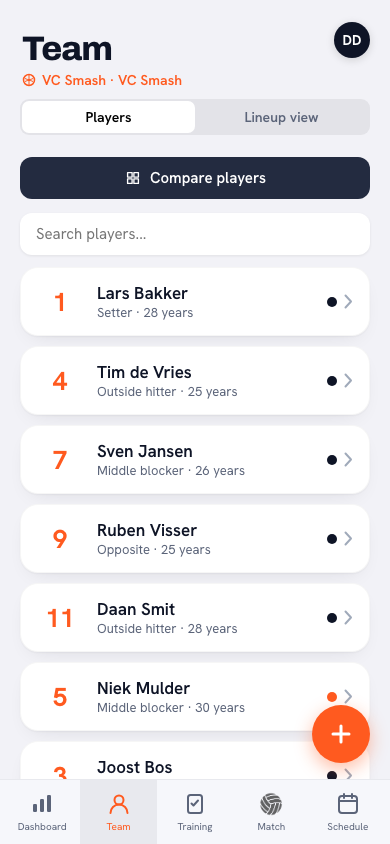
“Top and bottom were right. The middle was not. The player I had put fifth was actually eighth. Those are not dramatic numbers, but that is exactly the kind of player you lose if you never do anything about it.”
Which way did that gap lean?
“Always the same way. I consistently overestimated how much a substitute had played and underestimated how much a starter had played. I think that is because you remember the decision, not the duration. I know exactly that I put someone on. I do not remember that it was at 21-14.”
“A substitution at 21-14 is five rallies. In your head it is ‘he got some court time’. On paper it is almost nothing.”
Why does Koach count playing time in rallies and sets instead of minutes?
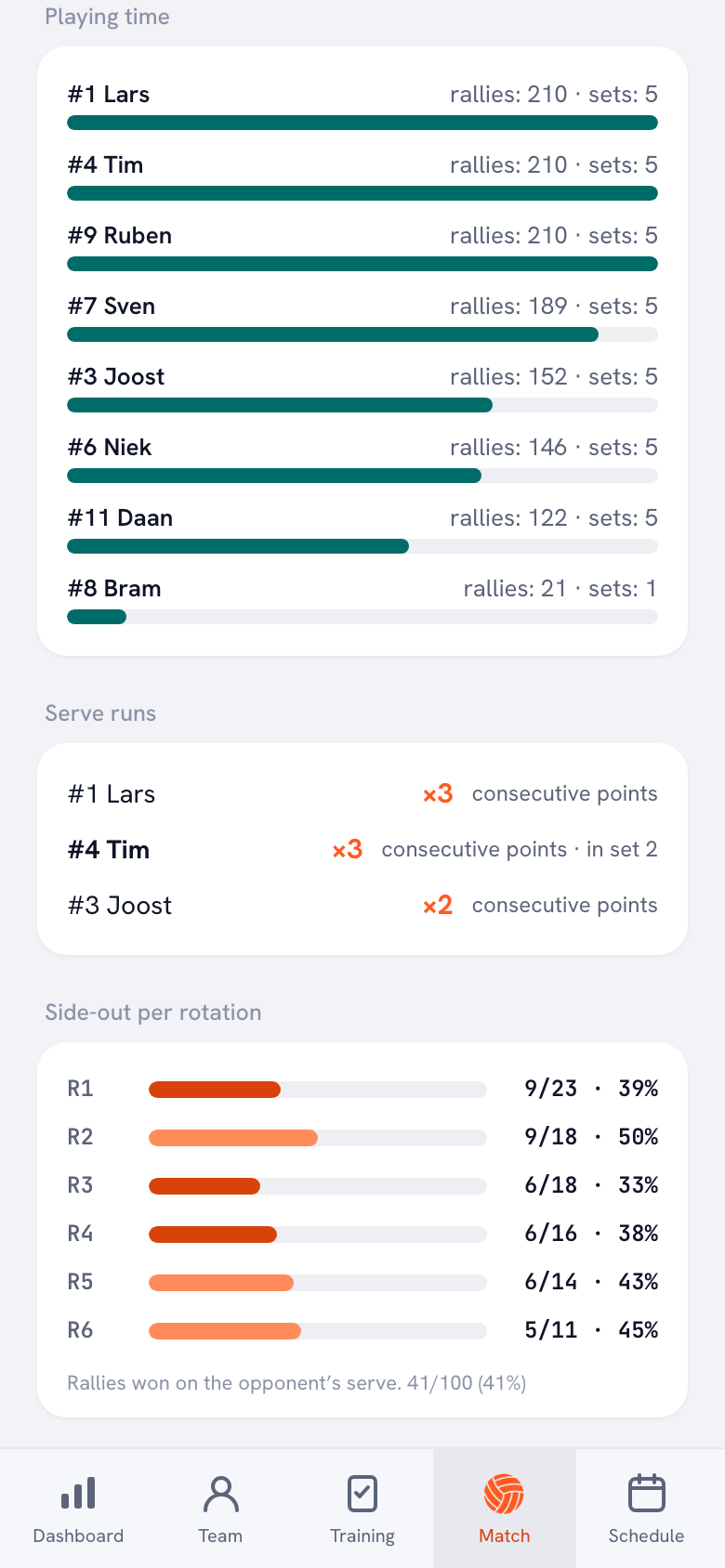
“Because volleyball has no clock. A set can be 25-12 and over in fifteen minutes, or 31-29 and take half an hour. Minutes tell you nothing about how much ball someone actually got. Every rally a player is on court counts as one for him. And a set counts for him the moment he was on for at least one rally in it.”
“That is also how you experience it as a coach. You do not think in minutes, you think in balls. Both numbers sit in the list, because rallies on their own would hide how the sets were split.”
And the player who mostly comes on in sets you are losing?
“That is the most lopsided case of all, and you never see it coming. A set you lose 25-12 is 37 rallies. A set you win 27-25 is 52. If you mainly bring someone on when it has gone already, his name will sit there with a tidy ‘sets: 2’ next to it while he got a fraction of the ball of someone with those same two sets.”
“That is why the two stand next to each other. I would not trust sets on their own. Nor rallies on their own, because then you cannot see whether someone came on briefly five times or filled one complete set.”
And across a whole season?
“Then your home screen shows Playing time this season, with the lowest at the top. That was deliberate: the names you need are at the bottom of a list like that, so I put them at the top. The first two get a small tag saying start first? That is not an instruction, it is a reminder for Saturday.”
“Underneath the list it says how many matches it was measured in, and that number matters more than it looks. There is a hole in it: if you handed the scoring over to someone on the bench, that match has no court tracking, so it does not count towards playing time. Then the split looks more lopsided, or fairer, than it really was. I would rather say that out loud than paper over it.”
During the match, can you see who has not been on yet?
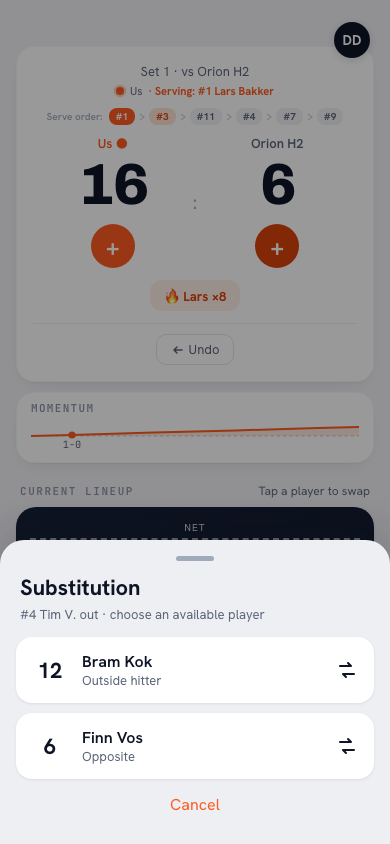
“No. And I am not going to dance around that: the substitution sheet shows who is available, with shirt number and position, and nothing else. No bars, no count of who has played least.”
“I do not regret it either, though I understand the question. At 21-14 I do not want to be reading a table. The fairness conversation belongs on a Friday evening, not on the bench with one point to go. What is on that sheet is the substitution counter — six per set, and at six it stops.”
So what is the cheapest moment to give someone court time?
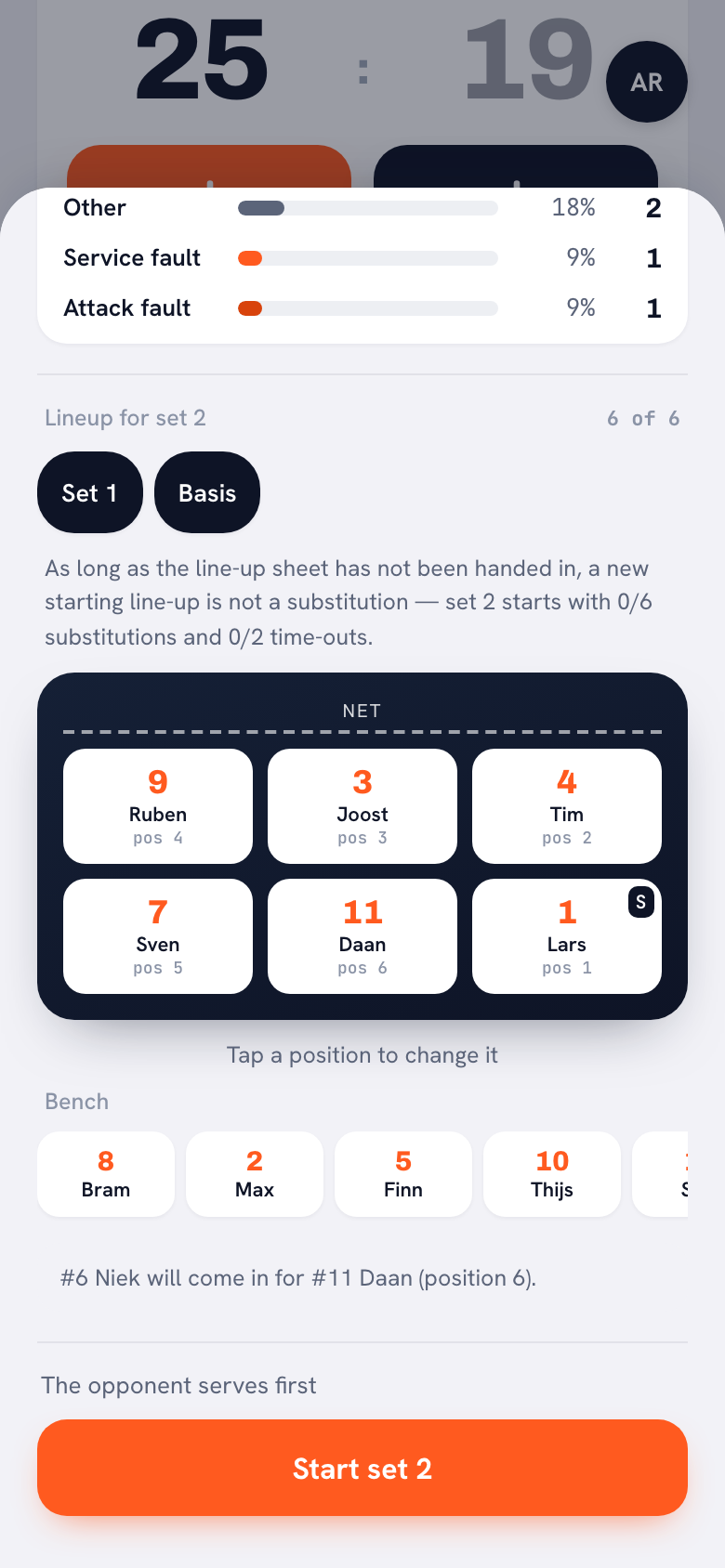
“The start of a set. As long as the line-up sheet has not been handed in, a new starting line-up is not a substitution — that set simply begins at nought of your six again. The set break says so in as many words, because I kept forgetting it myself.”
“Someone who starts a set plays twenty-odd rallies no matter what. Someone you bring on halfway has to take what is left. If you really want to share the bench out, share out starting spots, not substitutions.”
Where is the line for you between sharing court time and picking your best six?
“It sits in a different place every match, and it will stay that way. In youth volleyball, playing time is part of the development; nobody improves sitting on a bench. But in a fifth set that matters I put out the six that give us the best chance, and they know that in advance.”
“What I do not want is the app making that call for me. There is no fairness score anywhere and no warning pops up. It only says: this is what happened. What you do with that is coaching.”
Has the counting changed the way you coach?
“It changed the way I prepare more than anything. I now look at that list on Friday and decide who starts on Saturday, instead of working out mid-match who I still have to fit in. That saves me a lot of fretting on the bench, and it saves the players a lot of guessing.”
And when a player asks you about it?
“Then I show them. That is the whole difference with a year ago, when all I had was ‘I feel like you are playing enough’. A player with their own account sees their own playing time on their profile, but not their team-mates’. That is deliberate — otherwise it turns into a league table in the group chat.”
“The conversation got easier too. Not because the numbers prove him right, often they prove me right, but because we are both looking at the same sheet of paper.”
Finally: what would you tell a coach who wants to start tracking this?
“Change nothing for the first three matches. Just count. The temptation to straighten things out after one match is huge, but one match tells you nothing — there is an injury in there, a 25-12, somebody who turned up late. Only after three or so does a pattern appear, and only then is it worth letting it correct your instinct.”
Know who is playing too little
Koach counts playing time per rally and per set as soon as you score a match live. After three matches or so, your home screen shows you who is falling behind.
Try Koach free