
Illegal Substitution in Volleyball: How the Mistake Happens
You raise the substitution paddle, the second referee shakes their head, and at that moment you don't know two things: whether you have lost count or whether it is about the pairing. Coaches call that an illegal substitution in volleyball, and there are two that you as the coach cause yourself: the seventh substitution and the return substitution for the wrong starter. Six substitutions per set is plenty — until you are halfway through the fourth set dealing with cramp, an off day and a tactical plan all at once. This piece shows how those two faults happen, why the return substitution is the trickiest, and how to get your count back halfway through a set.
Illegal substitution in volleyball: the two you cause yourself
Most playing faults are made by players. These two are not. They happen on the bench, during a break in play, with all the time in the world — and that is exactly why they can be prevented.
The seventh substitution. You have had six and request one more. That is not a borderline case and not a matter of interpretation: it is refused. Usually because you had lost count, not because you were deliberately taking a risk.
The wrong return substitution. A player who has been off comes back for someone other than the player who replaced them. This is the trickier of the two, because the counter is nowhere near six and so it feels as if nothing is wrong. Yet this is the fault behind most refused substitutions.
What happens in both cases starts the same way: the substitution does not go ahead and the referee records the request. Whether a delay sanction follows straight away depends on the moment and on how often it has already happened to your team; if an illegal substitution is only discovered after play has continued, the consequence is heavier. Exactly what that costs differs per federation — it is in the regulations of your own competition, not in a general article. Do count on it costing at least time, attention and a break in play at a moment you could not afford one.
Both faults are about how you use your substitutions, not about how many you have. How many substitutions you may make per set, what happens to the rotation and how to think in pairs before the match is in the substitution rules with the maximum per set. Below it is only about what goes wrong.
Why the pairing is the cause behind almost every refused substitution
As soon as you substitute a player, a pairing is created. Starter A goes off, bench player B comes on. From that moment the two belong together for the rest of the set: A may only come back for B, and B may only make way for A. After that the pairing is closed and neither of them can be used for a substitution again this set.
An example from a set you will probably recognise. Your outside hitter passes badly twice and comes off; the bench player comes on instead. That is substitution one. Five points later things are going well again, you want your regular hitter back, so you swap them round. That is substitution two, and the pairing is now closed. At 20-20 you would really like to bring that bench player on again for your other outside hitter — and you can't. That player has already been on court this set, and only for that one player.
Two things make this so stubborn. At that moment you still have four substitutions left, so your counter does not warn you. And on the bench you only see people sitting, not pairings: who has already been on is not written on their shirt.
The same pairing holds a second trap. Once your starter has come back, you cannot substitute them again this set — not for a different bench player either, and apart from an injury not to give them a breather. Anyone who wants to bring their regular hitter to the bench once more at 22-20 runs into that.
The pairing system is the international rule. Competitions that allow more substitutions per set sometimes also differ in who may come back for whom; check that once in the regulations of your own competition. If you want to use two pairings at once around the setter, that is the double substitution, with exactly the same rule underneath.
What you mainly need to know here: no app guards this for you. The counter can stop the seventh substitution, but whether player A comes back for the right player is something you or someone on your bench keeps an eye on.
Write down the pairing, not the number. Four tally marks on your card only tell you that you have had four. Four lines with two names — 'Maya on for Lucy' — tell you at 22-22 exactly what you want to know then: how many you have left, and who can still be used.
Lost count halfway through the set: three ways to get it back
It happens in a long set: you no longer know whether you are on four or five. Arguing with your memory gets you nowhere. There are three ways to get out of it quickly, and all three are better than guessing.
- Ask the table. The scorer at the officials' table is and remains decisive, even if you think otherwise. At the next break in play, have it calmly checked with the second referee; under FIVB rules your game captain does that. It takes a few seconds and it is the only source that counts if there is a dispute.
- Reconstruct it from your own card. If you record every substitution as two names instead of a tally mark, the answer is already there. Go from top to bottom, count the lines and immediately see which pairs are closed.
- Read it off if you score live. If you track the match in an app that counts substitutions, the count is already there. That is the cheapest of the three, because you don't have to do anything extra for it — provided you entered every substitution.
What you should not do is reconstruct the count during a rally. You are then not watching the game, and the substitution you request afterwards often comes too late or at the wrong moment. When you substitute at all, and why, is a separate consideration — it is in choosing the moment to substitute during the match.
The substitution watch on the bench
For the libero it works well to have one player on the bench check whether the replacement is right. For ordinary substitutions exactly the same solution works, and it costs you nothing.
Give one person on the bench the substitution watch. That is usually the player who is not playing this set, an injured player who is watching anyway, or your assistant coach. Their task consists of three things:
- They record every pairing the moment it is created, with two names and nothing more.
- They say the number out loud as soon as you want to request a substitution: "this is number four." That way you hear it before the second referee has to say anything.
- They check the return substitution — the one thing they are really there for. If you want a player back, they check whether it is the right pair.
One extra agreement makes the difference: they are allowed to interrupt you. A substitution watch who politely waits until you have finished talking is not a substitution watch. At the start of every set they begin with a clean list, because both the counter and the pairings start again each set.
If your libero also works with a watch like that, you can give both tasks to one person, as long as they know the difference: the libero replacement does not count towards the six. How exactly that works is in the libero replacement and its own rules.
Your substitution is refused: what you do at that moment
It happens, and then the only question is how much it costs you. Don't push. The second referee is not negotiating, and every second you spend talking about it turns a refused substitution into a delay of the game.
Send the player back to the bench, have the lineup put right and play on. At the next break in play, have your game captain calmly check what the table has counted or which pairing is recorded — not to argue, but to get the rest of the set straight again. If you are wrong, from that moment you know exactly how many you have left. If you are right, it can be sorted out after the match, not during it.
Afterwards, put your own notes next to the scoresheet. Not to prove you were right, but because it shows you straight away where it went wrong: in the count or in the pairing. That is the only information that lets you do it differently at the next match.
One exception belongs here: if it concerns an injured player and your substitutions are used up, different rules apply. They are in the rules around an injured player during the match. And if you want the full picture, the rest of the rules of the game are in the overview of volleyball rules.
What Koach counts and blocks — and what it doesn't
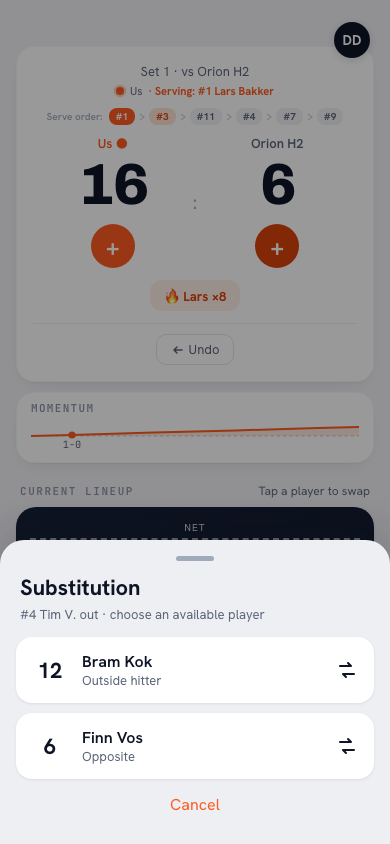
If you score the match live in Koach and enter every substitution, the app stops the first of the two faults. It counts the substitutions per set and blocks the seventh: if you pick a substitute when you have already had six, the substitution does not go through and you only get the message that you have already made six substitutions this set. The count is always visible: at the top of the substitution sheet, next to the title, you see how many substitutions you have used this set, and that counter turns red once it is full. The time-out button works the same way for your two time-outs. Libero replacements are explicitly filtered out of that count, because under the rules they are not substitutions. If you make a mistake, you reverse a substitution with 'Undo'. How to enter a substitution in two taps is in entering a substitution during the match.
Just as important is what the app does not do. It does not check the return substitution: that player A may only come back for the player who replaced them is something you guard yourself or with your substitution watch. The counter is fixed at six and so does not suit competitions that allow more substitutions. And it only counts what you enter — miss one and the number is no longer right, and the counter at the officials' table remains decisive in any case. So the app prevents exactly one of the two faults in this article, and it is the easier of the two.
If you want to remove that one fault from your matches: enter the substitutions live at your next match, and the counter on the substitution sheet keeps up automatically and the seventh substitution will not get through. You keep track of the pairings with your substitution watch. You can try Koach free for 14 days.
Frequently asked questions
What is an illegal substitution in volleyball?
An illegal substitution is a substitution that is not allowed under the rules. The two a coach causes themselves are the seventh substitution in a set and the return substitution for the wrong player. In both cases the substitution does not go ahead and the referee records the request. Whether a delay sanction follows and how heavy it is depends on the moment, on repetition and on the regulations of your own competition.
What happens if you request a seventh substitution?
The substitution is refused and you play on with the players on court. The referee records the request; whether a sanction follows straight away and how heavy it becomes on repetition is determined by the regulations of your competition. So it is not a substitution that 'just fails': at the very least it costs you a break in play at a moment you had not planned one.
Can a player come back for a different player than the one who replaced them?
No. As soon as a player is substituted, a pairing of two is created: the starter and their replacement. The starter may only come back for that same replacement, and after that the pairing is closed for the rest of the set. This is the reason behind most refused substitutions, precisely because at that moment you often still have substitutions left.
Does an app keep track of the maximum of six substitutions?
Koach counts the substitutions per set and blocks the seventh with a message; libero replacements are not included in the count. Two limits come with it: the app does not check whether your return substitution is the right pairing, and the counter is fixed at six, so it does not suit competitions that allow more substitutions. It also only counts what you enter — the counter at the officials' table remains decisive.
How do I know halfway through a set how many substitutions I have made?
There are three reliable ways. Have your game captain check with the second referee at the next break in play, because the count at the table is decisive. Record every substitution as two names on your card, so you see the number and the pairings at a glance. Or read off the count if you track the match live digitally.


Try it yourself in Koach
Less admin, more coaching.
Get started with KoachOr read first what the volleyball coaching app does.