
Volleyball substitution chart: fair playing time, with an example
The short answer
You set up a volleyball substitution chart before the match: who starts each set and who comes in at a fixed moment, within fixed pairs of players for the same position. Rotate per set who plays the whole set and who plays half. Stay under six subs per set and check afterwards, in rallies, whether it turned out fair.
You don't make a volleyball substitution chart in the gym but at the kitchen table. Then you know in advance who plays when, you stay within the substitution rules and nobody has to guess whether they'll get in this set. Below: the rules, how to build one and a checked example.
Why a substitution chart?
If you sub on feel, you put out your strongest six and wait for a quiet moment that never comes. The bench players then go in at 22-15, for a handful of rallies. You remember that you put them in; you don't remember that it was three balls. A chart moves that decision forward, to a moment when you can calmly do the maths.
A chart also makes your choices explainable. Whether everyone should play exactly the same amount is another question: on a competitive team the split may be uneven, as long as you say beforehand why. That's what distributing playing time fairly is about. This article is about the chart itself, for teams where everyone plays roughly the same amount.
Which substitution rules does your chart have to follow?
- Six subs per set. Under rule 15.1 of the FIVB rules, each team has two timeouts and six substitutions per set.
- Fixed pairs. Rule 15.6: a starter may leave the game once per set and come back once, only in their own position. A substitute comes in once per set and can only be replaced by the same starter. That's why you build a chart on pairs.
- A new set is not a sub. Before each set you hand in a new starting lineup (rule 7.3.2). Whoever sat on the bench last set can simply start.
- Youth leagues sometimes have their own rules. In Volley Stars, the mini-volleyball of the Dutch federation Nevobo, everyone plays the same amount is on the rule card. In the mini-volleyball of the school competition in Valladolid (Spain), every player on the score sheet has to be on court for at least 25 points (of both teams combined), or you lose the match, and there are eight subs per set (rulebook). In the youth league of Saratoga Springs in the United States, every player plays at least half of every match (Youth Volleyball Rules). In the Brushy Creek Youth Volleyball League, also in the United States, every non-injured player who is present has to be part of the lineup rotation (league rules). All four checked on 23 October 2026.
Rules like these differ per country and per league, so check your own rulebook. The general substitution rules are in how many subs in volleyball.
How to build a substitution chart in four steps
- Make pairs. Two players who can play the same position. You only sub within a pair, so you never run into rule 15.6.
- Choose a fixed sub moment. For example as soon as one of the two teams reaches 13 points; in a set to 15, at 8 points. It's rarely exactly half the rallies, but a fixed moment is one you won't forget.
- Divide per set. Who plays the whole set, who the first half, who the second?
- Rotate the roles. Whoever played the first half this set plays the second half next time. That way it's not always the same player on court for the end of the set.
Example: a substitution chart for 10 players
Ten players, six positions. Make five pairs: 1 and 2, 3 and 4, 5 and 6, 7 and 8, 9 and 10. Each set, one pair plays the whole set together. The other four pairs each share one position: one starts, the other comes in at the sub moment.
| Set | Whole set | First half | Second half |
|---|---|---|---|
| 1 | 1, 2 | 3, 5, 7, 9 | 4, 6, 8, 10 |
| 2 | 3, 4 | 1, 6, 8, 10 | 2, 5, 7, 9 |
| 3 | 5, 6 | 2, 4, 7, 9 | 1, 3, 8, 10 |
| 4 | 7, 8 | 1, 3, 5, 10 | 2, 4, 6, 9 |
| 5 | 9, 10 | 2, 4, 6, 8 | 1, 3, 5, 7 |
At the sub moment you sub within the pair. In set 1, 4 comes in for 3, 6 for 5, 8 for 7 and 10 for 9; in set 2, 2 comes in for 1, 5 for 6, 7 for 8 and 9 for 10.
- Subs. Four per set. That leaves two for an injury or a tactical sub.
- Playing time. After five sets everyone has played exactly three sets: one whole set and four halves. And everyone played a second half twice, plus the end of their whole set.
- A four-set match. Then it can't be exactly equal: four sets of six positions is 24 set slots, and 24 divided by 10 is 2.4. After set 4, players 1 through 8 have played two and a half sets and 9 and 10 two. So start the next match at set 5 of the chart; then 9 and 10 play a whole set first.
One condition: a pair that plays the whole set together is on court at the same time. That works with two outside hitters or two middles, and in youth volleyball with players who still play everywhere. If you only have one setter position, as in a 5-1, let the setter pair share every set and divide the whole sets over the other four pairs. After four sets each setter has then played two sets and every other player two and a half, still with four subs per set. If you have seven, eight or nine players, use the chart in volleyball rotation with 8 players.
Running the substitution chart in Koach
Koach doesn't make the chart for you: you decide who plays when. The app does help you stick to it.
- Beforehand. Set out the starting lineup of each set in Team > Lineups and save it under Saved lineups with Save current, for example as Set 1 through Set 5. Plan set 1 at the match with Plan lineup; then your players can also see in advance who starts (see sharing the lineup with your players).
- During the set. At the sub moment, tap the player who's coming off on the live screen. The Sub for sheet shows the bench sorted by sign-up and counts your subs, for example 4/6. If a sub breaks rule 15.6, the app asks Is this substitution allowed?, and on a seventh it says You have already made 6 substitutions this set. Step by step it's in entering a substitution during the match.
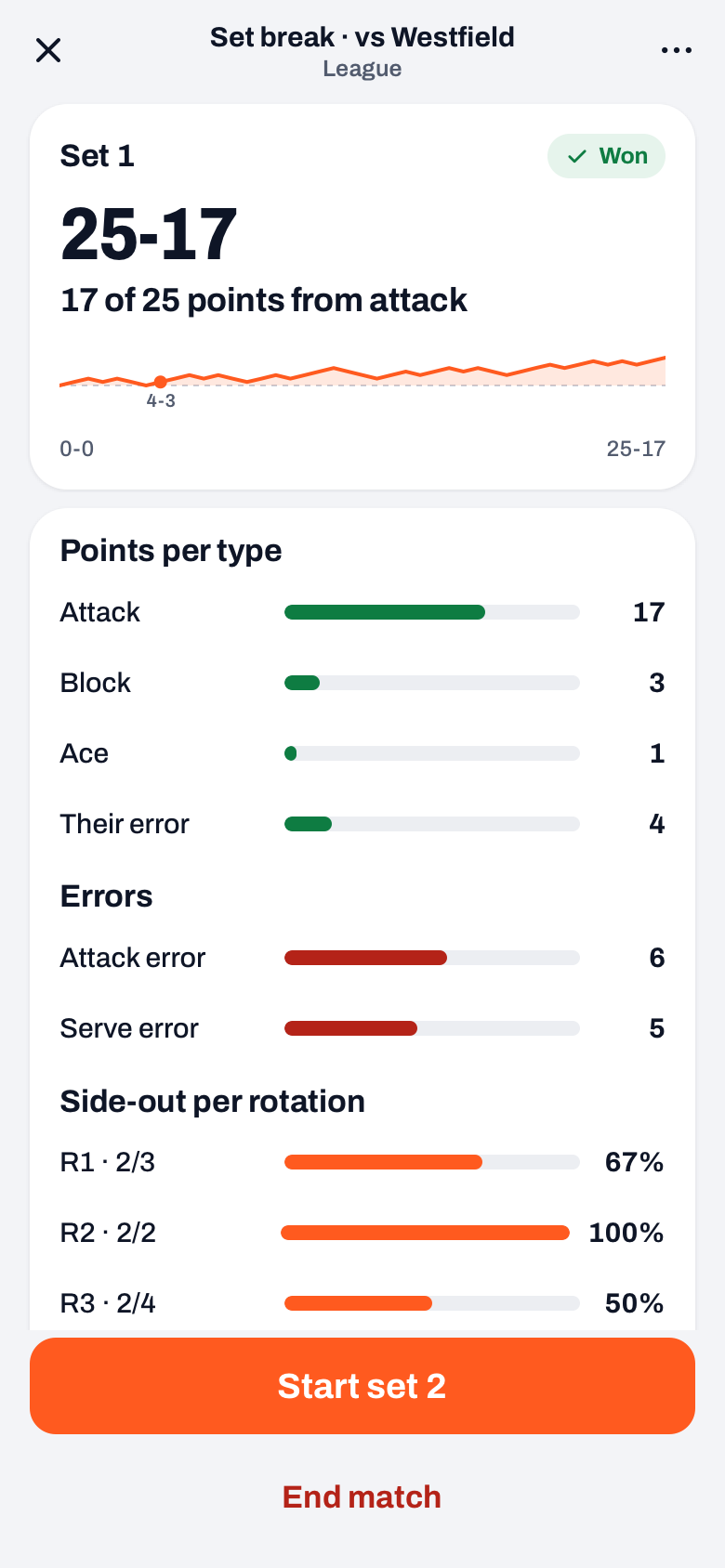
- In the set break. After each set the set break opens with Lineup set 2 (or 3, 4, 5). Above the court are buttons with the lineups of earlier sets and your saved lineups. One tap and your chart for the next set is ready, and that doesn't count as a sub.
14 days free, no credit card. Set up your chart as saved lineups and see after the match how many rallies everyone really played.
Try the substitution chart in KoachSeeing afterwards whether playing time was fair
A chart is a plan. Whether it turned out that way you only see after the match, because a 25-23 set has different halves than a 25-12 set. That's why Koach counts playing time in rallies: every rally a player is on court counts as one for them. In the played match, under Players, there's the Playing time block, with each player's rallies and sets, a line about who played the least (with their rallies out of the total) and the best plus/minus.
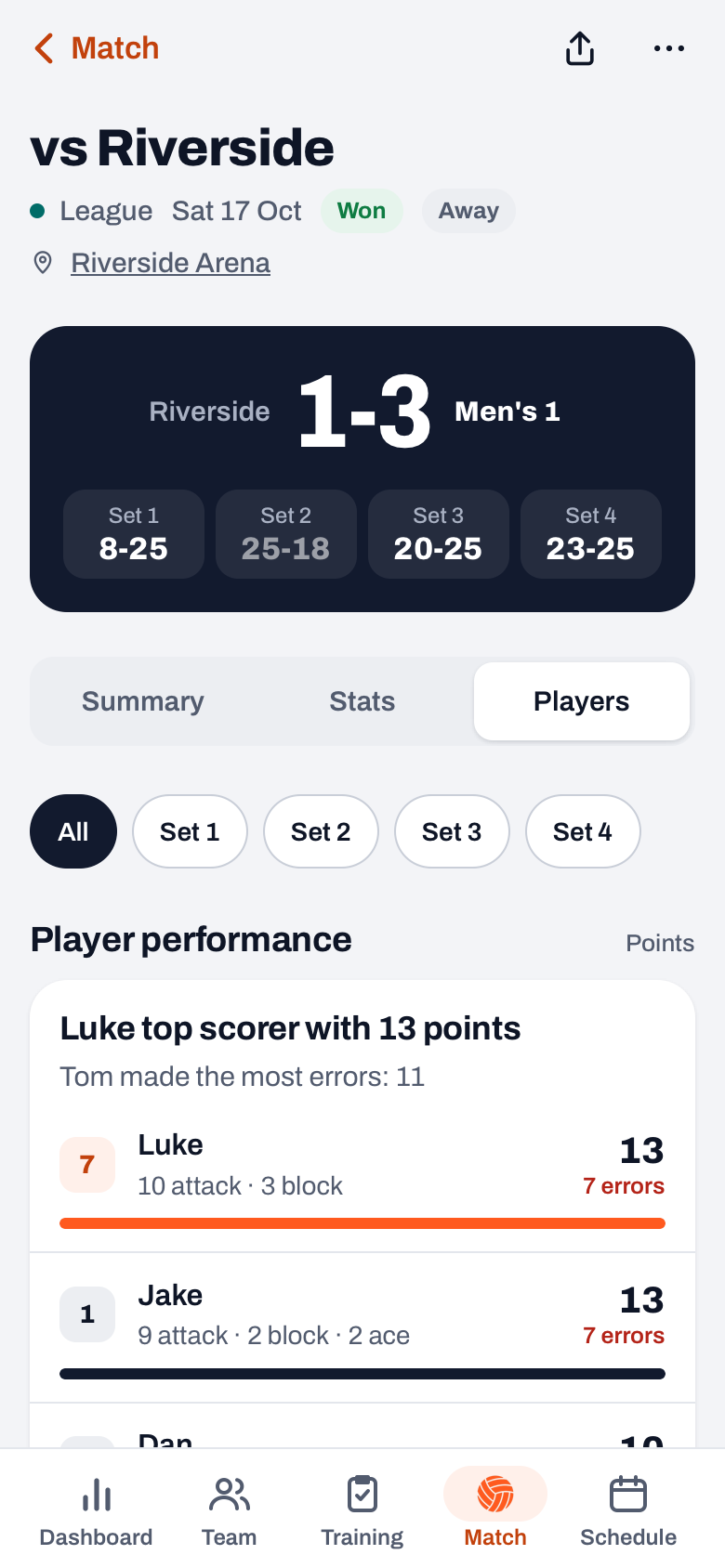
Playing time only counts for matches you track live, and the libero counts too: when they come in for a middle, they get those rallies. Over the whole season, the dashboard shows who plays the least, and in All season insights, under Playing time, those players are marked Start first?. How that meter works is in tracking playing time. What Koach costs after the 14 free days is on the pricing page.
Let the bench guard the sub moment. Agree that the subs stand up at 12 points and come and stand next to you. Then you won't forget the sub when it gets tight, and your bench knows the chart applies, even when the score is close.
Frequently asked questions
How many subs are allowed per set in volleyball?
Under the FIVB rules, six per set, alongside two timeouts. A new starting lineup at the start of a set doesn't count as a sub. A replacement between the libero and a court player doesn't count either. Some youth leagues allow more, such as the mini-volleyball in Valladolid with eight subs per set; so check the rulebook of your own league.
How do you make a substitution chart for 10 players?
Make five pairs of two players for the same position. Each set, one pair plays the whole set together, and the other four pairs each share one position: one starts, the other comes in halfway. That way you use four subs per set, and after five sets everyone has played exactly three sets. In a four-set match, carry on at set 5 next time.
Does everyone have to play the same amount in youth volleyball?
That differs per league. The rule card of Volley Stars, the Dutch federation's mini-volleyball, says everyone plays the same amount, in Valladolid every kid has to be on court for at least 25 points, and in Saratoga Springs (United States) everyone plays at least half of the match. Many leagues say nothing about it; then it's an agreement within the club or your own as the coach. Set that agreement at the start of the season.
Does Koach make the substitution chart for me?
No. You come up with the chart yourself. Koach helps you run it: saved lineups per set, the sub counter, the warning on a sub that breaks the rules and the playing time in rallies afterwards. You can try the app free for 14 days, with no credit card; after that, Coach costs €2.99 per month for one team. The player account is free.


Set up your substitution chart in Koach
14 days free, no credit card. After one match you'll see whether everyone really played.
Get started with KoachOr read first what the volleyball coaching app does.