
Volleyball club handbook: what goes in and who keeps it current
Nearly every club has a handbook, and at nearly every club it sits on a drive three people know how to find. It was written in an enthusiastic summer, runs to forty pages and is never opened again — not even by the new team parent standing in front of a locked hall door at eight on a Saturday morning. The problem is not that clubs write too little down. The problem is that they write the wrong things down, in a place nobody looks at the moment it is needed.
A forty-page handbook solves nothing
A club handbook is not read the way a book is read. It is consulted in the ninety seconds before somebody has to do something: the bar volunteer who cannot get the till working at quarter to eight, the stand-in scorer who does not know where the match sheet is, the coach facing an injury and looking for where the first aid kit hangs. If the answer is not within two screens, that person calls somebody anyway — and the handbook has served no purpose at all.
That is where the most important design rule comes from: every section answers one question and fits on one page, about 250 words. Anything longer is not a chapter but an appendix. A forty-page handbook is rarely more thorough than a twelve-page one; it just contains more text making the answer that did matter impossible to find.
Another distinction: a handbook does not describe policy but actions. Policy belongs in a policy plan; a handbook says who you call, where something is kept, what you may decide yourself and how quickly you will get an answer.
Start with the questions, not with the chapters
The fastest way to know what belongs in it is to look backwards. Scroll twelve months back through the committee mailbox and the club chat and note every question that was asked at least twice. At most clubs a surprisingly short list remains, and those questions are your table of contents. Anything you cannot think of a matching question for is a chapter for nobody — leave it out.
That approach has a pleasant side effect: you write in the language of the person asking. Not "Equipment management protocol, article 3", but "A net is broken. Now what?". Somebody looking for something searches on their own question, not on your heading.
The nine sections that always belong in it
These nine subjects come back at every club. Behind each one is the question it answers — write that question literally as the heading above the section.
- Roles and points of contact — "Who do I need?" Per subject a name, a phone number or email address, the hours that person is reachable, and one sentence on what they do and do not decide. Hard rule: if a subject has no name against it, that subject belongs to nobody and sooner or later it goes wrong. Who decides on team selection, who breaks the tie when two coaches want the same player, who calls an angry parent back.
- Hall, keys and times — "How do I get in and when do I have to be out?" Who has a key or code, how you get one, who does the final round, and the number you call when the door is locked and twenty children are standing there. Do not put the hall schedule itself in as a table — it changes too often; point to the place where the current schedule lives.
- Equipment — "Where are the balls and what if something is broken?" Which store room, which cart belongs to which group, what is the club's and what is a team's, who reorders, and how you report damage. Add how many days a report takes to be picked up; without a deadline, reporting has become optional.
- Scorer's table and referee — "I'm scoring on Saturday, what time do I need to be there and what do I do?" Start time minus how many minutes, where the match sheet or tablet is, who the first referee is and what you do if they do not turn up. Which qualification is required at which level and which form applies differs by federation — so do not put rules there but a link to your own federation's page, plus the name of the person who arranges it at your club.
- Bar and hall duty — "What is expected of me and how do I swap?" Start time, finish time, what you open and close, how the till or payment system works, and above all: how you swap a shift and with whom you arrange it. A swap procedure that only runs through the committee guarantees empty shifts. If your rota runs in the app, this section should point to the bar duty rota instead of holding a second list that goes stale.
- Expenses and reimbursements — "I paid for something myself, how do I get it back?" Who you send it to, with what proof, within what deadline, and what is and is not reimbursed: travel, referee fees, a course, equipment you bought yourself. One payment route, not three. What is allowed tax-free as a volunteer payment differs by country and changes almost every year — so never put an amount in the handbook without the year next to it, and point to your federation or tax authority for the current limit.
- Code of conduct and safeguarding — "What do I do if I see something that isn't right?" The behaviour rules in ten sentences at most, who the confidential contact person is and how to reach them without going through the committee first, and what screening your club asks of anyone working with members. Whether a criminal record check is compulsory and how you apply for one differs by country and by federation: describe what you require and where the application runs, not what the law says somewhere else.
- When something goes wrong — "It's Saturday morning and something has happened, who do I call?" Three scenarios is enough: cancellation, injury and incident. Three lines per scenario: who decides, who informs whom, and what you record afterwards. For an injury, add where the first aid kit and the defibrillator are, who is trained, and when you call the emergency number straight away. Anyone who still has to arrange the cancellation and the communication at team level will find the runbook in calling off a match or a session.
- Communication channels — "Where does this kind of information normally live?" Which channel for what: the calendar is authoritative for times and locations, one club channel for club-wide messages, the team app for the day-to-day, email for anything you need to find again later. Add who is allowed to send something club-wide; three people mailing all members without coordinating is the fastest way to make sure nobody reads anything.
The format: one source, and one page per role
Should the handbook be one document or a stack of separate instructions? Both, but not side by side. There is one source — one document or one page, on one link, that is always right. Out of that you cut one page per role, and that page is what people actually receive.
Four or five role pages cover everything at most clubs: coach, team parent or team manager, scorer's table, bar duty and fixtures secretary. The page for a coach contains exactly this, for example:
- Your session time, your part of the hall and the moment you have to be off the floor.
- How you get in and who locks up.
- Where your ball cart is and what you tidy away afterwards.
- The number you call if the hall is locked.
- How and through which channel you cancel a session, and the latest time you can do it.
- What to do with an injury: where the kit hangs, who is trained, when you call the emergency number.
- What you decide yourself (drills, line-up, substitution policy within your team) and what you do not (team selection, extra hall hours, taking a player from another team).
- Who your point of contact is and when they are reachable.
Eight lines. That fits on one side, hangs in the hall and goes into the coaches' chat as a photo. Everything else a coach needs is about their own team and not about the club — that is what the team agreements they make with their own group are for.
The onboarding page for a new volunteer
This is the handbook's most important application: somebody who says yes today should be able to start within ten minutes. In those ten minutes a new volunteer needs five things, in this order: what is my job (in one sentence, not in a role profile), who is my point of contact (name, number, availability), where is the kit, what may I decide myself and what do I do if something goes wrong. Leave out the fourth and nobody dares do anything; leave out the fifth and somebody calls you on Saturday morning.
Always attach one name to it. A document recruits nobody and keeps nobody; a person does. Agree that the point of contact calls once in the first week with the same three questions: is it working, what did you run into, and what would you have wanted to know when you started. That last answer is free maintenance on your handbook — exactly the gap the previous volunteer quietly solved for themselves.
Update it the moment somebody asks a question
This is where most handbooks die. They are written once, celebrated once, and then go stale in silence: the phone number is wrong, the treasurer is somebody else, the hall times have shifted. Two rules prevent that.
Rule one: every section has one name and one date. At the top of each section it says "Last changed: 14 March — Marieke". One name, no committee: "the board" as owner means nobody in practice.
Rule two: a question that is not in the handbook gets added within 24 hours. Not at the end of the season, not on a list — straight after the answer, in two minutes. This is the only maintenance rule that survives in practice, because it hooks onto something that happens anyway: somebody asked a question and somebody answered it. A club that keeps this up for a season has a handbook by the end of May that covers exactly the questions people actually have, and nothing more.
The annual round still exists alongside it, but as a safety net, not as the main event. Schedule it in the month your teams for next season are put together — at many clubs April or May, but that depends on your federation's competition calendar. Ninety minutes is enough: go through all the names, numbers, times and amounts, and delete whatever nobody consulted in twelve months. Put it in the same week as the rest of your season preparation.
What it does not need: anything a system already keeps current
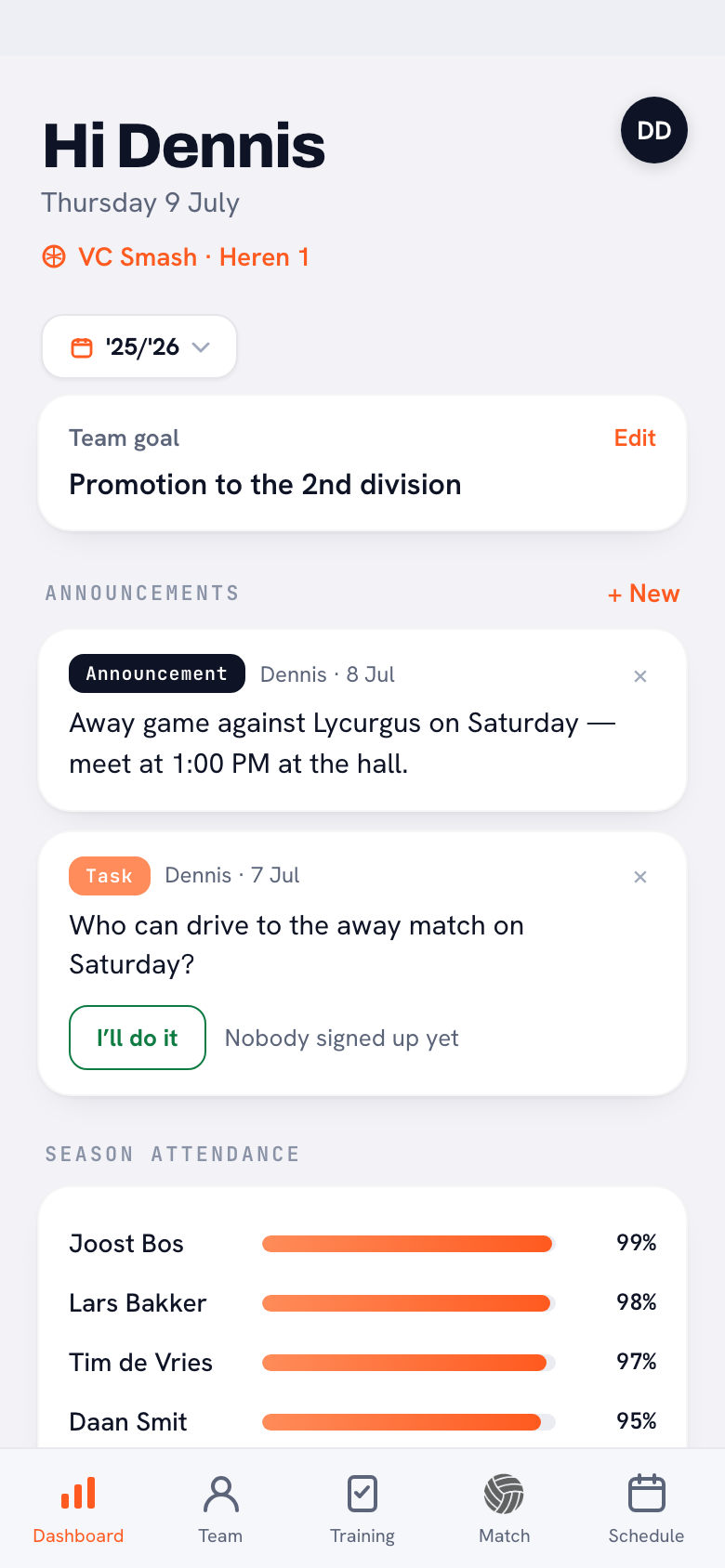
A handbook should be as short as possible, and the fastest way to keep it short is to leave out everything that is already automatically up to date somewhere else. Session times, fixtures, who is coming, who is driving, which drills a team uses, how a player is developing: that belongs in the calendar and the team admin, not in a text file somebody has to update by hand. In Koach those things sit with the team itself — how your teams sit under one club is arranged through linking a team to a club, and what you see and can set as an administrator is in managing your club. The handbook points there once and does not repeat the contents.
What is left is exactly what a handbook is for: the arrangements that live in no system at all. Keys, protocols, money flows, conduct rules, phone numbers, and the question of who decides what. That is usually ten to fifteen pages across nine sections — and not forty.
Where the handbook stops: one team's knowledge
One thing deliberately does not belong in it, however tempting: a specific coach's knowledge of their specific group. Who can cope at a second position, why number 12 nearly quit in November, which drills carry this team — that is not club information but team information, and you hand it to a successor instead of putting it in a club document where it will be wrong within a season. How to organise that handover is in handing over to a new coach; if several coaches work alongside each other on the same team, the same principle applies in a team with several coaches. The club handbook only covers what every role has to do the same way at every team.
The test: hand it to somebody who joined last month
You cannot tell whether your handbook works by reading it yourself. You already know the answers. Instead, take somebody who recently became a volunteer, give them three questions and watch without helping: "Nobody with a key has turned up at eight on Saturday — what do you do?", "You have paid fifteen euros for balls yourself — how do you get it back?" and "A player gets injured during a session — what do you do in the first two minutes?". If they find all three answers within two minutes, the handbook is finished. If they have to call somebody for one of them, you know exactly which section is missing or too long.
Run that test once a year with a different new volunteer. It costs a quarter of an hour and nearly always produces a few concrete improvements.
Key point: a club handbook is not a document but an answering machine. Only write down what somebody has genuinely asked at some point, keep every section to one page with one name and one date above it, and add to it the moment the question comes in — not once a year, when everybody has forgotten what went wrong.
Frequently asked questions
How long should a club handbook be?
One page per role and ten to fifteen pages in total. Every section answers one question in about 250 words; anything longer belongs as an appendix at the back and not in the running text. A forty-page handbook is rarely more thorough, only harder to search.
Who owns the club handbook?
One person for the whole thing and one name per section, with the date of the last change above it. 'The board' as owner means nobody in practice. Anyone who no longer wants to maintain a section hands it to a successor, or the section disappears.
What should a club handbook live in: a document, a shared folder or a web page?
In something that opens on a phone without having to log in or search first, and on one fixed link. The format matters less than the rule that there is exactly one source; two versions that can be edited independently will contradict each other within a season.
How often should you update a club handbook?
Continuously and once a year. Continuously means: a question that was not in the handbook gets added within 24 hours, straight after you have answered it. The annual round is the safety net — ninety minutes in which you check names, numbers, times and amounts and delete what nobody consulted.
Do the code of conduct and volunteer screening belong in the handbook?
Yes, but briefly and specific to your club: the behaviour rules in ten sentences at most, the name and direct contact details of the confidential contact person, and what screening you ask of anyone working with members. What is legally required and how such a check is applied for differs by country and by federation, so point to your own federation for that.
Does team information such as player notes belong in the club handbook too?
No. Anything about one specific team or one specific player changes too fast and belongs with the team itself, in the team admin and in the handover to the next coach. The club handbook only describes what every role has to do the same way at every team.
 Electronic Volleyball Scoresheet vs Paper: Which Counts?
 How to Fill Out a Volleyball Score Sheet Step by Step
 Where to Put the Camera to Film a Volleyball Game
 Volleyball coach handbook: what to include, with a free template
 Sports club code of conduct: free template in Word and PDF
 Volleyball team handbook: free template in PDF and Word
Try it yourself in Koach
Less admin, more coaching.
Get started with KoachOr read first what the volleyball coaching app does.