
Volleyball coach handbook: what to include, with a free template
The short answer
A volleyball coach handbook gives every coach at your club the same starting point: who helps them, what a session looks like, the agreements, communication, equipment and support. Put only the fixed agreements in it. Session plans, drills, attendance and reports change every week, so keep those in an app like Koach.
A volleyball coach handbook is what you hand a new coach before their first session, so they don't have to chase three different people for answers. Below you'll find a free coach handbook template in PDF and Word, what goes in each section, and which parts are better kept in an app than on paper.
Download the free volleyball coach handbook template
First, what you came for: a coach handbook you can fill in, free, with no email address required.
- Volleyball coach handbook to print (PDF): five A4 pages with the eight sections below, plus a checklist for new coaches and a sign-off list for 18 coaches.
- The same template in Word (.docx): to adapt to your own club, with the same eight sections, the checklist and the sign-off list.
You're free to use, copy and adapt the template. At the top you fill in the club, the season, the version or date and the name of whoever keeps it up to date. Below that, a banner states the most important rule of the whole handbook: only put fixed agreements in it. Anything that changes every week, like the schedule, session plans and attendance, doesn't belong there.
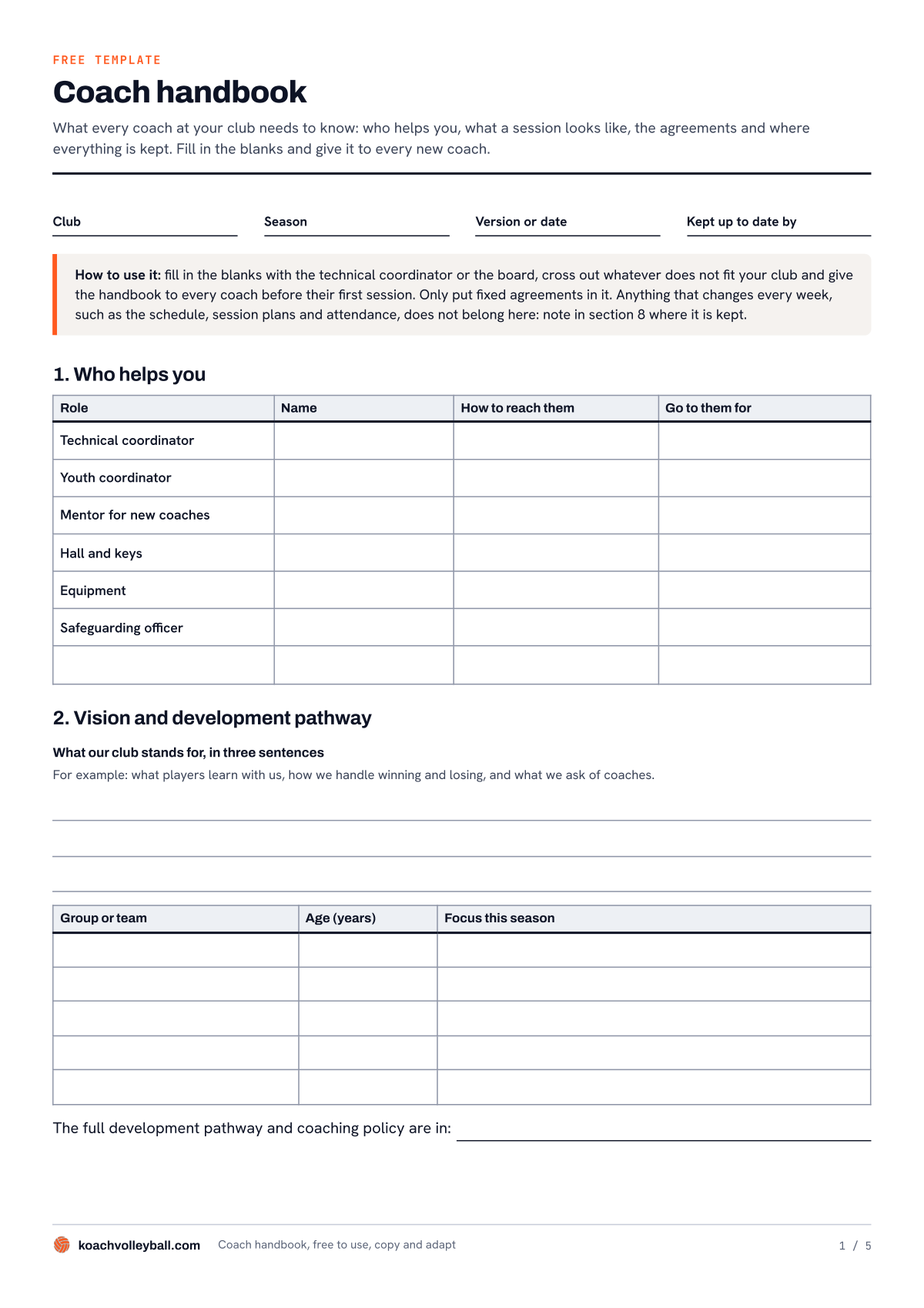
Page 1 of 5: the header fields, the table of who helps you, and the vision and development pathway.
Coach handbook, club handbook or curriculum?
Three documents often get mixed up. A club handbook is for everyone who helps out at the club: the concession stand, the scorer's table, the team parent and the coach too. A volleyball curriculum sets out what players learn at each age and why; the technical committee writes it to cover several seasons. And the coach code of conduct covers how coaches treat players, including minors.
The coach handbook sits in between. It's for coaches only, and it turns the club's policy into an ordinary night in the gym: what a session looks like at your club, what you expect from a coach and who they can turn to. You don't rewrite the curriculum or the code of conduct in it. You point to them, so there is only ever one version of each agreement.
What goes in a volleyball coach handbook? The eight sections
The template follows the questions a new coach asks in their first few weeks. In each section you fill in the blanks and cross out whatever doesn't fit your club.
- Who helps you. A table with role, name, how to reach them and what to go to them for. The roles are already filled in: technical coordinator, youth coordinator, mentor for new coaches, hall and keys, equipment, and safeguarding officer. If a role has no name next to it, that's the first thing to sort out.
- Vision and development pathway. What your club stands for, in three sentences, and for each group or team the age in years and the focus for this season. The full pathway lives in the curriculum; here you just note where to find it.
- What a session looks like. Five blocks with minutes and what you expect: warm-up, technique, drill or small-sided game, match play and wrap-up. Below that come the fixed rules, such as one focus per session that you tell the players at the start, and where coaches find the club's drills and session templates.
- Agreements for coaches. How early you're in the gym, how to cancel a session and arrange cover, that you record attendance, what to do when a player misses a few sessions without letting you know, and what to do about an injury: where the first aid kit is, where the AED is and who to call after you've called the emergency number.
- Communication. What you tell players and parents at the start of the season, which channel announcements go through, who cancels a session, and that you discuss questions about playing time at a calm moment, not right after a match.
- Equipment. Balls, nets, cones, the first aid kit, the key and the match shirts: where they are, who manages them and how to report something broken or missing.
- Support and coach education. How many sessions a new coach gets support for and from whom, how often you watch a colleague's session, the check-in with the technical coordinator, which courses the club pays for and where you claim expenses.
- What is not in this handbook. A table of everything that changes often and where it's kept instead: training times and halls, the match schedule, the player list, session plans and templates, drills, attendance, the report after the session and notes on players.
Then come two parts that aren't content but make all the difference. You go through the checklist for a new coach together in the first few weeks: meeting the technical coordinator and the mentor, access to the player list and the club's app or folder, the key, a look at the equipment, the signed code of conduct and the first session prepared. On the sign-off list, every coach confirms they've read the handbook.
How to fill in the coach handbook template
- Fill it in with two people. The technical coordinator knows what needs to be in it on the coaching side, and someone from the board knows the practical arrangements. A small club without a youth coordinator leaves that row empty or puts a different role there.
- Only fill in a number you'll actually deliver. In many places there's a blank for minutes, hours or times per season. If the handbook promises a mentor for the first sessions, that mentor has to actually be there.
- Give one person ownership. The top of the template has the version or date and who keeps it up to date; the last page has who adopted it and when the next review is. A handbook without an owner is out of date within a season. So put the review on the list you use to plan your volleyball season.
- Hand it over before the first session. Go through the checklist with the mentor in the first few weeks, then have the coach sign the sign-off list.
What to keep in an app instead of the handbook
A handbook that needs updating every week doesn't get updated. That's why the template has a separate section for what does not belong in it. Those things live where coaches already work. Here's how the handbook and Koach split the job:
| Item | In the handbook | In Koach |
|---|---|---|
| Vision, pathway and fixed agreements | Yes | No |
| Keys, first aid kit, AED and equipment | Yes | No |
| Session plans and templates | Only where they're kept | Yes, and with Club from other teams too |
| Drills | Only where they're kept | 200 animated drills plus your own |
| Practices and matches | No | Yes, in the schedule |
| Attendance per session | No | Yes |
| Report after the session | No | Yes, and with Club for club leadership too |
How Koach keeps track of the parts that change every week
We make Koach, so read this part as an explanation of our own product. The idea is simple: the handbook says what a coach does, and the app is where they do it.
Session plans and templates
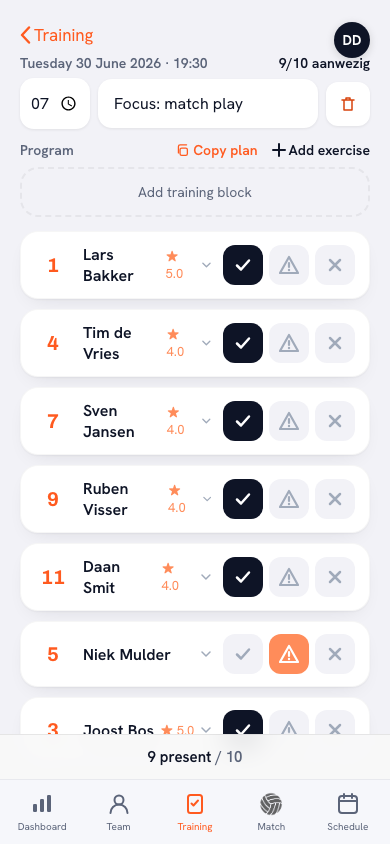
On the Training tab, a coach builds their plan in blocks, each with its own duration. What the session is about goes in Focus / note (optional) when they schedule it, and it then shows at the top of the session, under the date. With Save as template they keep a plan that works, and with Copy plan they put it on a later date. At a club on Koach Club, that copy screen also shows From other teams in the club, with the explanation: "Templates saved by the coaches of other teams. Copying leaves their template untouched." So a new coach starts with their colleagues' plans instead of a blank page, which is exactly what section 3 of the handbook asks for.
We set up Koach Club together with you. Leave your details on the clubs page, and we'll get in touch and set up your teams and coaches with you. Coaching a single team yourself? Try Koach with that team free for 14 days.
Book an intro call Start with your own teamDrills
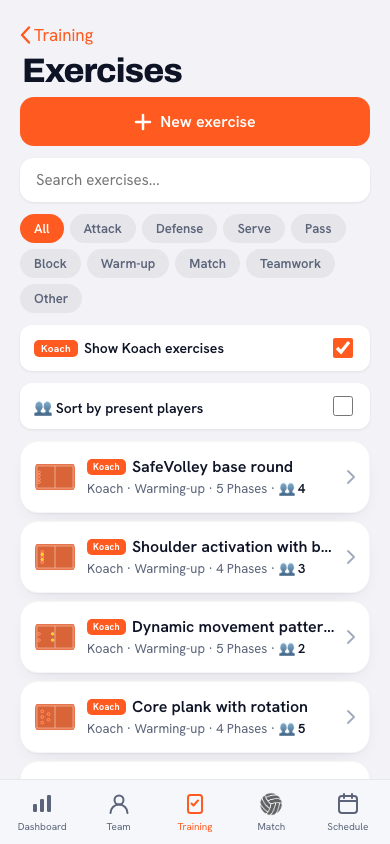
The exercise library holds 200 animated drills, which you can step through phase by phase and filter by Attack, Pass, Warm-up and more. Coaches add their own drills, and the Coach: filter shows who made which one. How to agree on that as a coaching staff is covered in sharing drills between coaches.
Attendance and the report after the session
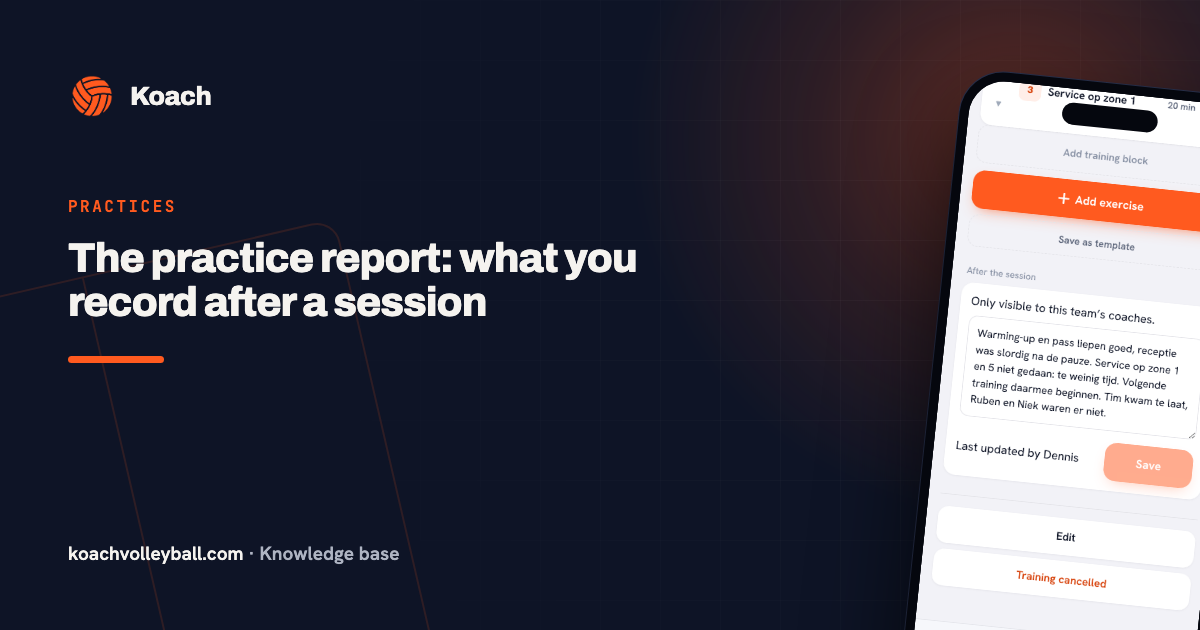
For each session, the coach ticks off who was there: present, late or absent. In the plan, they mark for each block whether it got done. Below that sits the After the session section, with a short report and the Focus for the next session. Because the report sits under that evening's plan, there's no separate file anyone has to maintain. The app itself says who reads it: "Visible to this team's coaches. If your team belongs to a club, the club's leadership (club manager, board, technical manager) can read it too." What to write in it is covered in the report after practice.
What the technical manager sees
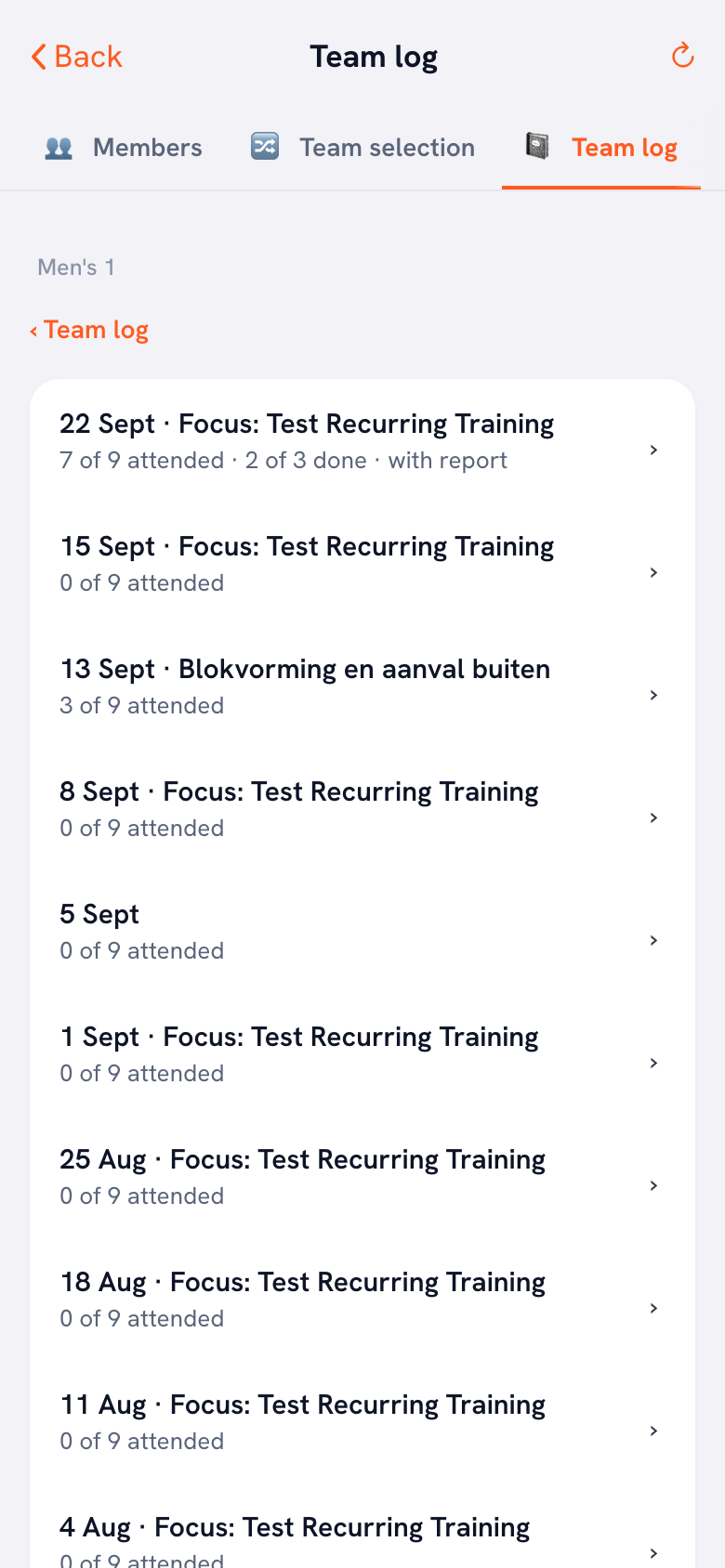
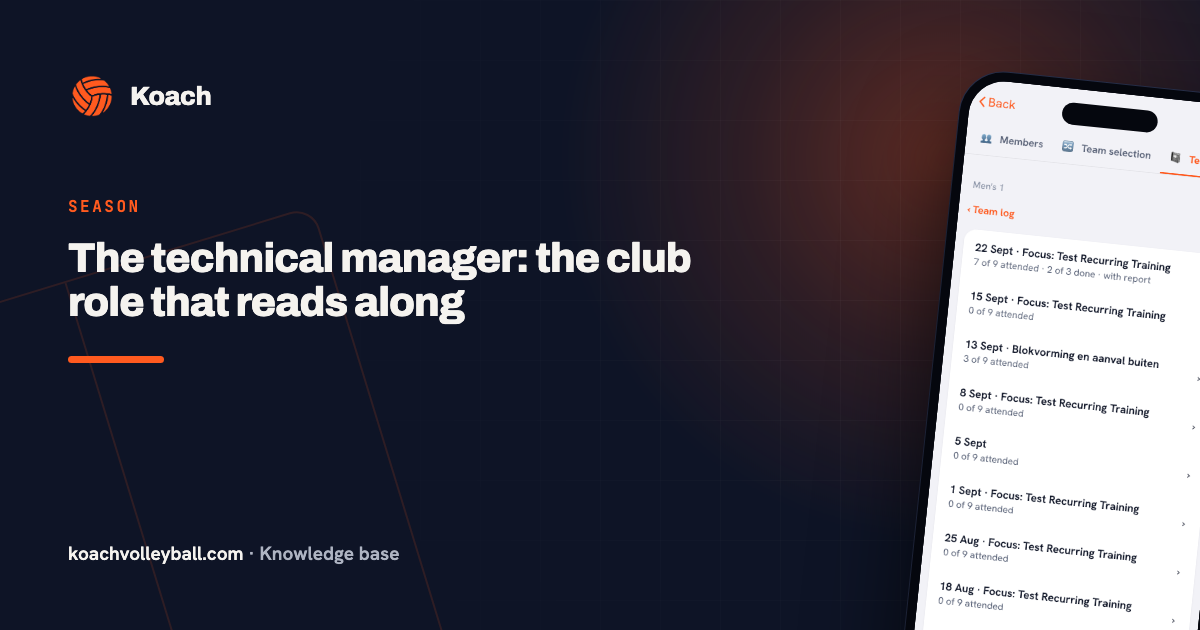
With Koach Club, the club gets the Team log: every team's sessions, newest first, with attendance, how much of the plan got done, the report and the notes on players. The app describes the Technical manager role like this: "Reads along in the sessions, reports and notes of every team. Changes nothing and sees no contact details." Give that role to the technical coordinator from section 1, and they can see how a new coach is getting on without having to call every week. More on that role in the technical manager as a club role.
What Koach doesn't do
- No home for the handbook itself. You can't upload documents to Koach. Keep the handbook in the club's shared folder or on its website, and in section 8 note that session plans, drills and reports are in Koach.
- No vision or curriculum. Koach doesn't write your coaching policy and has no AI or practice generator. A coach builds their own session from the drills.
- No membership records. Koach doesn't replace your membership system and doesn't track which coach holds which background check or qualification. That stays with the club.
- No club features without Club. On a Coach plan, a coach works with their own team. Templates from other teams, the team log and the technical manager are part of Club.
Which clubs is this for, and what does it cost?
The handbook works for any club, with or without an app: print it, fill it in and give it to every new coach. Koach Club fits when you have several teams and want session plans, drills and reports to stay with the club when a coach leaves. Coaches join with the Club code.
It's less of a fit if you have one or two teams whose coaches see each other in the gym every week; then a handbook on paper is enough. If you coach a single team yourself, you don't need the club features.
Club costs €9.99 per month, or €8.33 per month on a yearly plan, for unlimited teams and coaches. Players and parents use the app for free. Club has no free trial: use the form on the clubs page to request an intro call, and we'll set up the club with you. A coach can still start free for 14 days with one team, no credit card needed. All prices are on the pricing page.
Let your next new coach test the handbook. After their first month, ask what they still had to check with someone. Every answer that wasn't in the handbook goes into it that same week.
Frequently asked questions
What is the difference between a coach handbook and a club handbook?
A club handbook is for everyone who helps out at the club, from the concession stand to the scorer's table, and answers practical questions for all those roles. A coach handbook is for coaches only and goes deeper into their job: what a session looks like, which agreements apply, how to communicate with players and parents, and who supports you. If your club has both, the club handbook points coaches to the coach handbook.
What should a youth volleyball coach handbook include?
The same sections, with a few extra points. For each group, note the age in years and this season's focus, who the youth coordinator is, what you tell parents at the start of the season and which background check or certificate the club asks of coaches. For working with minors, point to the code of conduct, and spell out what to do about an injury and who to call.
How long should a coach handbook be?
Short enough to read before the first session. The template is five A4 pages, including the checklist and the sign-off list. Long documents like the full development pathway and the code of conduct don't go in it; you note where they are. Anything that changes every week, like session plans and attendance, is kept somewhere else, so the handbook doesn't go out of date.
Is the coaches handbook template free, and can I edit it?
Yes. The coach handbook is free as a PDF to print and as a Word file to edit, with no email address required. You're free to use, copy and change it: remove or add roles, put your own blocks in the session structure and adapt the wording to your own club.
Can I try Koach Club for free?
Club has no free trial. Club costs €9.99 per month, or €8.33 per month on a yearly plan, for unlimited teams and coaches, and players and parents pay nothing. Use the form on the clubs page to request an intro call, and we'll set up the club together with you. A coach can still start free for 14 days with one team, no credit card needed.
Give your coaches one place for their sessions
We set up Koach Club together with you. Request an intro call on the clubs page. Coaching one team yourself? Start your 14-day free trial below.
Get started with KoachOr read first what the volleyball coaching app does.