
The technical manager: the club role that reads along
The coach of your girls' B1 stops in November. For a year they have kept track of who was there, what they did and what struck them about a few players. Their successor starts in December from nothing — not because it is recorded nowhere, but because nobody in the club can reach it. Everything that coach knew walks out of the hall with them.
The problem every club knows
A club runs on volunteers, and volunteers change. A coach who stays for two seasons is already above average; one who stops halfway through a season is no exception. What is then gone only becomes apparent at their successor's first session: they do not know what has been covered over the past months, which drill did not work, who is nursing an ankle and which player has just started turning up more often again.
The painful part is that it usually is written down somewhere. The coach kept it up neatly in the app: per session who was there, what of the programme was done, a short report and their notes on players. Only all of that hangs on the coaches of that team. Anyone who is not a coach of that team does not get to see it — not the chair, not the youth coordinator, not somebody who needs it tonight.
Work it out for one team. Thirty-four weeks, two sessions a week: that is almost seventy evenings on which somebody wrote down who was there and what was done. That is not a nice extra but the entire working history of that team, and it is exactly what you need at the moment a new coach is standing in front of it who knows nobody yet.
That is not a fault but a choice: notes made by an adult about a child should not be open to half the club by default. But it does turn the handover between two coaches into a spoken account that depends on whether those two happen to speak to each other. What such a handover looks like when you do it well is covered in handing a team over to a new coach.
For exactly that gap there has been a fifth club role since September 2026: the technical manager.
Who the role is in practice
At most clubs the technical manager is not a new position but a name for somebody who is already there. The technical committee, the youth coordinator, sometimes the club's head coach. It is the person responsible for the content of the coaching work: who coaches which team, how it is going, and what has to happen when somebody drops out. What such a committee does at a club and how you staff it is covered in the technical committee of a volleyball club. This piece is about what the app gives that person.
So the role does not exist to give somebody more standing, and not to build in an extra layer of supervision either. It exists to make one thing possible: that there is somebody at the club who can see what has happened inside a team at the moment the coach is no longer there. Continuity, nothing more.
How you give somebody this role sits outside this article. Like the other four roles it goes by email address, with a role selector next to it, and the whole procedure with all five roles side by side is in adding club administrators and the five roles. Look it up there; here it is about the person and their boundary.
What they read
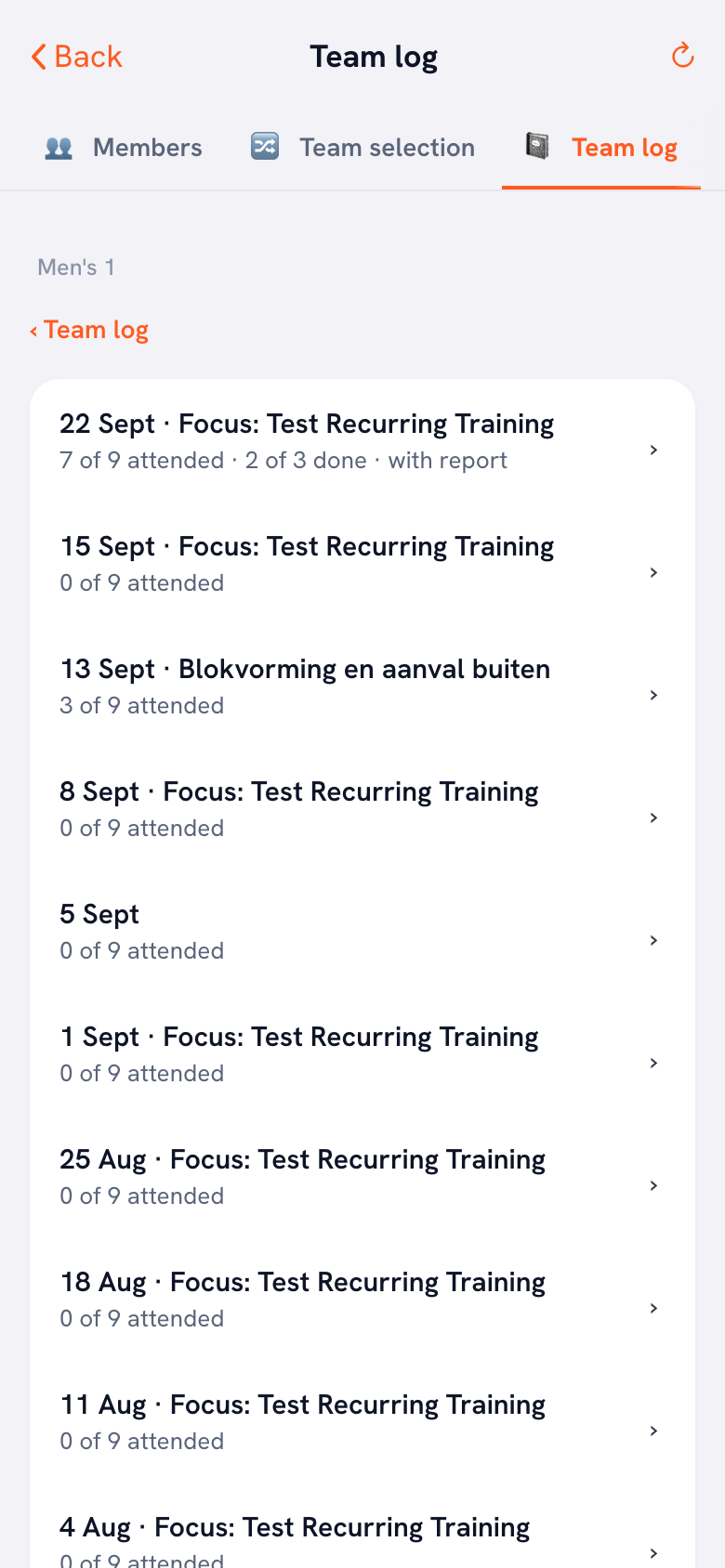
The technical manager has access to the team log of every team in the club. That log shows, per team, the last twelve sessions held, newest first, with four things for each evening: how many players were there, what of the programme was done, the report the coach wrote and the notes they made that evening about players. Underneath sit the next planned sessions.
From those planned sessions only the number of blocks travels, not the content. That is deliberate: what is in next week's session is the coach's work, and a board member reading along in a programme that has not been delivered yet is looking over a shoulder rather than back in time.
Beyond that they see two things outside the log. The first is the signals block above that same team list: the things that stand out per team, so that they do not have to click open twenty teams to discover that nothing is wrong at seventeen of them. Which six signals those are and where the thresholds sit is covered in the signals block on the club dashboard. The second is the member list with names and teams — enough to know who plays in which group, because a signal about a player whose name you cannot place is a number without a face.
In practice you read that log by scanning. Per session there is one line with the date, the title and how many players were there; only when you expand an evening do you see the programme with the done status next to it, the report and the notes. A new coach who wants to know where their team stands is therefore finished in a quarter of an hour instead of having to ask four people — and they do not have to ask anybody whether the attendance really was that bad.
The three things they pointedly do not have
A role only becomes usable once it is clear where it stops. With this role there are three boundaries, and all three of them are there for a reason.
- No contact details. They see names and teams, but no email addresses and no linked parents. That is the line between knowing who a player is and being able to approach that player directly. This concerns the contact details of often underage members, and who holds them is a question a club has to be able to answer — see member data at a sports club.
- No club export. With one tap the export delivers the names, the attendance, the notes and the assessments of every child in the club as a single file, outside the app and with no lock on it afterwards. That is the heaviest right there is, and it stays with the club manager and the board. The technical manager reads along inside the app, where the conversation belongs.
- No club announcements. They cannot send a message to the club's teams. Their role concerns the content of the coaching work, not communication on behalf of the club; that the board and the confidential adviser can do it and they cannot is therefore not a pecking order but a division of tasks.
Beyond that they have no business in the club part. No venues, no match days, no club duties, no team selection, no club email and no finances. The tabs for those are not even in their bar, and anybody who tried to open them around the button would not get the data either: every request is checked against the role again on the server. What else is in that club part is covered in the club dashboard for your club.
Read only, and that is not half a role
The most important boundary is one you see in no menu at all: the technical manager writes nothing anywhere. There is no button to add to a report, prepare a programme, change a note or remove a follow-up mark. The club leadership reads along, it does not coach along.
That sounds like a limitation and it is a precondition. The moment somebody from above can write inside a team log, it is no longer possible to trace who recorded what, and a coach has two bosses over their own notes. Anyone who wants to change something about a report or a mark does it in the team screen — and there the team permissions apply, so they have to be a coach of that team.
The consequence in practice is pleasantly simple: you can hand out this role without having to think about what might break. Nothing breaks. The role can delete nothing, overwrite nothing and send nothing.
What is deliberately not in the log
What they read is one side; what has not been put into that log says at least as much about how the role is meant.
- From the attendance only the number. It says that eight out of twelve were there, not which four were missing. Who was not there that evening is a conversation in the hall and not a line in a club dashboard. There is one exception to that rule: the signal about missing three sessions in a row does name names, because without a name you can do nothing with it.
- No sign-off messages and no reasons. What a player wrote when they signed off stays with the coach. That is often the most personal thing exchanged inside a team.
- No assessments and no ratings. What a coach gives a player in scores or ratings does not travel to the club part.
- No account keys. Whoever wrote a report or a note appears there with their name and not with a technical identifier. So you see who it was, without anything travelling along that you could do more with.
- No email addresses. Not of members and not of the coaches themselves.
There is one extension worth mentioning, because it is in there deliberately. Next to a session that was held sit the notes from that evening as well, and not only the notes on the player's own card. That is not a new kind of access — it is the same text — but the way in differs. A note belongs to the evening on which it was written, and anybody who only meets it in a long list of players reads it apart from the session, as a verdict. What does and does not belong in such a note is covered in keeping notes on players.
When to fill the role
Two moments make the difference. The first is now, before anything is wrong: a role you only create on the day a coach walks out comes a season too late, because the log they then open only starts filling from the moment the previous coach began keeping it. The second is when the teams for next season are being put together, when somebody has to be able to see how a player has developed this year without depending on what a coach remembers.
There is a third moment, and it is the least conspicuous: when a team quietly sinks. A group for which no programme has been prepared for six weeks and where attendance is dropping is usually not a group with a problem but a group with a coach who can no longer carry it. Without somebody who can see that, the club hears about it only when the first parents cancel their membership.
One person is enough, and more than two is rarely wise. This concerns notes about children, and a club that can state that exactly two people can reach them has a better story than a club where five people “got access somewhere along the line”. If such a person leaves the committee, take the role away as well: it costs one tap, and it is the only maintenance this role asks for.
In short. The technical manager reads the sessions, the reports and the notes of every team, plus the signals and the member list with names and teams. They write nowhere, see no contact details, get no export and send no announcements. Which six signals they see is covered in the signals block on the club dashboard.
Frequently asked questions
Can a technical manager also coach one of our teams?
Yes, and it changes nothing about what they may do in the club part. The two run alongside each other: in their own team they are simply a coach and may do everything a coach may do, and in the club part they are a technical manager who reads along everywhere and writes nowhere. If they want to change something in another team, the coach there has to add them as a co-coach.
Does a technical manager need their own subscription?
Not for the role itself: there are no costs attached to it, and the club dashboard stays open to them as long as the club pays, also without a team of their own. For a team, the same rules apply as for any coach: if the technical manager coaches a team that sits on the club account, they use Koach for free as long as the club pays. A team that is only their own needs its own subscription after the 14-day trial. What is also required is that the person already has a Koach account with exactly the email address you enter. If that account does not exist yet, you get a message and nothing changes.
Do the coaches see that somebody is reading their team log?
No notification appears at the moment somebody opens the log. It is not a hidden door either: the role is listed by name in the club's administrator list, and that list exists precisely so that you can show who can reach which data. So simply tell your coaches when you fill the role. A coach who knows the club reads along writes more usable reports than a coach who finds out later.
We have a confidential adviser. Can they not just read along?
Deliberately not. A confidential adviser works confidentially and one to one: a member or a parent comes to them with something they do not want to take to their own coach. That is exactly why they should not read along by default in what a coach writes about a child, because then their role and that of the technical leadership get tangled. They are two different jobs with two different kinds of trust.


Try it yourself in Koach
Less admin, more coaching.
Get started with KoachOr read first what the volleyball coaching app does.