
Coach development plan: free template for your club
The short answer
A coach development plan works best as one plan per coach per season: three goals at most, a way to learn each one, someone who watches sessions and three meetings. You can download that plan below as a free PDF and Word template. With Koach Club, the technical manager sees in the team log how the sessions actually went.
At most clubs, coach development only comes up when a coach quits. A coach development plan turns that around: goals at the start of the season, someone watching your sessions and three fixed meetings. Here you can download the free template and see what the team log in Koach Club adds to it.
Download the free coach development plan template
First, what you probably came for: a development plan for the coaches at your club, free and without handing over an email address. It was made for volleyball coaches, but it works for any coach with their own team.
- Coach development plan (PDF): ready to print, three A4 pages in portrait. The plan itself takes up two pages; the third is a filled-in example.
- Coach development plan (Word): the same plan with the filled-in example, to adapt to your own club.
You are free to use, copy and adapt the template. There is no Excel version: a development plan is about writing things down, and there is nothing to calculate.
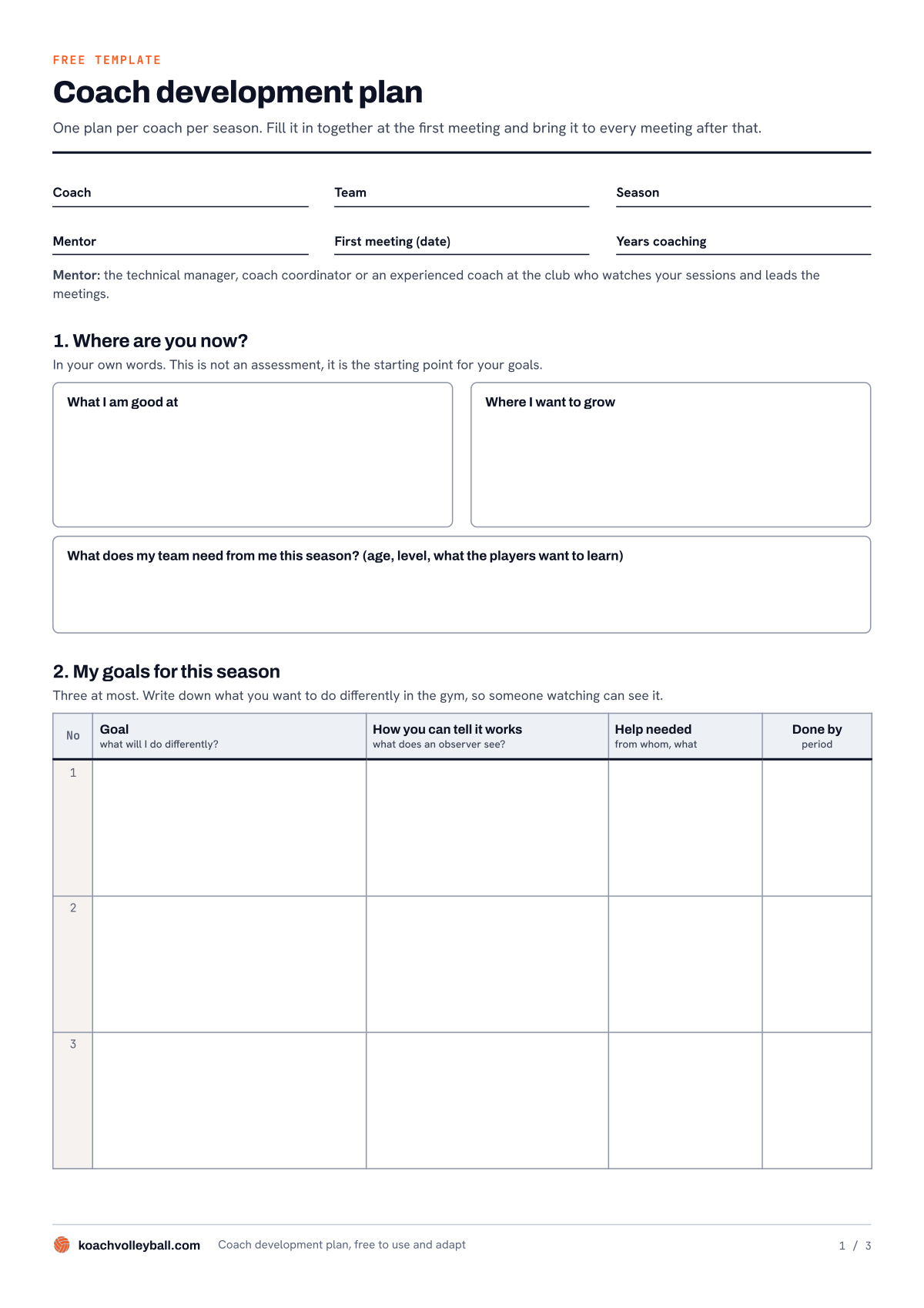
Page 1 of the template: the details of coach and mentor, where the coach stands now and room for three goals at most.
What is in the coach development plan?
The plan works with one coach, one season and one mentor: the technical manager, a coach coordinator or an experienced coach at the club who watches sessions and leads the meetings. At the top you fill in the coach, the team, the season, the mentor, the date of the first meeting and the number of years coaching. Below that come five sections.
- Where are you now? Two boxes, What I am good at and Where I want to grow, plus the question of what the team needs from the coach this season: age, level and what the players want to learn. It is not an assessment, it is the starting point for the goals.
- My goals for this season. Three at most, with the columns Goal, How you can tell it works, Help needed and Done by. The second column matters most: what does someone watching the session see once the goal is reached?
- How I will learn it. One or two ways per goal, with whom and when. Below the table you will find ideas, from a course or clinic to shadowing another coach or a coaches meeting at the club.
- Session observation. For each visit: who watched, the focus question, what stood out and the agreement for next time.
- Meetings. At the start, halfway through and at the end of the season: how are the goals going, and what do you change now?
The third page is a filled-in example for a made-up coach of a youth team aged 13 to 15, in her second season. Copy the format, not the content.
How to fill in a coach development plan
- Start with a first meeting. Coach and mentor fill in the first section together. Let the coach go first; the mentor adds to it.
- Write each goal as something you can see in the gym. Nobody can see "explain things better", but anyone can see "after the explanation the ball is back in play quickly". One goal that sticks beats three that never get started.
- Link a way of learning to every goal. Coaches often learn most from other coaches: shadowing, planning a session together or having someone watch. A course from your national federation can be part of it too.
- Agree on one focus question for each observation. The observer notes what happens, not what they think of it, and talks it through straight after the session.
- Actually hold the three meetings. Halfway through, you adjust the goals; at the end, you write down what the coach wants for next season.
A development plan is not an evaluation. The plan looks ahead and belongs to the coach; an evaluation gathers the views of players, parents and the coaching committee after the fact, and for that there is the coach evaluation form. The plan does help you keep coaches: a coach who sees the club investing in them has a reason to stay. How to find coaches and hold on to them is covered in recruiting coaches who stay. Where the plan fits into the season is in the checklist for organizing the volleyball season.
Why a coach development plan often ends up in a drawer
Scheduling the first meeting is the easy part. After that, things tend to stall:
- Between two meetings the mentor sees nothing. They watch once or twice and otherwise only know what the coach tells them.
- The halfway meeting runs on gut feeling. Nobody remembers exactly how the sessions of the past few weeks went.
- Goals about the session itself are hard to follow. Whether a coach gets through their session plan or writes a report is not something you see from watching one evening.
- The mentor is a volunteer too. They cannot drop in on every team every week.
You can leave it at the meetings, or keep the plan on paper or in Word, which works well for the goals and the agreements. The third option: put the plan next to what the coach records in an app after every session, so the mentor can see how things are going between meetings. That is what Koach Club does.
What Koach Club adds to coach development at your club
We make Koach, an app for volleyball coaches and their club, so read this part as an explanation of our own product. Koach has no feature for development plans or coach evaluations: the plan itself stays on paper or in Word. What Koach does do is show what happens in the sessions, and that is exactly the material for the meetings in the plan.
What the coach records after the session
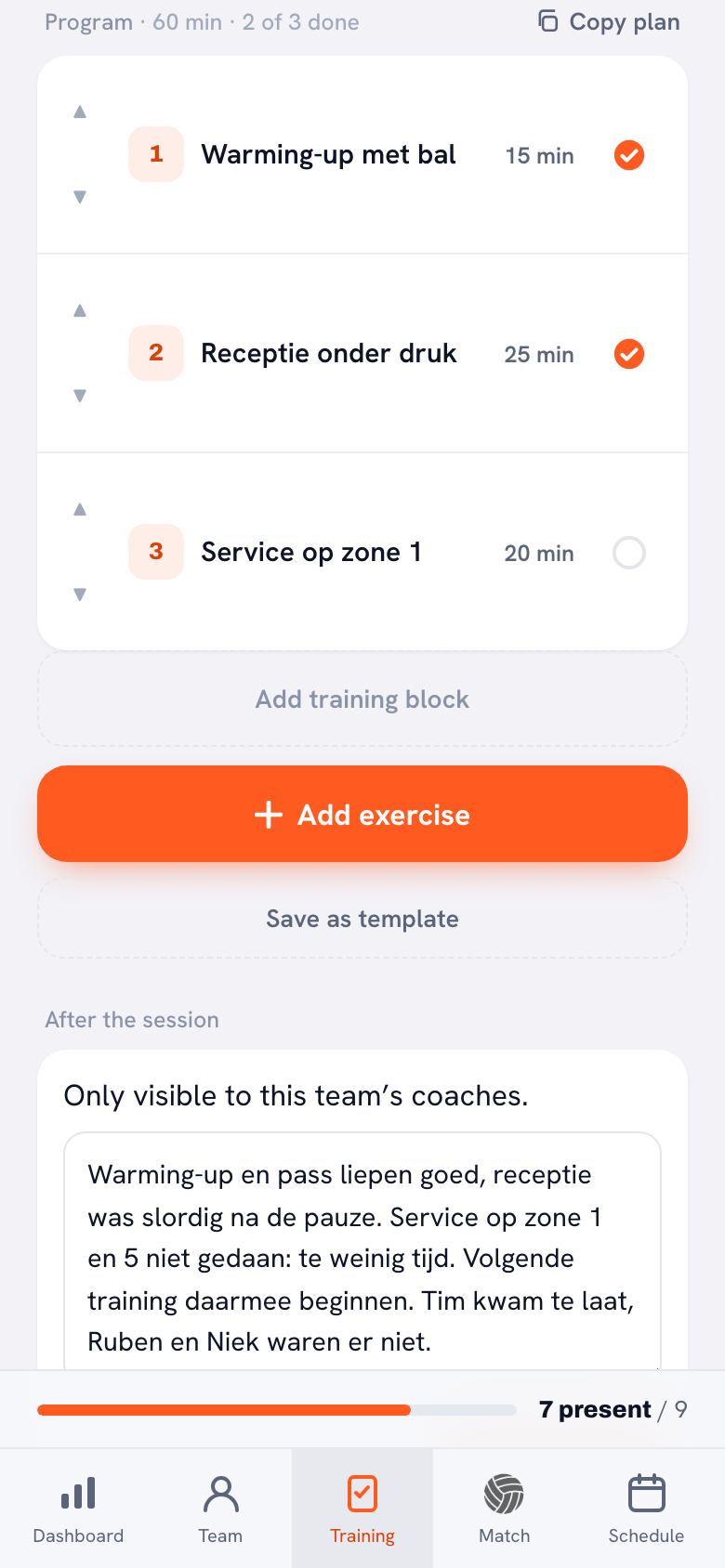
In the Training tab the coach builds the session plan in blocks. Afterwards, they mark what was done in each block (Done, Partly done or Not done) and write a short report under After the session, with a separate field Focus for the next session. A note about a player can be marked Needs follow-up. What such a report looks like and what goes in it is explained in the training report after the session.
What the technical manager sees
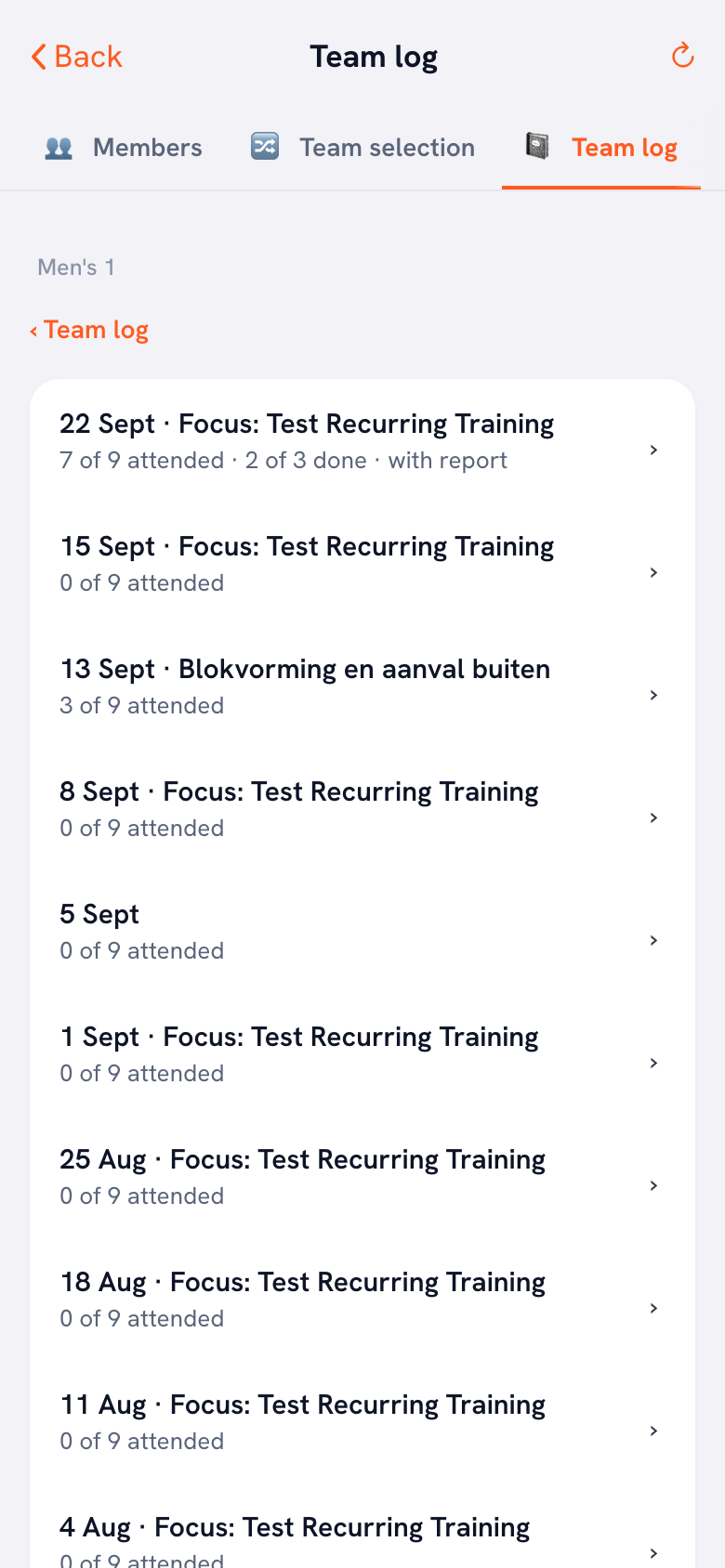
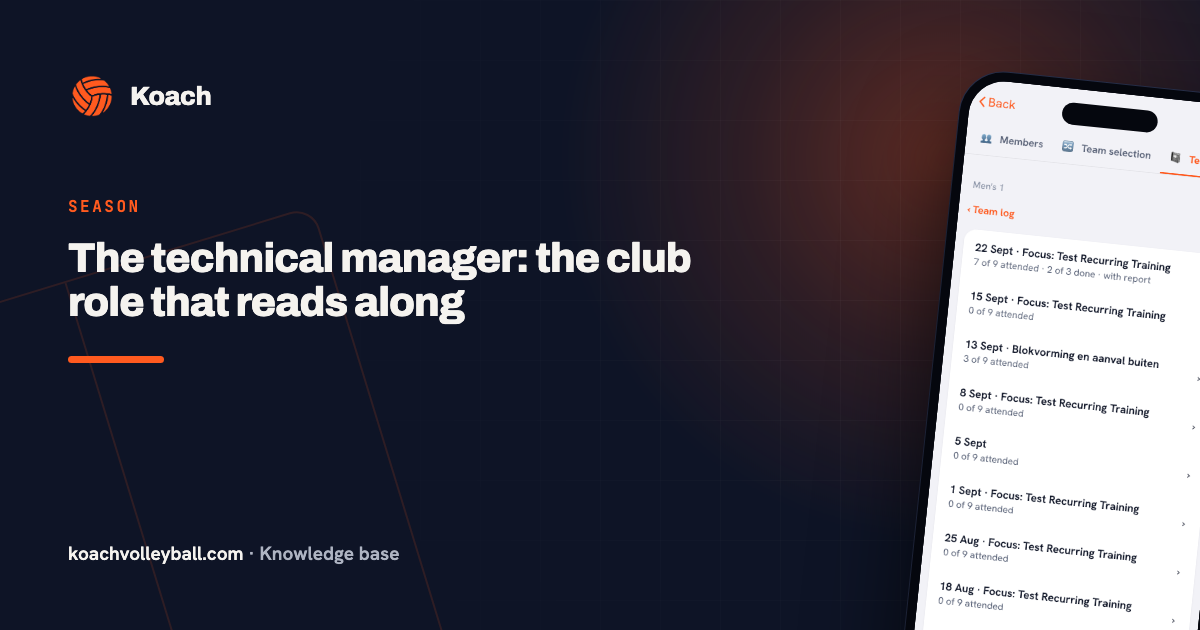
With the Club plan your club gets a club dashboard, and there you give the mentor the club role Technical manager. The app describes it like this: "Reads along in the sessions, reports and notes of every team. Changes nothing and sees no contact details." In the Team log they see the sessions each team has held: how many players were there, how many blocks were done and whether there is a report. Opening a session shows the plan, the report, the focus for the next session and the notes from that evening. Next to the report field the coach is told that the club's leadership can read it, so nobody reads along unnoticed. What the role can and cannot do is set out in the technical manager, the club role that reads along with every team.
For the development plan, that means:
- A goal about the session becomes visible. If the coach wants to write a report with a focus point after every session, the mentor can see in the log whether that is happening.
- Observations are better prepared. Reading the last few sessions beforehand leads to a sharper focus question.
- The halfway meeting is about what actually happened. Together you see which blocks keep getting skipped, instead of talking about a feeling.
- The coach can raise something themselves. A note marked Needs follow-up shows up for the club's leadership in the team log, without anyone sending a separate message.
We set up Koach Club together with you. Club has no free trial: leave your details through the form, and we will get in touch and show you how the team log and the technical manager role work. Coaching a team yourself? Then you can start right away: 14 days free, no credit card.
Book an intro call Start with your own teamSignals and templates from fellow coaches
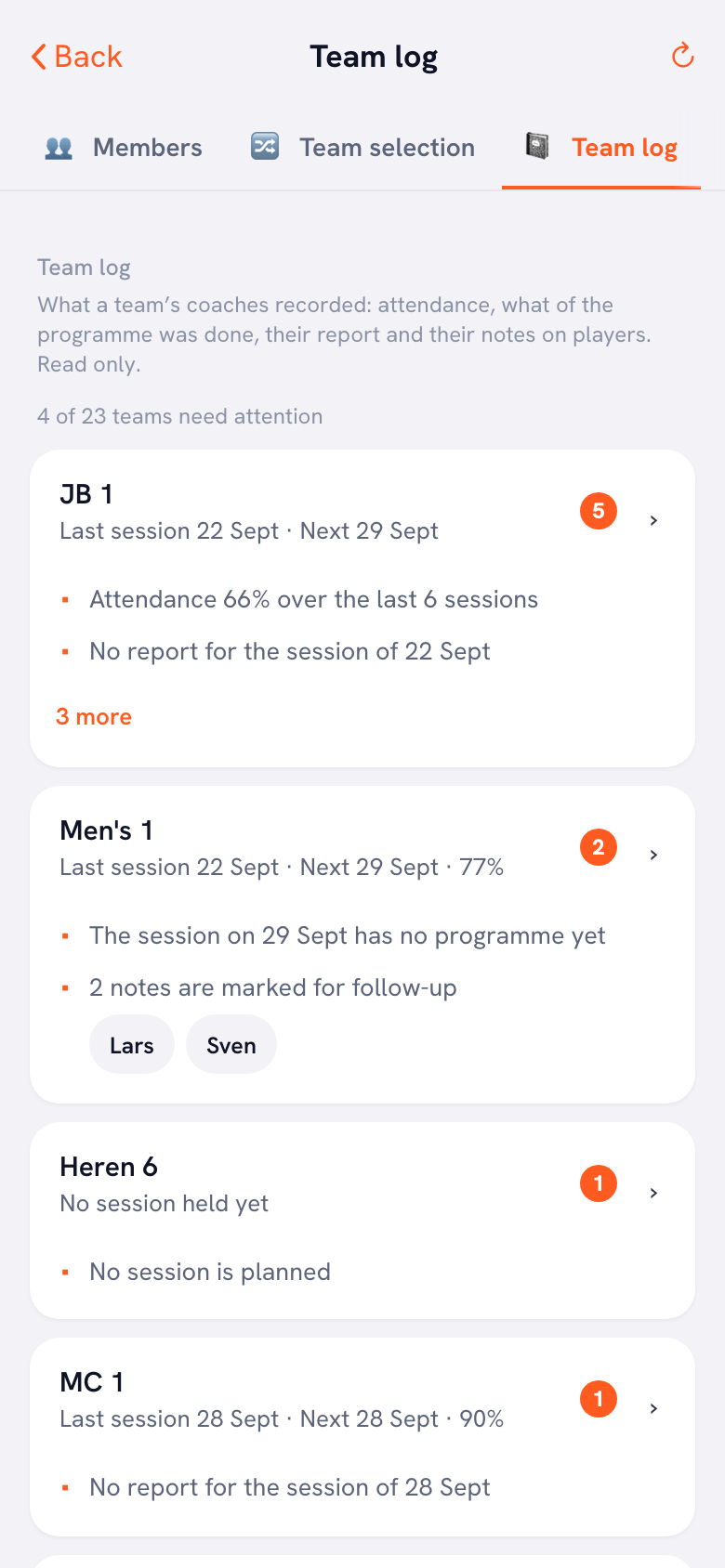
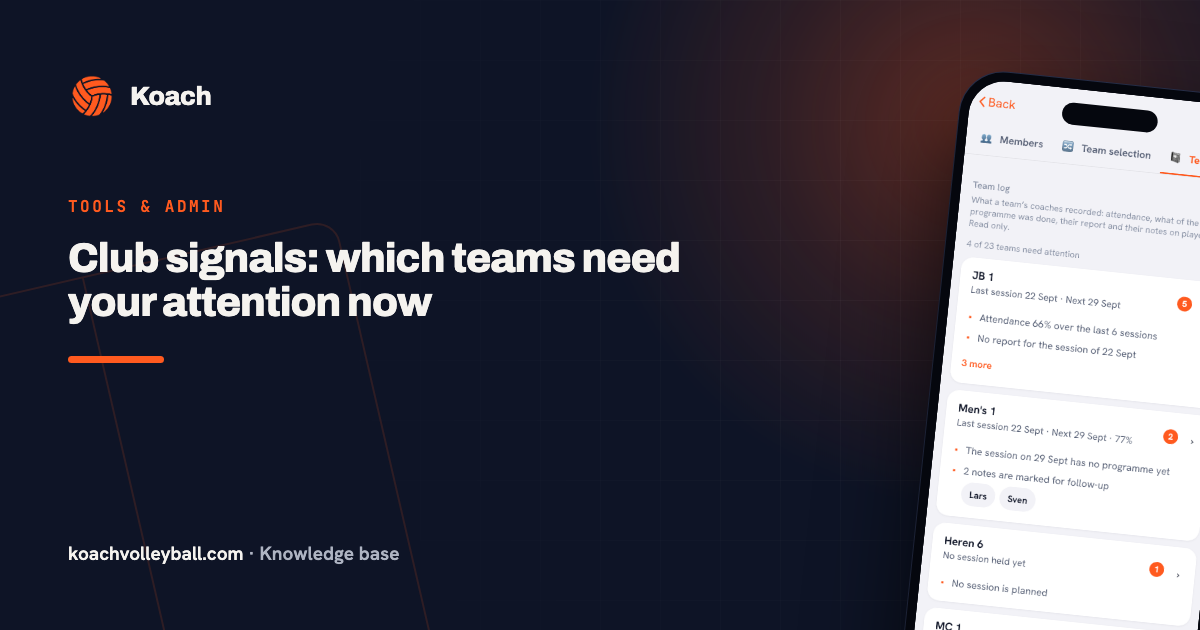
The start page of the team log has the signals panel: for each team, whatever stands out, such as a session without a report, a planned session without a plan or notes waiting for follow-up. For the mentor it is a nudge to get in touch, not a verdict on the coach. Which signals there are and where their limits lie is explained in the signals panel in the club dashboard.
And for learning from each other: when a team belongs to a club, Copy plan also lists the templates that coaches of other teams have saved, under From other teams in the club. A new coach can take a session from an experienced colleague into their own team, and the colleague's template stays exactly as it was.
Template alone or Koach Club: which fits your club?
| What you want | Template only | Template plus Koach Club |
|---|---|---|
| Cost | Free | €9.99 per month, or €8.33 per month billed annually |
| Recording goals, learning and agreements | Yes | In the template; Koach has no feature for it |
| Works without an app or account | Yes | The template does, the log does not |
| Seeing how sessions went between two meetings | Only if you watch | Yes, in the team log |
| Report and focus for each session | No | Yes, written by the coach in the app |
| A nudge when a team needs attention | No | Yes, signals per team |
| Reusing sessions from fellow coaches | On paper or by email | Templates from other teams |
| A score or verdict on the coach | No | No |
The template alone is the better fit for a small club with a handful of coaches, or when the coaches do not use the same app. A mentor who knows every coach well and is regularly in the gym has all they need in the plan and three meetings.
Koach Club is the better fit when you have several teams, a technical manager or coaching committee that cannot be at every session, and coaches who already track their sessions in an app or want to start. Be clear about what it is not: Koach does not rate coaches, does not track coaching certifications or courses and does not record video of sessions. The log only shows what a coach records. If a coach writes no report, there is no report to read.
What does Koach Club cost?
The template is free. Koach Club costs €9.99 per month, or €8.33 per month billed annually, for unlimited teams and coaches. Club roles such as technical manager are included, even for someone without a team of their own, and players and parents pay nothing. Club has no free trial; you book an intro call through the form on the clubs page, and then we set up your club together with you. The Coach plan (€2.99 per month, one team) comes with a 14-day free trial, but it does not include the team log or the technical manager role. All prices are on the pricing page.
Turn one goal into something that shows up in the report. Agree at the first meeting that the coach writes one sentence after every session on how that goal went. At the halfway meeting you then have a run of evenings to look at, instead of one memory.
Frequently asked questions
What is a coach development plan?
A coach development plan is an agreement between a coach and their mentor at the club about where the coach wants to grow this season. It holds three goals at most that you can see in the gym, a way to learn each one, moments when someone watches a session, and three meetings: at the start, halfway through and at the end of the season. On this page you can download a free template as a PDF and in Word.
Who mentors the coaches at a club?
Usually the technical manager or director of coaching, the coaching committee or a coach coordinator. At a smaller club it is often an experienced coach who takes a new colleague under their wing. More important than the title is that every coach has one regular mentor who watches a session now and then and leads the meetings. That person's name goes at the top of the development plan.
What is the difference between a coach development plan and a coach evaluation?
A development plan looks ahead: the coach chooses their own goals and agrees how to learn them. An evaluation looks back and gathers the views of players, parents or the coaching committee on the season that has just ended. The two work together: what comes out of an evaluation can become a goal in the next plan. For the evaluation there is a separate form.
Can the technical manager see every team's sessions in Koach?
Yes, with the Club plan. In the team log they can read along with each team: how many players were there, what of the session plan was done, the coach's report and the notes on players. They cannot change anything and see no contact details. Coaches see next to the report field that the club's leadership can read it. Koach has no feature for keeping development plans or coach ratings.
How much does Koach Club cost, and can I try it first?
Koach Club costs €9.99 per month, or €8.33 per month billed annually, for unlimited teams and coaches. The technical manager is included, even without a team of their own. Club has no free trial: you book an intro call through the form on the clubs page, and then we set up your club together with you. If you coach one team yourself, you can try Koach free for 14 days with no credit card, but without the club dashboard.
Help your coaches grow with what they already record
Club has no trial: we set up your club together with you. Coaching a team yourself? Start right away.
Get started with KoachOr read first what the volleyball coaching app does.