
Coach evaluation form: free template in PDF, Word and Excel
The short answer
A coach evaluation form has three parts: an anonymous survey for players, one for parents and a review form for the club's meeting with the coach. Download all three free as PDF and Word, plus an Excel sheet for the answers. Koach has no evaluation feature, but with Koach Club you do see the facts from practice.
You need a coach evaluation form that lets your club review a coach fairly, without it turning into a trial. Here you can download three forms, read how to hand them out and make sense of the answers, and see which facts from practice to put next to them.
Download the coach evaluation form: PDF, Word and Excel
First, what you probably came for: an evaluation form for a volleyball coach, free and with no email address required. It is made up of three forms and a step-by-step guide, and you choose which format suits you.
- Volleyball coach evaluation form (PDF): for printing. Five A4 portrait pages: the player survey, the parent survey, the club review form in two parts and a page on how to use it all. Printing on US Letter? Choose Fit to page in the print dialog.
- Volleyball coach evaluation form (Word): the same forms and the same guide, so you can adapt the statements and questions to your own club.
- Volleyball coach evaluation form (Excel): for processing the returned surveys. For each statement you see the average, the number of answers, how many people gave a 1 or a 2 and, for the players, the gap with the coach's self-assessment. There is room for 30 forms per survey.
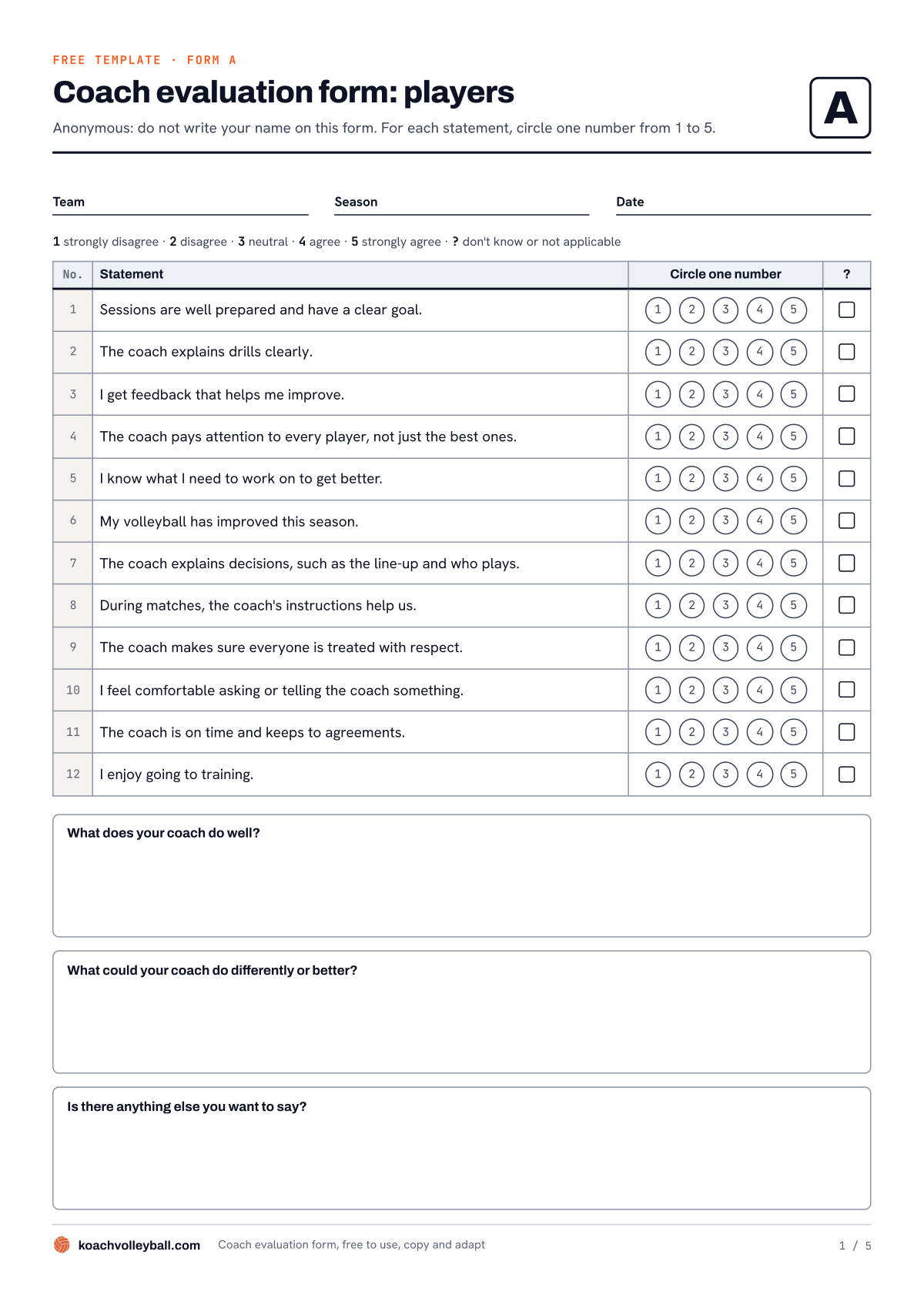
Above is page 1, the player survey. You are free to use, copy and adapt the template.
What's in the coach evaluation form?
Evaluating a coach means hearing from three groups: the players they coach every week, the parents who see what comes home from practice, and the club that holds the review meeting with them. That is why there are three forms.
Form A: players, anonymous
Twelve statements rated from 1 (strongly disagree) to 5 (strongly agree), with a box for "don't know or not applicable". They cover how well sessions are prepared and explained, feedback, attention for every player and not just the best ones, explaining decisions such as the lineup, coaching during matches, respect and enjoyment. Then three open questions: what does your coach do well, what could they do differently or better, and is there anything else you want to say.
Form B: parents, anonymous
Ten statements for parents of youth players, covering among other things communication and availability, fairness, the workload and health of the players, and the coach as a role model in behavior and language. Then two open questions. Parents with children on more than one team fill in a form per team.
Form C: the review meeting with the club
For the technical committee or the technical manager. You fill in part 1 before the meeting: what the surveys say, the facts from the sessions and what you saw when you watched a practice. You fill in part 2 together with the coach: what is going well, what could be better, what they need from the club, the agreements, and whether they carry on with this team next season.
How to use the form in seven steps
- Tell the coach in advance what is going to happen. What you will ask, who you will ask, and who will see the results. A coach who hears about it from a parent feels judged instead of supported.
- Hand out Form A and Form B. A goes to the players, B to the parents, especially on youth teams. With young players, read the statements out loud.
- Have the forms returned anonymously, in a sealed box or envelope, and never to the coach.
- Ask the coach to fill in Form A about themselves. That is the self-assessment.
- Work out the average for each statement, or type the answers into the Excel file, with one column per returned form.
- Fill in part 1 of Form C: the results, the facts from the sessions and what you saw at a practice.
- Hold the meeting using part 2. Start with what is going well, then what could be better and what the coach needs from the club. Finish with agreements.
Do it twice a season: halfway through, while there is still time to change something, and at the end, when you talk about next season. Use the same statements both times so you can see what has changed. Put both dates straight into your season plan, so an evaluation doesn't only happen once something has gone wrong.
How to read the results without being unfair to anyone
- First count how many forms came back. Four forms from a team of twelve say very little, however good the average looks.
- Look at the 1s and 2s. One angry parent drags an average down; five players who disagree tell you more. That is why the Excel file counts them separately.
- A big gap with the self-assessment is something to talk about. If the coach gives themselves a 5 for explaining and the players give an average of 3, that is a question for the meeting, not a conclusion.
- Show the coach the summary, not the individual forms. Handwriting is easy to recognize, and this keeps players and parents anonymous.
- Put opinions next to facts. A low score for enjoyment tells you something. Next to attendance that has been dropping for weeks, it tells you more.
Anything that applies to every coach, such as a theme that comes up on every team, belongs in a session with the whole group rather than in the review with one coach. That is what the coaches' meeting with a fixed agenda is for.
Opinions next to facts: where do the facts come from?
The "Facts from the sessions" block in Form C asks for seven things: how many sessions were held, how many had attendance recorded, the average attendance, how many sessions had a plan beforehand and a report afterwards, how many players missed three or more sessions in a row, and the player notes marked for follow-up. The form itself adds: only fill in what was actually recorded.
Without an app you ask the coach for them: their attendance list, their session plans, their notebook. That means asking them for evidence about their own work, right before a meeting about that work. If your coaches work in Koach and your club has Koach Club, those facts are already in the team log, as far as the coaches record them.
| What you need for Form C | Without an app | With the team log in Koach Club |
|---|---|---|
| How players and parents experience the coach | Yes, from the surveys | Also from the surveys, because Koach has no anonymous survey |
| Sessions and attendance | If the coach keeps an attendance list and hands it in | Yes, the number present at each session, if the coach records it |
| The session plan and how much of it got done | From the coach's memory | Yes, per block done, partly done or not done |
| Report after the session | If the coach keeps a notebook | Yes, if the coach writes one |
| Players who keep missing practice | Work it out yourself | Yes, a signal after three sessions in a row absent |
| How the coach is doing personally | Yes, in the meeting | Only in the meeting, not in the log |
| Cost | Free | Club: €9.99 per month |
What the team log in Koach Club shows
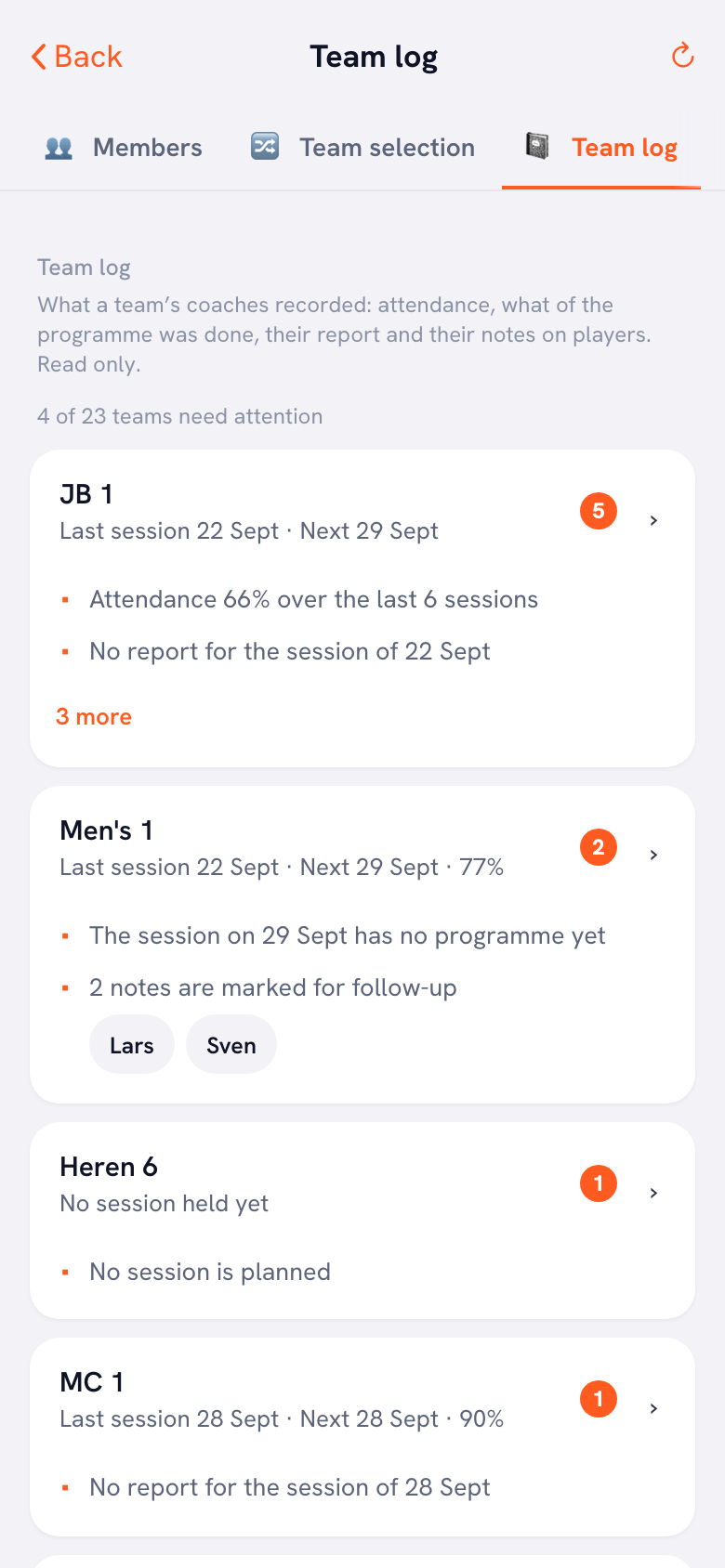
The team log is in the club section of the app: Profile, then Club dashboard, and the Team log tab at the top. At the top you see how many of your teams need attention, and for each team its signals, such as a session without a report or without a plan, players who were absent three sessions in a row, or notes waiting for follow-up. Each team also shows its attendance over the last six sessions, only where attendance was recorded. What each signal measures exactly is explained in the signals block of the club dashboard.
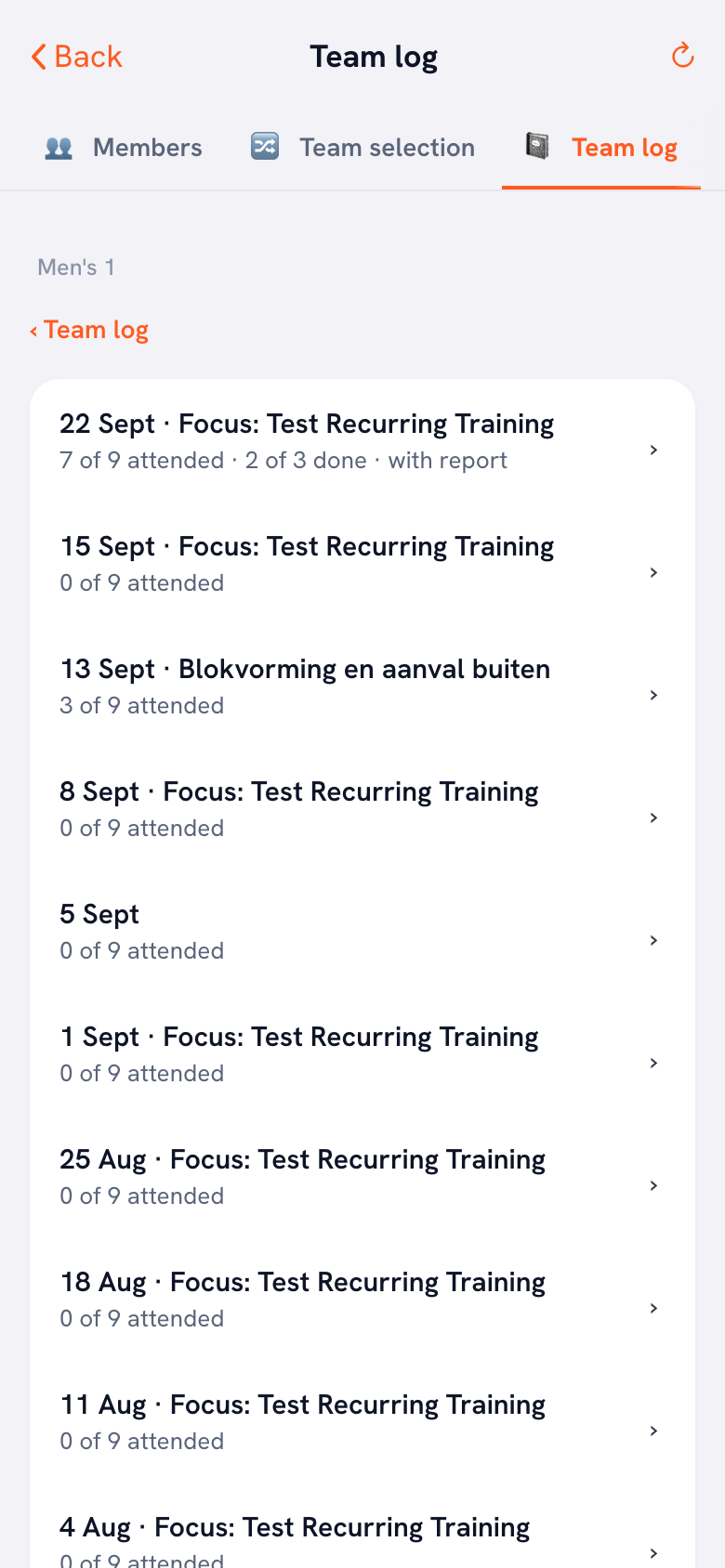
Tap a team name to see the last twelve sessions held, newest first; Show older sessions loads earlier ones. Each evening gets one line: how many players were there, how many blocks of the plan were done and whether there is a report. Expand an evening for the plan with a mark per block for done, partly done or not done, the coach's report with their Focus for the next session, and their notes on players.
We set up Koach Club together with you. Club has no free trial: leave your details, we get in touch and set up your teams and coaches with you. Coaching one team yourself? Then you can try the app free for 14 days.
Book an intro call Start with your own teamYou count the numbers for Form C yourself over the review period; players who missed three in a row and notes waiting for follow-up are listed under the signals. The only percentage you get is attendance: in the team log over the last six sessions, and in the club dashboard overview over the season. Koach does not give the coach a score. The coach writes the report in the After the session block, below that evening's plan; see the practice report after a session.
Who reads the log, and what is not in it
The team log is visible to three club roles: the club manager, a board member and the technical manager. The last one fits an evaluation best: they read along in the sessions, reports and notes of every team, change nothing and see no contact details. What else that role can and cannot do is covered in the technical manager as a club role and in the interview about the team log.
What is deliberately left out: who was missing on a given evening (you only see the number present), reasons for not attending, and player ratings. And the log only holds what the coach records. A coach who doesn't write reports is not a bad coach because of it; an empty line is a question for the meeting, not evidence. Simply tell your coaches that club leadership reads along, long before it comes up in a review meeting.
What Koach does not do in a coach evaluation
- No evaluation module. Koach has no questionnaire, no anonymous survey and no score for coaches. You fill in the forms on paper or in Word, and you process them in Excel.
- No verdict on the quality of a session. The log shows what was planned, done and written down, not whether it was good. For that you watch a practice yourself, point 3 of Form C.
- No record of the meeting. You keep the agreements from part 2 in your own files.
- No content without input. If a coach doesn't take attendance and doesn't write reports, there won't be much to see.
Who is this for, and what does it cost?
The form suits any club that wants to sit down with its coaches once or twice a season, with or without an app. It is free, and you don't need Koach to use it.
The team log suits a club with several teams whose coaches already keep attendance, session plans and reports in Koach. Then the facts for part 1 are ready before you schedule the meeting. It doesn't suit you if your coaches record nothing.
The team log, the signals and the technical manager role are part of Club: €9.99 per month, or €8.33 per month on an annual plan, for unlimited teams and coaches. Club has no free trial: use the form on the clubs page to book an intro call. Coach costs €2.99 per month for one team and comes with a 14-day free trial, but it does not include the club module. All prices are on the pricing page; in the App Store and Google Play you see the price in your own currency.
In every review, ask what the coach needs from the club. A course, an assistant, equipment or better court time: asking shows that the evaluation is there to help a coach, not to judge them. Write the answer down with the agreements in part 2, with a name next to it, and work it out in a development plan for the coach.
Frequently asked questions
What questions should be on a coach evaluation form?
Ask about what players and parents notice every week: whether sessions are prepared and have a goal, whether explanations are clear, whether every player gets attention, whether decisions such as the lineup are explained and whether players enjoy coming. Ask parents about communication, availability, fairness and the coach as a role model as well. End with open questions about what is going well and what could be better. The free form on this page has 12 statements for players and 10 for parents.
Should a coach evaluation be anonymous?
For players and parents, yes. With their name on it they are less likely to write down what isn't working, especially when the coach also decides who plays. Have the forms returned in a sealed box or envelope and not to the coach, and show the coach only the summary, not the individual forms. The review meeting with the club is the opposite: you hold it together with the coach, with agreements that have a name next to them.
How often should you evaluate a coach?
Twice a season is a good rhythm: halfway through, while there is still time to change something, and at the end, when you talk about next season. Use the same statements both times, so you can see what changed after the first meeting. Fix both dates at the start of the season, so an evaluation doesn't only happen once something is already going wrong.
Can I evaluate coaches in Koach?
Not with a questionnaire: Koach has no evaluation module, no anonymous survey and no score for coaches. With Koach Club, club leadership can read in the team log what the coaches record: attendance for each session, the session plan with what got done, the report and the notes on players. Those are the facts for the meeting. You collect the opinions of players and parents with the forms on this page.
How much does the Koach team log cost?
The team log is part of Club: €9.99 per month, or €8.33 per month on an annual plan, for unlimited teams and coaches. Players and parents use Koach for free. Club has no free trial; you book an intro call through the form on the clubs page. Coach, for one team, comes with a 14-day free trial, but it does not include the club module. The evaluation form itself is free.


Bring the facts to your next coach review
Club has no free trial: book an intro call through the clubs page and we will set up your club together with you. Coaching one team yourself? Start your 14-day free trial below.
Get started with KoachOr read first what the volleyball coaching app does.