
“He oversees eight teams and could not read a single note from any of them”
Volleyball coach Dennis Boekhout, 28, on the team log in the club module: what the club leadership may read, what stays out on purpose, and what being read changes for a coach.
A club runs on people who do it alongside a job, and those people move on. The coach who quits in November takes everything he knew out of the door with him. His successor starts from zero, not because none of it was written down, but because nobody else could get at it.
Since September 2026 the club module in Koach has a team log: the club manager and the board can read what a team’s coaches recorded. Read only, behind a single right. A conversation about where that request came from, what deliberately stays out, and why Dennis will not talk the downside away.
This one did not come from your own team, I gather.
“No, this one came from a club. A technical coordinator rang me. He oversees eight teams, he is not on the sideline at a single one of them, and yet he is the person who has to know at the end of the season how it went and who took which step.
“He oversees eight teams and could not read a single note from any of them. No report, no line about a player, nothing. Everything a coach records hangs on that one team inside the app, and he was not a coach of any of the eight.”
Why not simply make him a coach of all eight teams?
“Because that solves the problem by making it bigger. A coach does not only read, a coach writes. Line-ups, sign-ups, notes, attendance, the lot. You would be handing someone eight keys because he wanted to look through eight windows.
“It is also unfair on the coaches themselves. Suddenly there is an extra name inside their team that nobody has ever met in the gym. I wanted one door that opens for reading, not eight doors you can also walk through.”
So what does he see when he opens it?
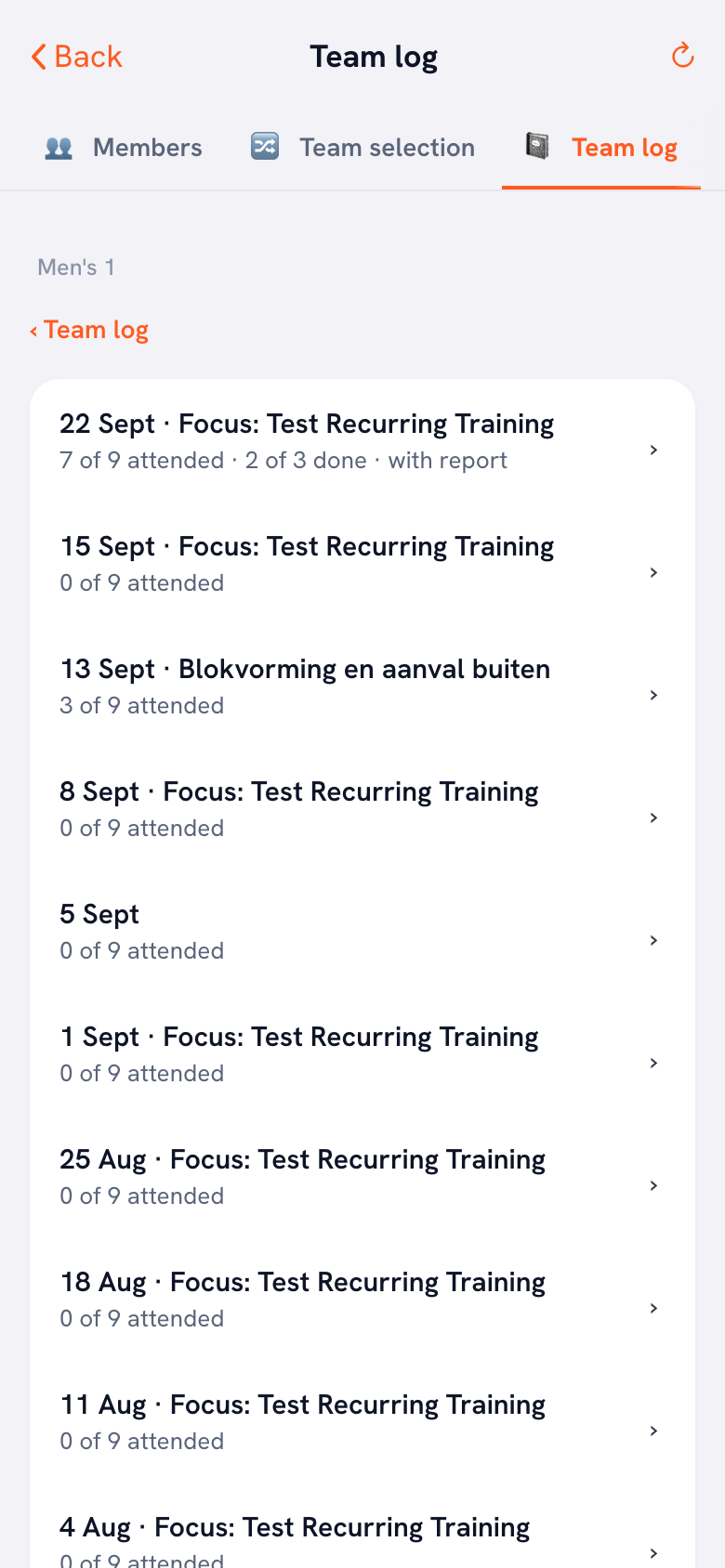
“First the teams of the club, just a list of names. He picks one and gets the last twelve sessions that actually took place, newest at the top. Each line carries the date, the focus of that evening and the turnout: seven of nine attended.
“And if the coach wrote something about it, that line ends with ‘with report’. It sounds like nothing, but it is exactly what you need in order to scan. Within three seconds you see where there is something to read and where an evening was simply an evening.”
And if he opens one up?
“Then the plan for that evening is there, block by block, and every block says whether it was done, partly done or not done. Those are the circles the coach taps in the gym. Underneath sits the report, and under that, who last updated it.
“That is the whole idea. Not ‘the session happened’, but ‘there were three blocks, we got through two, and this is what the coach wrote about it afterwards’. That is worth a conversation. An attendance percentage rarely is.”
The notes on players are in there too.
“They are, underneath the sessions. That is where the players of that team sit, and a tap opens what the coaches wrote about that player, with the date and the name of whoever wrote it. That name only arrived in late September. Older notes do not carry it and show the date alone.
“That name does more than you would think. ‘Keeps hesitating in attack’ from the Tuesday coach is a different sentence from the same words written by the coach on the sideline on Saturday. Without a name you read a team as one voice, and it never is one.”
Can he change anything in there?
“No. Nothing. No button, no pencil, no circle he can flip. Anyone who wants to edit a report does it in the team screen, where the coaches are and where the normal team permissions apply. The club leadership reads along, it does not coach along.
“And that is not only true of the screens. The server lets nothing but reading through either. Otherwise it is bound to happen sooner or later: somebody who means well and just ‘clarifies’ another person’s report.”
Who gets to see this? Anyone with a club account?
“No, and that is the most important sentence in this whole story. It hangs on one right in the club’s permission list, and that right belongs to the club manager and a board member. Nobody else. There are four roles in that list, and this right is switched on for two of them.
“The treasurer does not either, because the treasurer deals with money. Nor does the club’s confidential adviser, the person a child can go to in confidence, and that one surprises people. But she works one to one. If she can look into what adults write about children by default, she has become something other than what she was appointed for.”
What is deliberately not in there?
“Match notes. I left those out on purpose. Around a match is when a coach writes most sharply about his players, and that belongs between him and that team. The log is about how a team is being developed, not about what went wrong in the third set on Saturday.
“Less travels than people assume anyway. No email addresses, no messages people send when they drop out, no reasons for an absence, no figures or ratings per player. From the attendance only the number comes across. Who was missing on Tuesday is a conversation in the gym, not a line on a club dashboard.”
The flip side: a coach now knows he can be read.
“True, and I am not going to polish that away. Above the report field it says the report is only visible to this team’s coaches. Inside the team screen that sentence is accurate. But the club leadership now has its own door beside it, and that is a different story.
“I defended that to myself for a while with ‘it is read only, after all’. Too easy. If you know somebody is looking, you write differently: more careful, smoother, less useful. That is a real price, and you pay it quietly.”
How should a club handle that?
“By saying it out loud. One sentence at the coaches’ evening: there is a team log, the club manager and the board can read your report, and this is why we want that. A coach who stumbles on it six months later never writes anything down again.
“And keep the same test I use for notes on players: would I dare read this out to the player and his parents six months from now? Write like that and being read costs you nothing. Write a verdict instead of an observation and you had a problem either way.”
When do you use a thing like this? A weekly look?
“No, and that is exactly the wrong reflex. This is not a weekly report and certainly not a checklist. If the club leadership walks through every team each Monday, you have built a supervisor instead of a club, and within one season you see it back in how little still gets written down.
“It is meant for two moments. When you sit down with a coach, and when somebody takes over a team halfway through. Then you read half an hour back and you know where that team stands. The rest of the year it can stay shut.”
Do not let the knowledge leave with the coach
In the club module of Koach the club leadership can read back the sessions, reports and notes of every team, without becoming a coach and without being able to change a thing. Koach is free to try.
Try Koach free