
Recruiting volunteer coaches: how to find ones who stay
Every spring, the same meeting: four teams without a coach and a list of names nobody believes will say yes. The reflex is an appeal in the newsletter, and that has produced nothing for four years running. Meanwhile somebody quietly steps down who one conversation in January would have kept. This is about both: where coaches come from, and why they walk away.
Work out once what a departing coach costs you
At almost every club, recruiting and retaining sit on the same budget line: zero. That makes them look equally expensive. Put hours underneath and the picture flips. Take a club with fourteen teams and eighteen coaching slots — some coaches take two. If one in four leaves each season, you have four to five vacancies. For one vacancy, this is roughly what it costs you as a technical committee:
- One hour thinking about who it could be.
- Two hours approaching people. Count on asking six before one says yes.
- Two hours getting acquainted: coffee, watching a session, going through the arrangements.
- Six hours in the first weeks: shadowing, answering questions, the first time something goes wrong.
That is well over ten hours per vacancy, and that is when it goes well. If the new coach quits in November anyway, you start again in the worst part of the season. A twenty-minute conversation in March with the coach you already have costs twenty minutes. On top of that comes what you cannot express in hours: all the knowledge about the group that walks out of the door with a departing coach. How to limit that is in handing over to a new coach; this is about the question that comes before it. Keeping the work of a departing coach with the team instead of on a personal phone is exactly what Koach for volleyball clubs is built around.
Asking someone to coach is not like asking for a bar shift
Most clubs recruit coaches with tools built for ordinary volunteer jobs: an appeal in the newsletter, a message in the club app, a sign-up sheet at the bar. For bar shifts that works fine. For coaches it does not, because you are asking for something completely different.
- A bar shift is four blocks of four hours a year, swappable with another member. If someone does not turn up, somebody shuffles along and almost nobody notices.
- A coach is 34 to 40 evenings on the same day of the week, plus match days. Those evenings are not swappable. If you are not there on Tuesday, nobody is, and twelve children walk back out at eight o'clock.
The exact length differs by federation and by country: count once how many training weeks and match days your calendar has, and use that number in every conversation. Being honest about forty evenings works better than leaving it out, because the coach discovers it in October anyway. The rest of this article follows from that difference: nobody voluntarily commits to forty evenings in response to an appeal aimed at everyone, so you have to shrink the ask instead of repeating the appeal.
Four channels that actually produce coaches
All four are inside the club. A coach rarely walks in from outside. So look in this order.
- Parents of a youth team. They are standing there anyway, and with the youngest age groups the parent who feeds balls and explains the game is already a coach in practice — just without the title. Do not force the title: many parents say no to "youth coach" and yes to "game leader on Saturday morning with the minis", while it is the same job. The word stops people, the job does not.
- Players from your top team. The twenty-two-year-old from men's 3 is in the hall on Tuesday anyway. Ask him for the hour before his own session, not the one after. And ask him for the under-15s or under-17s: he wants to recognise his own sport, with a net at full height and a real rotation. Put him with the six-year-olds and you have lost him within two months.
- Members who have stopped playing. The player who stopped last year because of her knee, or because it no longer fitted around work and a small child, often still wants to do something — just not three evenings. Call within six months of them stopping; after that the hall is no longer a habit and coming back becomes a decision instead of a continuation.
- Pairs. Two people sharing one team. This channel delivers the most and is used the least. It halves the ask (twenty evenings instead of forty), it makes absence solvable and it removes the biggest reason people leave: standing there alone. Two parents alternating Tuesdays is a full solution, not a sticking plaster. The condition is that they see the same arrangements and the same admin, otherwise you get two half sessions that do not know each other — here is how to work with two coaches in one team.
The way you ask decides the answer
"Do you want to become a coach?" has four open ends: how often, for how long, with whom, and what if it turns out not to suit. A question like that gets a no, even from people who actually want to. A question that gets a yes nails all four down. What does not work: "We're still looking for a coach for the under-15s, would that be something for you?" What does work: "I'm asking you personally, not the group chat. Tim coaches the under-15s on Tuesdays from seven to half past eight. I'm looking for someone to shadow him until the Christmas break — that's eight Tuesdays and you don't have to prepare anything. In December we'll ask whether you enjoyed it. If you say no then, that's the end of it and you'll have got us out of a hole."
Four rules are built into that:
- Ask one person, by name. A question in a group chat of thirty people is a question to nobody.
- Name an end date. Eight weeks, or until the winter break. People say yes to something that ends. Without an end date you are implicitly asking for three seasons, and that is how they hear it.
- Say who they will do it with. "With Tim" is a different offer from "on your own".
- Say what they will not have to do. The travel rota, the match sheet, the parent contacts. Everything you explicitly take out makes the ask smaller.
On qualifications: almost every federation runs a coaching course at two or three levels, though the names differ from country to country. What they cost, how long they take and who pays varies by federation; check that with your own. More important is when you offer it. Put the course up front ("get your certificate first") and you have added an extra barrier to an ask that was already big. Offer it in month three or four, when someone is already standing there and notices they want to do things they cannot yet do. Then it is not a requirement but a gift — and one of the few things a club really has to give.
The first eight weeks decide whether they stay
New coaches rarely quit because they cannot do it. They quit because they are on their own from evening one. An eight-week induction costs the club six hours and saves you a vacancy. A workable build-up:
- Weeks 1 and 2 — shadowing. They run the warm-up and nothing else. Watching is the job here.
- Weeks 3 and 4 — one block. Twenty minutes they lead themselves, talked through together beforehand.
- Weeks 5 and 6 — half a session. The experienced coach stands there and says nothing during the drill; feedback comes afterwards, in the car.
- Weeks 7 and 8 — a full session, with a twenty-minute review in week 8. One question matters more than all the others: what is costing you more time than you expected?
Sort out the boring part before evening one as well, because that is where it goes wrong in practice: the key or door code, where the ball cart is, where the pump is, who they call about an injury, where the first aid kit hangs and who their fixed point of contact is. That last one is a single name with a phone number, not a committee. For the content of that first season, give them starting out as a volleyball coach; that saves you half the questions.
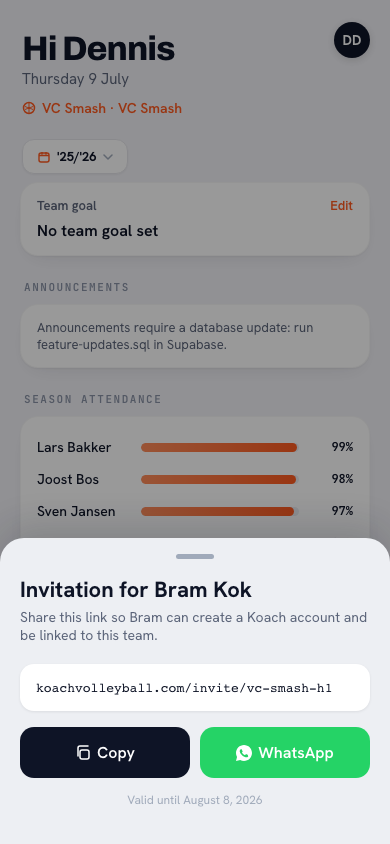
The less a new coach has to build from scratch, the smaller the chance they drop out. If the team is already set up in Koach with the player list, last year's attendance and their predecessor's drills, they start evening one with a session instead of an empty notebook.
Three moments when a coach decides to stop
At the committee meeting, a departure feels sudden, but the decision is almost always taken at one of these three moments. Know them and you can put yourself in the way.
- Around week 6. The novelty has worn off and the arithmetic disappoints: the evening that was going to cost ninety minutes costs four hours — preparing, leaving work early, fetching balls, and twenty messages at night. The signals are small: they ask whether someone can cover, they arrive exactly on time instead of ten minutes early, and they stop asking questions. This is the moment to take jobs away, not to ask whether they are managing.
- After the winter break. January is the heaviest block: dark, cold, and seven out of twelve turn up at the first session back. A coach standing in a half-empty hall concludes that nobody cares. Two things help: somebody from the club coming to watch that first week, and a conversation about the attendance figures rather than about the feeling.
- In April. Almost nobody quits here — here people fail to continue. That is not a decision against the club but the absence of a decision for it, usually because nobody asked, or asked only in June, when the coach has already planned something else. Ask in March, well before the teams are entered, and do not ask "are you doing it again next year?" but "what would have to change for you to say yes again next year?".
It is rarely about the players
Ask a coach who has stopped why they gave up and you almost never hear anything about the group. Four other things do keep coming back, and all four can be solved at club level.
- The group chat. Forty messages a week, two of which are about the session. Agree that absences do not go in the group but in one fixed place, and that the coach is not expected to read along in the evenings — see setting up the team chat properly.
- The driving. Working out who drives on Saturday is the job coaches complain about most and the one with the least to do with coaching. Give it to a parent or to the team and keep the travel rota away from the coach.
- The parents. Not the shouting from the sideline, but the two parents who have an opinion about the line-up afterwards. Appoint one person at the club who takes those conversations over, and say so before it happens — a coach who knows they are allowed to refer it on does not lie awake over it.
- Saturdays. Plenty of people are happy to coach a session but not to be at every match as well. That is not half-hearted commitment, that is a diary. Split those roles if it is the only way to keep somebody: the coach on Tuesday, a parent or a player from a higher team as match coach. Two half leaders beat none at all.
Three twenty-minute conversations a year
Retention is not an atmosphere and not a bunch of flowers; it is a conversation in the diary. Three a season is enough, twenty minutes each: one around week 6, one after the winter break, one in March. Always the same three questions:
- What is costing you more time than you expected? This is where the real work surfaces: the driving, the app, finding a hall after a cancellation.
- What are you doing now that is not really yours? Almost every coach has quietly taken on two jobs nobody gave them.
- What would have to change for you to say yes again next year? Ask this one in March, not in June.
Write the answers down and do something with them within two weeks, even if it is only one thing. A conversation without follow-up is worse than no conversation: you have then confirmed that the problem is known and that nothing happens. Note the answer to question three somewhere your successor can read it too, because that spring meeting is run by different people every year.
What you can take away without asking anyone
Part of the retention work costs no conversation at all, just a decision. Three things most clubs can do straight away:
- Keep the hall time stable. A training slot that shifts by an hour every season forces every coach to make a fresh choice about their evening. Some of them will say no.
- Make sure the equipment is right. A ball cart with eight hard balls, a pump that works, a net that can be set to height. Small, but it is the first ten minutes of somebody's evening every week.
- Take the admin away from the coach. Sign-ups, attendance, jobs and announcements belong in one place they do not have to maintain themselves. In Koach those run through announcements, polls and tasks, and you manage teams, coaches and roles centrally through club management. The point is not which tool you pick, but that a new coach walks into a club on evening one where it is already sorted.
Key point: recruiting and retaining are the same job at different moments. Every part of the ask you shrink up front — eight weeks instead of a season, with Tim instead of alone, without the travel rota and without Saturdays — is the reason that same coach is still standing there in April.
Frequently asked questions
How many coaches do I need for a club with ten teams?
Count on slightly more slots than teams, because some teams train twice a week and the odd coach takes two groups. More important than the total is the distribution: aim for pairs at the youth teams, because that halves the ask per person and absorbs absence.
Does a youth coach need a qualification from the federation?
What is compulsory and what is merely recommended differs by federation and by country; check with your own before you promise anything. In practice it almost always works better to let someone shadow for eight weeks first and offer the course afterwards, rather than the other way round.
What do I do if there is still no coach two weeks before the start?
Deliberately choose a temporary arrangement instead of carrying on searching: two parents alternating, a player from a higher team for the hour before their own session, or an experienced coach running two groups at once in the same hall. Do say how long it lasts, otherwise the stopgap quietly becomes the permanent solution.
Does paying coaches help?
An allowance can compensate for travel costs and lost time, but it solves none of the four most-cited reasons for leaving: the group chat, the driving, the parents and Saturdays. Money spent without tackling those four buys you a season at most. Whether and how much you may pay also depends on the rules in your country and your club's own arrangements.
When do I ask whether someone is continuing next season?
In March, and in any case before the teams for the new season are entered. Do not ask it as a yes-or-no but as 'what would have to change for you to say yes again' — that gives you a list you can act on, instead of an answer you can only wait for.



Try it yourself in Koach
Less admin, more coaching.
Get started with KoachOr read first what the volleyball coaching app does.