
Starting as a volleyball coach: your first season step by step
Nobody starts out as a fully fledged coach. Most volleyball coaches fall into it: the previous coach quit, you happened to be closest. This article lays out your first season step by step — what to arrange before the first practice, how to build the season and where to put your energy, and where not.
What does a volleyball coach actually do?
On paper: run practices and coach matches. In reality, four roles come with it that nobody tells you about in advance: organizer (hall, balls, attendance), communicator (players, parents, board), referee of small conflicts and keeper of the atmosphere. The good news: you do not have to master everything in year one. The coaches who last are rarely the most tactically brilliant — they are the ones who bring structure and communicate honestly.
Before the first practice: three things to arrange
- Know your group. How many players, which positions, what level? For a new team a tryouts helps you choose fairly; for an existing team a round of getting-to-know-you talks is worth its weight in gold.
- Make agreements. In the first week, lay down team agreements together about attendance, cancelling and behavior. What you agree in September, you do not have to fight for in January.
- Choose a captain. Not the best player, but the player who carries the team — more on that later.
Building your season
Think in three blocks. Block 1 (until the autumn break): foundation — basic technique, a fixed warm-up routine and your first lineup. Block 2 (until the winter break): deepening — tactical agreements, conditioning and jump power, and learning to handle match tension. Block 3 (after the winter break): harvesting — fewer new things, more sharpness, and time for team building when the grind sets in. Whoever wants everything in October has lost their team by February.
Running practices without experience
A good practice has a fixed skeleton: warm-up, technique block, game form, closer. More about that structure is in running a volleyball practice. Two beginner mistakes to avoid: talking too much (players learn from hitting balls, not from listening) and doing something new every week (repetition feels boring to you, but is exactly what players need). Do not forget the physical foundation either: injury prevention and a short cool-down belong there from day one.
Your first match day
Coaching the match is a craft of its own: time-outs at the right moment, substitutions without panic, radiating calm while not feeling it yourself. Read up via match coaching and keep it simple: one tactical point per time-out, and afterward first name what went well. Want to go a step further, then scout the opponent — but only once your own team is settled.
The organization around it: keep it small, but do arrange it
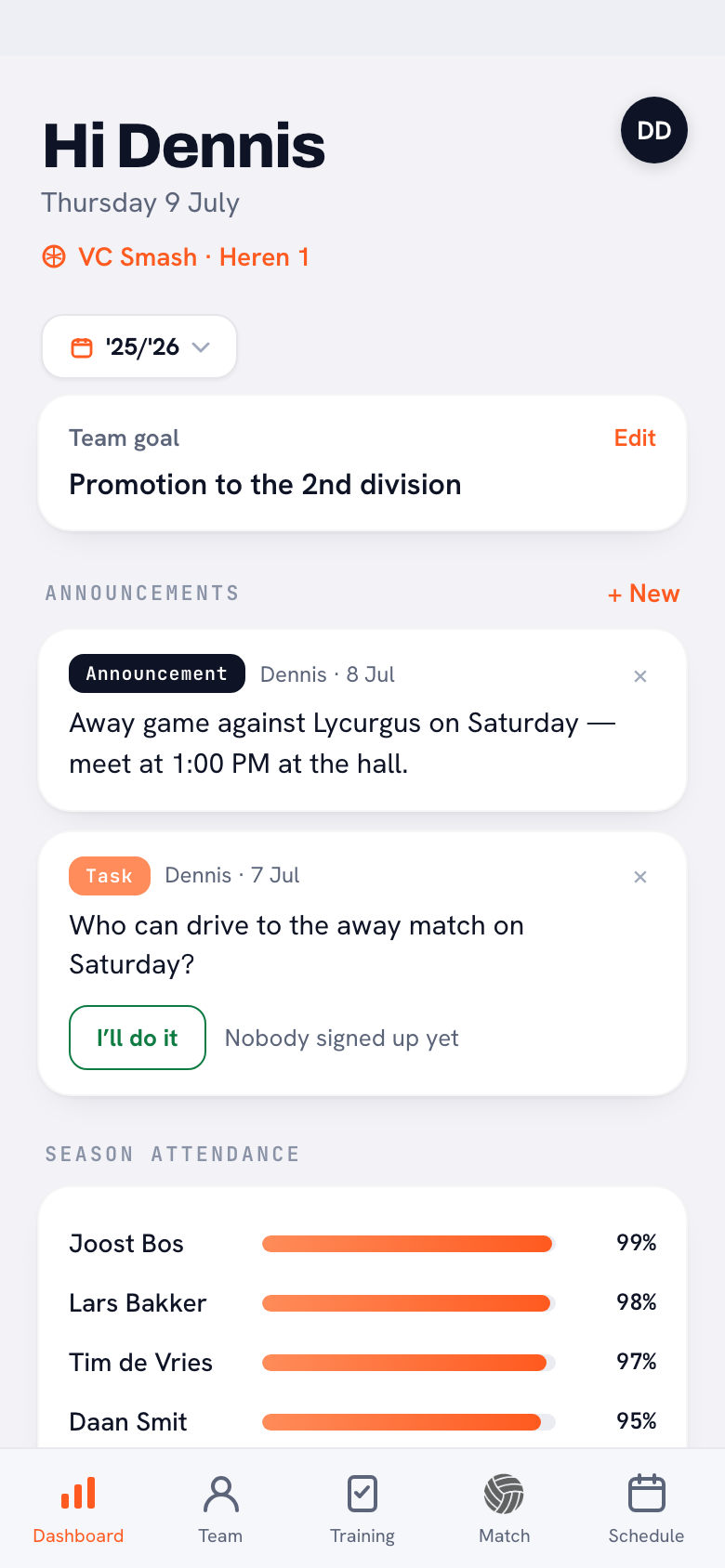
Alongside the volleyball runs a second season: the organizational one. Who is there on Tuesday, who is driving Saturday, who cancelled and why? Arrange that from week one in one fixed place instead of scattered across chat messages and your memory — track attendance per practice, a team calendar everyone sees, and short notes per player. It sounds like admin, but it is coaching: the player who is absent three times in a row is one you want to speak to in week four, not discover in December. Also agree right away on how you communicate: cancelling to you personally (not quietly in the group chat), and announcements from you on one fixed channel. For youth teams a third line comes with it: the parents. One short parents' evening or message at the start of the season — what your approach is, what you expect of them on the sideline — prevents nine out of ten difficult conversations later.
Common mistakes in season one
- Wanting to be a friend. Being kind and being clear do not exclude each other — but whoever sets no boundaries in September will not manage to set them in January.
- Coaching only the best players. The middle group determines your team's level; the weakest player determines your atmosphere. Divide your attention deliberately.
- Dividing playing time by feel. Nothing undermines trust faster than the sense that the coach has favorites. Track who plays how much and be able to explain it.
- Not asking for help. A parent who runs the scoreboard, a player from a higher team who trains along occasionally, a fellow coach as a sounding board — coaching is not a solo sport.
Do not forget yourself
Coaches develop too. After a few weeks, ask your players for feedback ("what should I keep doing, what differently?"), watch an experienced colleague at work, and where possible take a coaching course through the federation. And pay attention to the mental side — with your players via mental training, but also with yourself: a lost match is data, not a verdict on you as a coach. At the end of the season, schedule your own evaluation moment: what went well, what will you do differently next year, and do you even want to continue with this group? Coaches who have that conversation with themselves start season two with a plan instead of a repeat.
The 80% rule for your first season: if your practices have structure, everyone knows where they stand and players come with pleasure, you are doing well. The tactical finesse comes on its own in season two.
Frequently asked questions
Do I need a diploma to become a volleyball coach?
For most youth and lower senior teams no — the club decides who stands in front of the group. A coaching course (for example VT2 through the Dutch federation) is recommended, though: you get didactics and drill material that last you for years.
How much time does coaching take per week?
Count on double the hall hours: two practices and a match mean six to eight hours in practice, including preparation and communication. With fixed routines and good administration that shrinks considerably after a few months.
What is the biggest mistake of beginning coaches?
Wanting everything at once: new technique, new tactics and stricter discipline in the same month. Choose one focus per block and repeat a lot — a team remembers what it does often, not what it heard once.
Can I coach and still play myself?
Yes, many coaches do — but not in the same team without arrangements. If you coach your own team, arrange for someone to take over the match duties while you are on the court.


Start your first season with an overview
Team, practices, attendance and matches in one place — so you keep your attention on the coaching.
Get started with KoachOr read first what the volleyball coaching app does.