
Recruiting new members for a sports club: what works and what does not
In May the team allocation will not add up: the youngest youth group has seven names and needs ten. Someone suggests an open day, because that is what we did last year — eleven children turned up and two stayed. New members are not an event but a sum with a handful of fixed channels, and those channels sit closer to the gym than most clubs think.
Work out first how many you need
Every club loses members. People move house, get injured, have a baby, go off to study or find another sport more fun. Add it up and most clubs see between ten and twenty per cent of their members leave each season. At a hundred and eighty members that is eighteen to thirty-six people. Bring in ten a year and you shrink — even if that open day felt good.
That total is not enough on its own, though, because a club does not recruit "twenty-five members". You need children of eight to ten to fill the bottom, three thirteen-year-olds for a team that will be too thin next year, and adults who can make Wednesday evening. So once a year, somewhere in May, make one sheet of paper listing per year of birth how many members you have, and underneath it what is needed to keep every team at eight or more. Out of that sheet rolls an assignment like: six children from the two youngest years, three girls of thirteen, four adult beginners. You can do something with that. "We need more members" is not an assignment.
That count per year of birth is the same one that shows where you lose them; how to build and read it is in keeping youth players. Recruiting and keeping are two taps on the same bath: a club that brings in twenty and lets twenty-five walk away works harder than the club that recruits ten and loses five, and is worse off.
Where new members really come from
Ask your next twenty sign-ups — one line, on the sign-up form itself — and the answer almost always falls into this list, roughly in this order of yield.
- A friend of an existing member. By far the biggest source, and with youth players almost the only one. Children play sport where their friends play sport.
- A brother, sister or parent of an existing member. They are already in the gym every Saturday. The only thing missing is someone asking them once.
- Having seen the sport at school or at another club. A PE lesson, a school tournament, an older cousin who plays. This channel works with a delay: whoever sees it in March signs up in September.
- Someone who is looking. Moved house, stopped with another sport, or fancies it again after years away. This person searches online and lands on your club website or on your federation's page.
- A former member coming back. Small in number, but it costs almost no effort and they stay a long time.
The conclusion is uncomfortable for anyone who enjoys designing flyers: most new members come in through someone who is already there. Your recruiting power sits inside the gym, not outside it. That does not mean you can do nothing outward-facing — sources three and four are real — but it does mean you fish out sources one and two first, because those cost an evening and no budget.
One open day a year is the most expensive way to recruit
The classic open day puts everything on one date: one lot of weather, one weekend, one diary that has to compete with every other. Anyone who is ill or away that weekend drops out. And anyone who only realises after three weeks that he enjoys it has no second moment.
Four small entry moments deliver more than one big one, and together they cost less work. A spread that fits most clubs:
- Early September, in the first two weeks of the season, while everyone is still choosing.
- November, when the first sports clubs of that year turn out to be disappointing and children switch after all.
- January, straight after the winter break. This is the most underrated moment of the year: good intentions, and adults looking for something.
- April, with the message that you can join in now to start properly next season.
Keep such a moment short and concrete: 75 minutes, at the normal practice time, in the normal gym. No tour, no welcome speech from the board, no sign-up table by the door. Balls from minute one, because that is what people came for. For the youngest groups, game forms in which everyone is moving straight away beat a drill with a queue: from twelve volleyball games for children you can pick three that work without any explanation.
The biggest practical mistake is staffing. Twenty new children with two coaches becomes a chaos in which nobody remembers a name. Count on one supervisor per six newcomers and take those people out of your own teams: sixteen-year-olds enjoy this job, and it is an hour, not a commitment.
The bring-a-friend practice is the only channel you can scale
Of all the actions a club can take, there is one with a predictable yield: every member may bring someone along to a normal practice. Reckon conservatively. In a team of twelve, four or five say yes, and of those three or four actually turn up. Do that with three youth teams at once and you have ten to twelve new children in the gym on one evening — more than most open days deliver, without a poster and without a stand.
Four things decide whether it works:
- Put the invitation in the child's hands, not the parents'. A message in the parents' group disappears among the rest. A card in the hand, at the end of practice, with a date on it, stays in a sports bag until Tuesday.
- Name one date and one time. "Bring someone along some time" never happens. "Tuesday 12 November, half past six, bring one person" does.
- Do not do it in September. Everyone has just started somewhere. November and January are the months in which children actually switch.
- Do not change the practice. Whoever comes along wants to see what it is like here on a normal Tuesday. A special show gives the wrong picture and produces disappointment in week two.
You do not find adults with children's recruitment
Adult intake runs along a completely different path. It is about people between twenty-five and forty-five who have moved house, stopped with another sport or played years ago. They do not walk past a stand; they search online for volleyball for beginners in their town, and their first question is never what level they are. Their first question is: does that mean every week, and a match every weekend?
That is why a recreational or entry group is not a leftover category but your front door. One evening a week, no league, and the chance to move up after a year if someone wants to. What you train in such a group without it going soft is in training recreational volleyball players. Do not put a new adult straight into a league team: he misses half the arrangements, stands beside the court every set and is gone by Christmas.
Make sure your club website also carries four things that are surprisingly often missing: which day and what time that group trains, in which hall, what a first session costs (usually nothing) and one name with a phone number. Not a contact form — a name. That is worth more sign-ups than any advert.
The first three practices decide whether someone stays
This is where most of it leaks away. Of the eleven children at that open day two stayed, and that was rarely down to the sport. Someone who has stood beside the court for an hour and a half without anyone asking his name does not come back — however much he enjoyed it.
Four arrangements catch that, and they cost not one extra minute of gym time:
- Appoint someone in advance to receive the new people. Not the coach: he is busy coaching. A parent, a teammate, a player from an older team.
- Give every newcomer a buddy from the group. That person walks around with him, points out the changing room and makes sure he belongs somewhere in every drill.
- Make sure he touches the ball in the first five minutes. Anyone who waits half an hour for his first ball contact has spent that half hour deciding this is not for him.
- Invite him out loud for next time at the end, with the date. Three seconds of work. Without that sentence people assume it was a one-off.
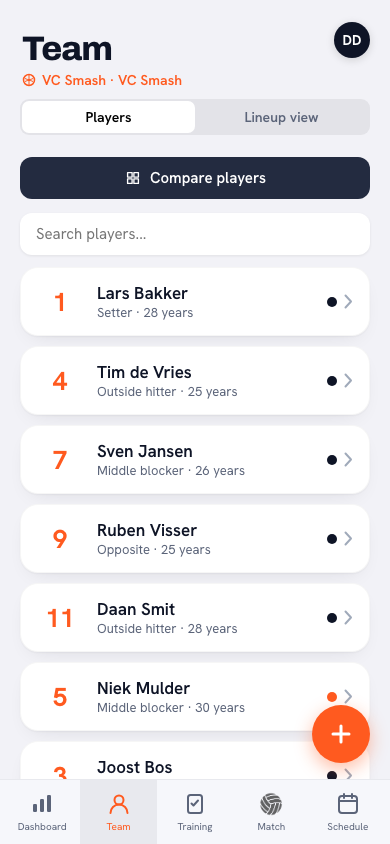
Administratively there is almost nothing to do in those trial weeks. Put a trial player in your team as a training guest, and he appears in the list and in the attendance without counting towards your playable squad — what does and does not count is in training guests and guest players. In that phase, do not ask for more data than a name, a phone number and an emergency number either; real membership only starts once someone says yes, and that route is in from a completed form to a place in the team.
Practical: agree that the third practice is decision day. At the end of it, someone asks the question out loud: do you want to join? Without that moment a trial player floats around for months, and floating trial players quietly drift away.
Do not recruit for a team that does not exist
The most expensive mistake in member recruitment is success at the wrong moment: bringing in nine children in an age group for which there is no gym time, no coach and no team. You have then made nine families enthusiastic and you have nothing to offer them. Those nine tell the story on, and that story does more damage over two seasons than the intake was worth.
So before every announcement, walk through these four questions:
- Is there gym time? Not "we will find something", but a slot on a day and at a time.
- Is there a coach? The scarcity usually sits here and not with the members. How to solve that question is in recruiting coaches.
- Does this age fit into an existing team, or does a new team have to be formed? That difference decides whether you are looking for three children or ten; see team selection in youth volleyball.
- Who decides where someone ends up? One person per age group, with the authority to say yes within two weeks.
If a team really is full, be honest about it immediately and name a date on which you will look again. A waiting list that someone knows about costs you nothing. A sign-up that gets no response for three weeks costs you the member and his story.
Three numbers to look back on next year
Almost every club evaluates recruitment on feel: "that open day was busy". Busy is not a result. Note three numbers per entry moment on one line, and after two seasons you know exactly which channel is worth an evening and which is not.
- How many people came? Count them on the day itself, not from memory afterwards.
- How many trained three times? This number says something about your welcome, not about your promotion. If it drops from twelve to three, something is wrong in the gym and not in the announcement.
- How many were still members six months later? The only number that ultimately matters.
Add one question to your sign-up form: how did you find us? One line of text, no drop-down. After a season you have twenty answers and you can see in black and white that fourteen new members came in through a teammate and none through the flyer that cost two people a Saturday. That is how you end a discussion which otherwise comes back every year.
Frequently asked questions
How many new members should a sports club recruit each year?
Reckon on ten to twenty per cent of your membership just to stand still; at a hundred and eighty members that is eighteen to thirty-six. More important than that total is the spread: count per year of birth what you have and what each team needs next season, and recruit against that list instead of against a general shortage.
Does an open day still work?
As a stand-alone event it almost always disappoints, because everything hangs on one date and one weekend. Four smaller entry moments a year — September, November, January and April — at the normal practice time in the normal gym deliver more together and cost less organising.
From what age can you recruit children?
That depends on the age from which your club has a group they can join; at most clubs that starts around six or seven with an adapted game form. What a child can handle at which age is in from what age can you play volleyball.
How often may someone train for free before joining?
Two to four times is enough to know whether it suits, and longer is mainly awkward: nobody is insured, nothing is paid and nothing is agreed. So put an end date on it and have someone ask the question on that day, rather than waiting for it to become clear by itself.
What do I do when a team is full and someone signs up anyway?
Say so straight away, and name a date on which you will look again — after the winter break, for instance, when the first leavers are known. Ask at the same time whether he would like to train with a group that does have room until then; that keeps someone on board without making a promise you cannot keep.



Try it yourself in Koach
Less admin, more coaching.
Get started with KoachOr read first what the volleyball coaching app does.