
Club registration form: from a completed form to a place in a team
Somebody wants to join and fills in a form. That is the easy part. After it comes a route past four people who do not automatically talk to each other, and somewhere along that route the application sits still for three weeks. This article is about that route, not about the fields.
The form is the easy part
Almost every club that sets out to tidy up its applications starts at the form: neater, digital, fields in a logical order. And then it turns out the mess never came in through the form at all. It sat behind it.
Because the applications did not come from one channel. They came via the address on the website, via a paper slip that stayed lying in the clubhouse, and via a coach who was collared after practice and thought: I will remember that name. Three entrances, three people each assuming the other picks it up. A better form changes none of that: the problem only starts when somebody taps Send.
Which details you ask for on that form is a separate question with a good answer we are not going to repeat here: the complete list — basic details, the four health questions, consent for photos and video — is in which player details you really need. And on what grounds you may keep those details, and for how long, is in GDPR for your sports club. This article is about what happens next: the road from a completed form to a name standing in the hall on a Tuesday evening.
The four stops of one application
At virtually every club an application passes the same four stops, which are rarely written down anywhere. Each stop should have one owner, and exactly one thing that comes into being there and nowhere else.
- Stop 1 — the form itself. Owner: whoever the applications land with, usually the club secretary or the membership administration. What comes into being here and nowhere else: the application date, and the confirmation that the application exists at all. Everything that goes wrong later goes wrong because this stop has no owner but a mailbox.
- Stop 2 — the membership administration and the federation. Owner: the membership administration. What comes into being here: the membership number and, if your club plays league volleyball, the registration with the federation your club belongs to. That differs from country to country — sometimes a form, sometimes a portal, sometimes weeks of waiting. This is also where the answer sits to whether somebody is allowed to play yet.
- Stop 3 — the treasurer. Owner: the treasurer. What comes into being here: the payment arrangement. The amount and how you collect it is a story of its own — that is what working out subs per team or per member is for. The trap is the start date: somebody joining halfway through the season rarely pays the same, and that date exists only at stop 1.
- Stop 4 — the team's coach. Owner: the trainer or coach. What comes into being here: the name in the squad, the shirt number, the place in the team group chat. This is the only stop the new player notices — and the only one where nobody keeps a form.
At every stop the same details are typed in again: name, date of birth, email address, four times, into four systems that know nothing about each other. That is why a change of address stays out of date in three places. You will not get rid of those four stops — a federation has its own portal, a treasurer his own bookkeeping. What you can do: write down per stop who has it, and cut back the number of times something is retyped.
The gap between applied and placed
Between stop 1 and stop 4 sits a period in which the applicant hears nothing. That is the most dangerous phase, and no form solves it.
Look at the question inside it: which team is this person going into? For an adult who clearly fits somewhere, that is a phone call. For a thirteen-year-old who has never played volleyball, it is a trade-off between two teams that are both nearly full, made by people who speak to each other once a month. Meanwhile somebody is sitting at home waiting who was full of enthusiasm last week.
Three things help, and none of the three costs money.
- Appoint one decision-maker per age group. Not a committee, one person with the authority to say yes. The committee may overturn that choice later; the applicant needs an answer now.
- Agree a maximum and put it on the confirmation. For example: an acknowledgement within two days with the name of the person picking it up, and a decision on the team within two weeks. Short enough to hold on to somebody, long enough to get a coach involved.
- Send an interim message if it is not going to work. A three-line message — we are still on it, you will hear more next week — keeps virtually everybody on board. Silence does not.
If the team really is full, say so straight away, with a date on which you will look again. A waiting list somebody knows about is fine. A waiting list somebody is on without knowing costs you the member as well as the story he tells about it.
Training along without anybody silently becoming a member
Most clubs let somebody train along a few times first. That is sensible, but it is also exactly the place where the administration comes off the rails — because somebody training along is not a member, and after a while becomes one anyway, without anybody having appointed a moment for it.
So for a trial period, ask for less, not more. What you need: name, date of birth, one phone number for the person himself or a parent, and one emergency number. No bank details, because nothing is being collected yet. No federation number, because nobody is playing yet. No signature under a membership that does not exist yet. Ask for those things and you are keeping data on somebody who never became a member.
Then head off the silence with one agreement: a trial period has an end date, and somebody phones on that date. Two or three sessions is enough to know whether it suits. Then there is one of two outcomes — it becomes a membership, and only then does the full form come round, or it stops. What somebody training along is and is not is in taking part without being in the squad.
In short: never let a trial period slide into a membership by itself. Put a date on it and have somebody phone that day — that one call heads off both an angry invoice and a player who was never officially registered.
The details you miss later
Three things virtually every club only needs at the moment they are missing, and all three can be collected in ten seconds at the point of application: an emergency number that is not the player's own number, the second contact for juniors — the other parent or guardian — and the arrangement about being picked up and sharing lifts after an away match. That third one is the hardest to reconstruct after the fact and the most sensitive when it goes wrong.
What belongs with the application here and nowhere else is the question of who they reach. An emergency number that only sits in the secretary's mailbox does not help the coach in the hall.
The exit nobody designs
Every club has a joining route and almost none has a leaving route. It is the same route in reverse, and the damage is greater: when an application stalls you lose a member you did not have yet; when a resignation stalls, somebody keeps paying for a sport he no longer plays.
So build into your form — or next to it — the one thing that is usually missing: an end-date route. Four things have to happen, and they are the same four stops.
- The resignation is confirmed, with the date on which the membership ends. Not “we have received it”, but a date.
- The member is deregistered with the federation if he was registered there. Fail to do that and the club often keeps paying for somebody who has gone.
- The final payment is set and the next one is stopped. This is the most common complaint from members who have left.
- The coach takes the name out of the team and out of the team group chat. Until that happens, somebody is still in the lineup and still getting messages about a match he will not be at.
Agree as well what happens to the data once somebody has gone: what you keep for the bookkeeping and what you clear out. The point being that the clearing out is attached to the resignation, not to an annual clean-up nobody ever does.
The fields, bare — and the last stop
If you want to build a form yourself, in whatever tool, this is the bare list — names only; the explanation per field is in the article on player details.
- Person: first name, surname, date of birth, gender (optional), address, postcode, town.
- Contact: email address, phone number, emergency contact with name and number.
- For players under 18: name, email address and phone number of the first parent or guardian, the same for the second, and the pick-up or lift-sharing arrangement.
- Sport: played before yes/no, previous club, preferred position, kit size, desired level or team.
- Health: any condition to take into account during exertion, medication that has to be within reach, allergies, previous injuries.
- Administrative: start date, payment details, agreement to the club rules, choice about photos and video, federation number if somebody already has one.
- Volunteering: one open question is enough — what would you like to do.
You can manage that list with any free forms package. What it does not solve for you is stop 4: getting the name actually into a team. That stays an email to a coach who retypes it.
In Koach that last stop is where the retyping stops. Koach does not host your registration form — which form you use stays your own choice. What does happen is that the coach puts the new name into his own team once, with a date of birth and a Member since field, and where necessary the Training-only player label for as long as it is still a trial. From that moment the committee sees that person in the club's member list without anybody forwarding anything. With Invite to Koach the coach sends a personal link; whoever opens it creates his own account and is linked to the team. After that the new member fills in his own phone number, emergency contact and emergency number under Edit profile — precisely the fields that always go stale in a mailbox. For juniors you do the same with Invite a parent, so that dropping out of a practice sits with the parent and not with a child who has no phone.
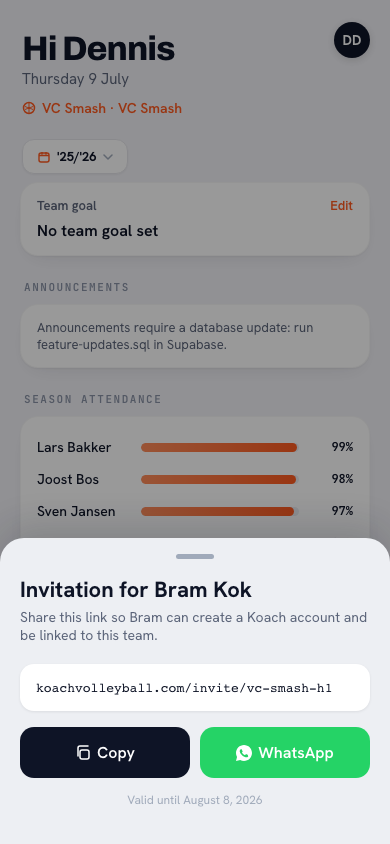
Two conditions come with it: the team has to be linked to the club — see linking your team to the right club — and the committee only sees the member list as a club administrator, as described in managing your volleyball club. Stops 2 and 3, federation and treasurer, simply stay as they are. But the application no longer sits in a mailbox waiting for somebody to notice it.
Frequently asked questions
Should we take the paper form out of the clubhouse if we go digital?
Not necessarily, but do not let it carry on as a second entrance. Turn the paper form into a prompt sheet that somebody then submits digitally himself, or agree that whoever takes it in sends it to one address that same evening. Two entrances that both count as the source is exactly where it goes wrong.
Who should receive the registration form: the secretary or the coach?
One club address, not somebody's private address and not the coach. A coach changes more often than a club address does, and he is the last stop, not the first. It is useful, though, if he automatically gets a copy of applications for his own age group, so he knows somebody is on the way.
Can somebody train with the team before he is a member?
At most clubs yes, but whether he is insured and whether he is allowed to play in matches differs from country to country and from federation to federation. Ask your own federation once and put the answer in your club handbook, then nobody has to work it out case by case.
How do I stop an application sitting there while the person receiving it is on holiday?
Put two people on the receiving address instead of one, and agree that every application gets a confirmation within two days with the name of whoever is picking it up. As long as that confirmation has not gone out, the application counts as open — and that is a check you do at a glance.





Try it yourself in Koach
Less admin, more coaching.
Get started with KoachOr read first what the volleyball coaching app does.