
Volleyball membership fees: per team or per player?
At a lot of clubs the fee comes about like this: take last year's number and add a few per cent. Nobody then knows where the amount came from, and at the members' meeting nobody can explain it. This article is about the club fee your members pay — not about software or subscriptions. It makes the sum underneath visible, and that sum starts with one distinction: which costs run per team, and which run per player?
Two kinds of cost, and why that difference decides everything
Most arguments about subs get stuck on whether the court hire is too high. That is the wrong question, and on top of that a question that works out differently in every country: in one town a club pays a market rate for its court hire, in the next it gets its hours almost free from the local council or from a school. What is the same everywhere is something else — the way costs move.
Every item of club expenditure falls into exactly one of two buckets:
- Costs that run per team. They don't change when a player joins or drops out: the practice slot in the hall, the match hours, the team entry fee with the federation, the referee and scorer costs for your home matches, the coach's fee and that team's set of balls.
- Costs that run per player. They scale one for one with the number of members: the per-member levy to the federation, the accident and liability insurance, the player licence if your federation issues one, and the share of the kit written off per player.
Why that difference bites so hard: the first bucket is usually the biggest, and it is fixed. A team of seven and a team of fourteen hire the same hall, enter the same competition and have the same coach. They just divide that bill by a different number. Once the amount is settled the second job begins, and that is keeping track of who has paid without an accounting package getting involved.
The sum, written out
Take one senior team, one season. The amounts below are examples — fill in your own figures, because court hire rates, federation levies and referee fees differ per federation, per council and per country. The pattern holds up whatever you put in.
Costs that run per team:
- Practice slot: 1.5 hours a week × 34 weeks × €20 an hour = €1,020
- Home match hours: 9 matches × 2 hours × €20 = €360
- Team entry for the competition: €150
- Referee and scorer costs at home: 9 × €25 = €225
- Coach's fee: €600
- Balls and team equipment: €120
Together €2,475 per team per season. On top of that the costs that run per player: federation levy €35, insurance €5, licence and kit write-off €10 — together €50 per player.
What does that cost per player, at four different squad sizes?
- 7 players: €354 team share + €50 = €404 per player
- 9 players: €275 team share + €50 = €325 per player
- 12 players: €206 team share + €50 = €256 per player
- 14 players: €177 team share + €50 = €227 per player
So a team of seven costs nearly twice as much per player as a team of fourteen: €404 against €227, a factor of 1.8. And that gap isn't because those seven players use more. They use exactly the same — with fewer people.
Who pays extra, and who chips in?
Say that same club has eight teams and 88 members, an average of eleven per team. One rate for everybody then comes out at €275 per member: eight times €2,475 in team costs plus 88 times €50 in per-player costs, divided by 88.
Now run two teams through that single rate. The team of fourteen costs the club €3,175 and brings in €3,850: a surplus of €675, or €48 per player that this team is overpaying. The team of seven costs €2,825 and brings in €1,925: a shortfall of €900, or €129 per player that this team is underpaying. Between the luckiest and the unluckiest member there is €177 a season, on a fee of €275.
That isn't a mistake. It is a choice — only a choice nobody ever made, because nobody ever worked it out. Once you do work it out, you can defend it: “big teams help pay for small ones, because otherwise we won't have a third team left” is a perfectly good position at a members' meeting. “It's how we've always done it” isn't.
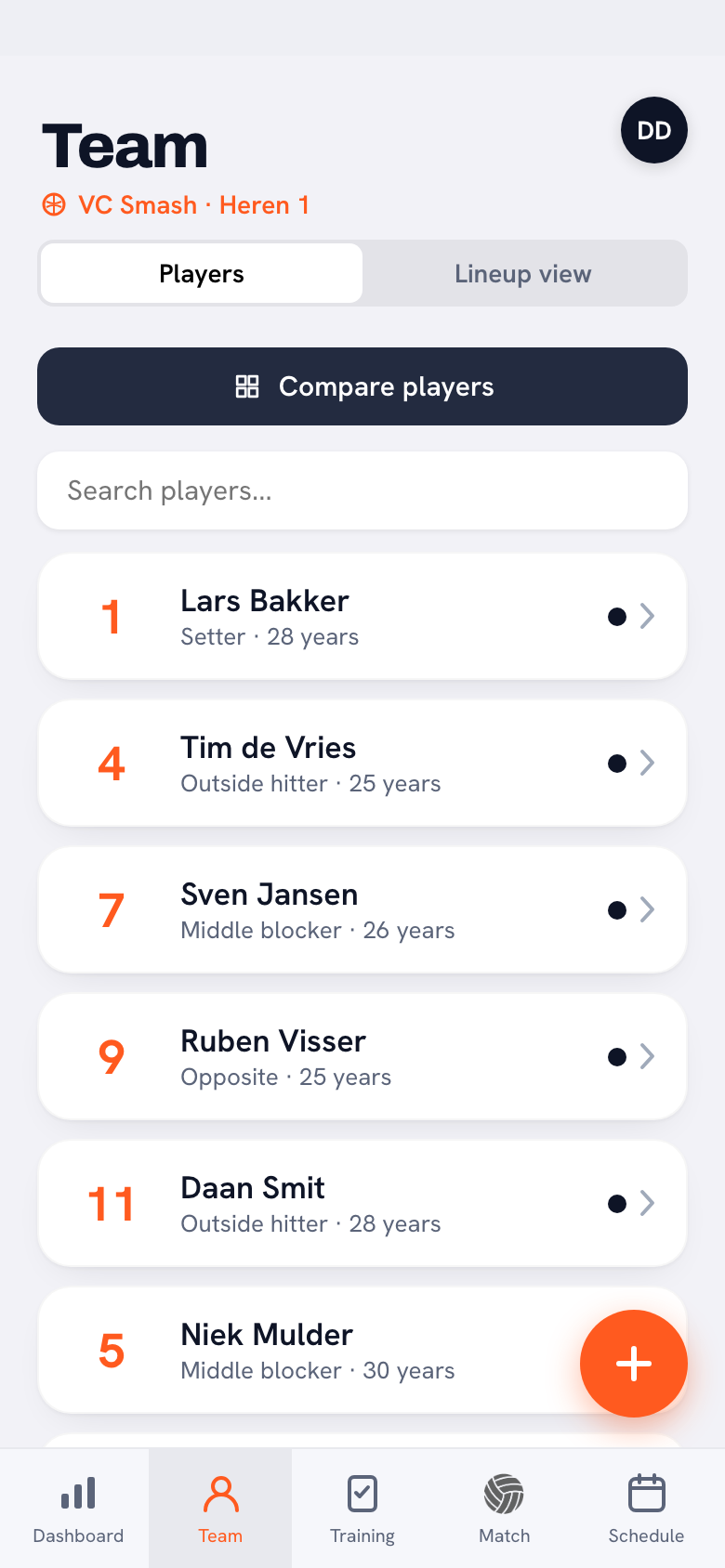
That denominator is where most budgets go crooked. Clubs work with the June membership figures and discover in November that three teams in practice consist of eight people. Anyone who tracks per team how many players are genuinely active — in Koach that number sits per team in the club dashboard, see managing your volleyball club — has the most important variable in the budget to hand all year. And to be clear: the cost of an app like that stands entirely apart from this sum and belongs under club resources rather than team costs; what that comes to is in what Koach costs.
Why court hire never runs per player
Court hire is usually charged per hour per court, and you don't hire half a court because your team is half the size. The same goes for the team entry, the referee and the coach: blocks you take whole or not at all.
From that follows a practical rule for the technical committee, one that looks like it has nothing to do with money and has everything to do with it: the cheapest way to keep the fee down is to fill your teams properly. Two teams of seven cost €4,950 in team costs between them; one team of fourteen costs €2,475. Merging them isn't a saving of a few pounds here and there but a halving of the biggest cost item. Who decides whether teams merge and when that decision falls is in who decides what at your club. Take that decision before the entry deadline; after it you are stuck with the bill for a season.
It works just as well the other way round: every player you add to an existing team that isn't full costs the club only the per-player share — €50 in our example — while paying the full fee. The ninth player in a team of eight is financially the best member you can recruit this season.
Key point: split your budget once into two columns — costs per team and costs per player — and divide the first column by the real number of players per team. That single page answers three questions in five minutes that otherwise take you three meetings: is our rate fair, which team is subsidising which, and what is actually costing so much.
Three policy choices that follow from the sum
- One rate for everybody. Simple to collect, whether you use direct debit, payment requests or bank transfers, simple to explain, and solidary: small teams survive because full teams help pay. Choose it deliberately and put the size of that solidarity in the notes to the budget. Downside: as more teams get too small, it presses ever harder on ever fewer people.
- A supplement or discount by squad size. Teams below an agreed threshold (say nine players) pay a supplement per player, teams above twelve get a discount. This is the fairest towards the individual member and it gives teams a reason to recruit for themselves. Downside: you penalise players for something they have little influence over, and one resignation in January can push a whole team into another band. So fix squad sizes on one reference date per season.
- A fixed team amount plus a personal player share. The club invoices the team a fixed amount (the team costs) and each member their own player share on top. The team divides the team amount among itself. This matches exactly how the costs really run, and teams immediately start looking differently at hall hours and tournaments. Downside: it is the heaviest variant administratively and you need someone per team to run the team kitty — a job that in practice lands with the team manager.
There is a fourth route that often gets forgotten: leave the rate alone and solve the problem where it actually sits. A team of seven is rarely a financial question and usually a membership question.
Tiers: youth, seniors and recreational players
Once you have the two columns, you can work out per type of team what a tier is worth — instead of guessing at it.
Recreational players are the cheapest, and it amounts to more than a small discount. A recreational group usually practises once a week, plays no league matches and therefore has no team entry, no match hours and no referee costs. In our example that takes out €150, €360 and €225: €1,740 in team costs is left instead of €2,475, and without a paid coach €1,140. Divided over fourteen participants that is €124 and €81 per person respectively, against €177 for a senior team of fourteen — and on top of that the federation levy for non-competing members is often lower. So a substantially lower recreational rate isn't a favour but an outcome, and that is how you explain it to the seniors paying the highest amount. What such a group needs beyond that is in coaching recreational players.
Youth is trickier. Youth teams often practise twice a week, need more supervision and are smaller in number — which regularly makes their cost per player higher than the seniors', while they usually pay the lowest rate. That is a perfectly good thing to choose; just call it a choice rather than a calculation, and say where the money comes from (the seniors, a sponsor, or the bar). While you are at it, don't forget the training of your youth coaches in that budget line: it costs money in the budget while being invisible in the rate, see recruiting and keeping coaches.
Two things don't belong in the basic fee: playing in a second team and tournaments. A member who plays in two teams costs the club no second player share — they are already a member and already insured — but does cost part of an extra team slot. A supplement the size of that team share is fair; a second full membership fee is not. And not every team plays tournaments, so settle the entry fees separately with the teams that take part. The rule of thumb: anything that not every team uses doesn't belong in the rate that every team pays.
Family discount: apply it to the right part
A family discount is quickly agreed and rarely worked through. Twenty per cent off for the second and third child from one family sounds modest; with fifteen families with two playing children and a youth rate of €200 it is €600 less income per season, and that amount has to come from somewhere else.
The sum also gives you the tidier version straight away: give the discount on the team share and not on the player share. That second child costs the club its own federation levy, its own insurance and its own licence — there is nothing to save there — while the team share genuinely can be softened when the family contributes twice. That way the discount survives, but it is explainable and it costs the club less. What parents spend beyond the fee on shoes, knee pads and kit is in what your child needs for volleyball — add that to your communication, because parents add it up too.
Bringing an increase to the members' meeting
With a fee increase the presentation often does more than the amount itself. Five steps:
- Send the sum out with the agenda, at least two weeks in advance. One page, two columns, six items. Anyone seeing the figures for the first time that evening can't check them and is more likely to vote against.
- Quote the difference per month, not per year. €24 a year is €2 a month. Both are true; the second is what the member feels.
- Show what you have already done first. An hour of hall time given up, an extra sponsor, an energy contract renegotiated. Without that list, the room reads the increase as the easy way out.
- Put one real alternative next to it. Not “otherwise we won't make it”, but “no increase means one practice slot fewer for the whole club, or one team we don't enter”. A choice between two concrete things gets support; a choice between an increase and vagueness doesn't.
- Vote on one proposal. Putting three variants forward is postponement with extra steps. Pick one as a committee and explain the trade-off.
Put one line in that same letter about the quiet arrangement: anyone who can't manage it at home emails one name and gets a payment plan or help from a hardship fund, and it stays between the two of them. Many local authorities and national funds run schemes for exactly this — ask your council or your federation what exists where you are. Include that sentence every year, even in a year when nobody uses it. Money is one of the reasons children disappear in silence — see my child wants to quit volleyball — and almost no parent brings that reason up unprompted.
What the coach says when the fee goes up
You aren't the treasurer, but you are the one on the sideline when the question comes. Three sentences are enough, and you can say them exactly like this:
- “From 1 January the fee goes from €251 to €275 — that's two euros a month.”
- “That's down to the court hire, not to extra things; it went up this year and it hits every team that practises.”
- “If it doesn't work out at home, email Sarah on the committee. There's an arrangement for it and it stays between you.”
And three things you don't do: negotiate about the amount, apologise on the committee's behalf, and join in speculating about what the committee should have done. If a parent wants the underlying figures, point them to the budget at the members' meeting — which is exactly why those two columns fit on a single page.
Frequently asked questions
Which costs run per team and which run per player?
Running per team: the practice and match slots in the hall, the team entry with the federation, referee and scorer costs, the coach's fee and the set of balls. Running per player: the federation levy, the insurance, the player licence and the kit write-off. The first group is usually by far the largest and doesn't change when a player joins or drops out.
Why does a small team cost more per player?
Because the team costs are fixed and shared among fewer people. In the worked example above, a team of seven costs €404 per player and a team of fourteen €227 — a factor of 1.8, while both teams use exactly the same hall, competition and coach.
Does every team have to pay the same rate?
It can, but then know what it means: full teams help pay for half-full ones. In the example a team of fourteen overpays by €48 per player and a team of seven underpays by €129 per player. That is a perfectly good choice as long as you make it deliberately and name it in the notes to the budget.
How much of a discount can you give recreational players?
Work it out rather than guessing. A recreational group usually practises once a week, plays no league matches and therefore has no team entry, match hours or referee costs; in the example €1,740 in team costs is left instead of €2,475, and without a paid coach €1,140. Over fourteen participants that is €124 or €81 per person, against €177 for a senior team of fourteen — which gives you a rate you can substantiate rather than defend.
How do you bring a fee increase to the members' meeting?
Send the sum out two weeks in advance, quote the difference per month rather than per year, show what you have already saved and put one concrete alternative next to it (one practice slot fewer, for instance). Then put exactly one proposal to the vote; offering three variants invites postponement.
What does a member who plays in two teams cost?
They cost the club no second player share — they are already a member, already insured and already licensed — but they do cost part of an extra team slot. A supplement the size of that team share is therefore fair; charging a second full membership fee is not.




Try it yourself in Koach
Less admin, more coaching.
Get started with KoachOr read first what the volleyball coaching app does.