
Volleyball drills for recreational players: fun without slack
At eight o'clock there are nine people in the hall; last week there were thirteen. Two of them once played three divisions higher, two others are still learning to set, and nobody is here to get promoted. Running a competitive session plan on this group does not work — not because they cannot do it, but because the conditions are different. Coaching recreational volleyball is a craft of its own.
Four constraints you cannot design around
This article is not about the group that has only just started — that one is covered in volleyball drills for adult beginners. It is about the established recreational group: same club, same evening, for years on end. What makes that group different comes down to four things that are simply fixed on a Tuesday night.
- You only know half an hour in advance who is coming. Twelve sign-ups and eight people on the floor is an average recreational evening. A session built for twelve is then unusable.
- There are three ability levels in one group. The player who used to play three divisions higher, the player who has played recreational volleyball for twenty years and never learned to set, and the one who joined last season. All in the same game.
- There is no ambition to win. Nobody comes here to move up a league. So everything you ask has to be sold on something other than results.
- You have one hour of hall time. Often literally eight to nine, with the next team already standing on the sideline at five to nine.
Strip your hour back and flip the ratio
Less of those sixty minutes survives than you think. Putting up the net and the posts costs four to six minutes if nobody played before you. A decent warm-up costs another eight. Taking the net down and clearing the balls costs three to four more, because the next group is waiting for it. What is left: roughly 42 minutes. Subtract the two minutes every change of format costs, and with three formats you are down to 36. That number is your entire plan: enough for one drill block and three games, and not for more.
With a competitive team the classic build-up is technique, application, game, with the emphasis on the first two. With recreational players that build-up collapses for three reasons. One: it assumes you can stack week on week, and you cannot when half the group turns up every other week. Two: a twenty-minute technical block in a group with no ambition to win turns into a conversation after eight minutes. Three: technique changes through repetition, and at one hour a week you simply never reach those numbers — however neatly your block is put together.
So flip it around. A workable split of those thirty-six minutes:
- 0–6 minutes: warming up is already playing. No pairs hitting at each other, but straight into two versus two over the net on half a court, three touches compulsory. Anyone walking in simply joins.
- 6–14 minutes: one drill block, one theme. Eight minutes maximum, one skill, no second explanation. Tonight the second ball, next week the serve.
- 14–36 minutes: three or four short games with changing teams, and one house rule per game that forces tonight's theme.
The gain sits in that last point. You do not have to train technique separately if the game demands it.
Smuggle the technique into the game
A house rule does what an instruction does not: it works even when you are not looking. Pick one per game — never two — and say it in plain language.
- Three touches are compulsory. Send it over in one or two touches and you lose the rally. This is by far the strongest rule: it forces the second ball, and that is the skill recreational games skip as standard.
- First ball forearm, second ball overhead. Trains the distinction many recreational players never made, because everything played forearm gets over the net too.
- A point from a jump attack counts double. People start jumping the moment it pays, not the moment you ask.
- A point after a block counts double. Otherwise blocking practically never happens in a recreational game.
- The player who sets may not score. Forces the third ball to actually go to a hitter.
- Everyone has to have touched the ball before you can score. Only in three versus three or four versus four. The weakest player gets balls automatically, without anyone having to say so out loud.
- Whoever wins the point rotates to the setter position. That way everybody sets a few times in an evening.
- You may serve from three metres inside the end line. For anyone who wants it, no discussion: an ace is a dead rally.
Announce it as a house rule, not as a learning objective. "Tonight everybody plays three touches" lands better than an explanation about building an attack, and it delivers exactly the same thing.
A fluctuating turnout is your starting point, not a problem
The mistake most recreational coaches make is planning an evening around a number. Plan it around a format: half a court with three or four a side. That format scales up and down without you having to rearrange anything, and it produces far more ball contacts than six versus six — the arithmetic behind that is in more ball contacts per session.
| Turnout | Format | What you arrange |
|---|---|---|
| 6–7 | 3 v 3 on half a court | With 7: one player sets for both sides and stays on |
| 8 | 4 v 4 on half a court | Three touches compulsory, otherwise they skip the second ball |
| 9 | Three teams of 3, half court | Winner stays on, two-minute games |
| 10 | 5 v 5 on a full court | No middle attack; the middle position sets |
| 11 or 13 | Full format plus rotating subs | On every side-out, position 1 comes off and the waiting player enters at 6 |
| 12 | 6 v 6 | The only evening you can genuinely work on rotation |
| 14 or more | Two games on half courts | Same rule on both courts, you move between them |
That rotating-sub rule for odd numbers is the most important row in the table: one player off on every side-out means everybody plays roughly the same amount, and it saves you every discussion about who is standing out again. If you are structurally at seven or at sixteen, also look at drills for a small team and drills for a large group.
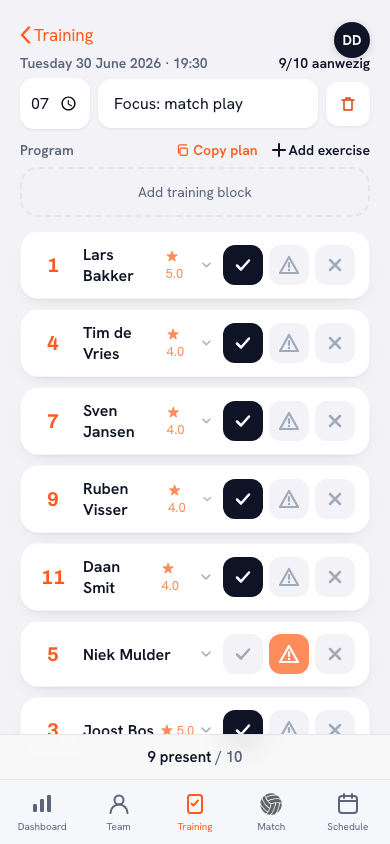
Practically: open the sign-up as early as possible and agree that people may cancel up to an hour before the start. You do not need to know who is coming to be nice about it — you need it to choose between half a court and a full one.
Bringing intensity without becoming strict
The classic trap is to start demanding more: harder, cleaner, more focused. With a group that turns up voluntarily and has nothing to win, that costs you both the atmosphere and the intensity within three weeks. Intensity should come out of the format, not out of your voice. Four ways that do exactly that:
- A team score instead of playing against each other. "Together we get twenty rallies of at least six touches." A group working together runs harder than a group playing each other, and nobody feels judged.
- Play on the clock, not to a score. Four games of six minutes instead of one to 25. There is always another one coming, so nobody has to pace themselves — and you know exactly when the hour runs out.
- Handicaps for whoever finds it easy. Only score from behind the three-metre line, only tip with the non-hitting hand, or a compulsory pass to a team-mate first. That raises the tempo and makes the game more even at the same time.
- Stakes that cost nothing. The losing side collects the balls, the winner picks the house rule for the next game. Enough to make something of it, too small to fall out over.
Reshuffle the teams every game. If the line-up changes every six minutes, winning is cheap and taking part is expensive — exactly the ratio you want with recreational players.
The strong player and the permanent beginner in the same game
This is the real recreational problem, and it goes wrong in two ways. Either the strongest player takes everything and the rest touch the ball three times a set, or he adapts so far that he gets bored and trains with another team on Thursdays two months later. Four interventions, in this order:
- Split on role, not on level. Put the strongest players at the setter position or as a fixed passer, not as a hitter. They get more balls than anyone and shape the game, without taking points away from others.
- Separate the two strongest and say so out loud. "I'm splitting you two up, otherwise it's not a contest" is a compliment, not a punishment. What you never do is a game of "the good ones against the rest", not even as a joke.
- Agree a zone. The ball in your area is yours to play. It sounds childish, but it solves most of the ball-poaching.
- Give the strongest a handicap or a job. Only scoring from the back court, or being responsible for coaching one team-mate during the game.
If you want to do this inside a drill rather than in the game, you work with the four dials from one session, six levels: the demand, the space, the role and the scoring. In a recreational group the role is by far the most useful of the four, because it puts nobody visibly on a lower rung.
Jumping once a week: what that does to a forty-year-old body
The load on recreational players is rarely too high — it is too uneven. Six days of nothing, then one hour in which somebody takes off at maximum thirty times and hits the floor flat a few times. That is exactly the pattern ankles, knees and shoulders object to. Four agreements that cost very little:
- An eight to ten minute warm-up with real jumping in it. Building up: ten small jumps, ten half jumps, five full ones, and only then the first attack. Two laps and some arm swinging is not a warm-up for a jumping sport — the build-up is in the warm-up.
- Put the jumping work in the first half of the hour. No fifteen-minute attacking block when everybody is already tired; that is the moment landings get sloppy.
- Keep the playing area clear and the centre line visible. Most ankle problems in a hall come from landing on someone else's foot or on a loose ball. Balls to the side, rally over.
- Anyone who has ever gone over on an ankle plays with tape or a brace. No discussion, just the agreement. More on that in injury prevention.
Two more things. Limit the number of balls hit at full power in one evening: a shoulder that gets used once a week is not built for fifty spikes. And check the net height for your group — it differs by federation and by category, certainly in mixed and recreational leagues. A net hanging a few centimetres too high turns a relaxed evening into an evening of forcing it.
The coach who plays as well
With recreational groups you are often on court yourself, otherwise there are only seven. That is fine, as long as you hold to two rules. Play in the game, not in the drill — in a drill you are needed to watch, and whoever is playing sees nothing. And play the position the group can least fill, usually the setter, not the spot you personally enjoy most.
On top of that, plan one block per evening where you deliberately stay off the court, and say it out loud: "this game I'm watching." Otherwise nobody really looks at the group for an entire season. If you play every week, you also belong in the attendance and the statistics — see the playing coach.
When the group gets too competitive
Recreational volleyball can tip the other way too: somebody shouting about a ball called out, or only hitting full power at people who cannot handle it. That is rarely a character problem and almost always a format problem. Tackle it in this order.
- Change the format first. A game on the clock instead of to 25, teams that change every game, or a team score. Usually the tension drains away by itself.
- Address the behaviour, not the person, and do it in the hall. One sentence, in passing: "We've got three more games — if half the balls are on the floor now, there's nothing left for later." Not in the group chat, because there it becomes bigger than it is.
- Have one short conversation on the side. "You're the strongest here and the group benefits from that. I just want us to notice it in the rallies and not in the score." Give them a job with it straight away: coaching, setting, or a handicap.
And at the start of the season make one agreement you can quote for the rest of the year: we keep score here, but nothing is at stake. That is not a soft message — it is precisely why these people turn up every week.
Key point: a recreational evening succeeds or fails on one number — how much of your sixty minutes is actually spent playing. Get to thirty and the group comes back next week and picked something up along the way. Drop below twenty because you ran a competitive session plan, and nobody will say a word about it. You see it in March, in the turnout.
Frequently asked questions
How many players do you need at minimum for a recreational session?
From four you can run a full evening: two versus two on half a court with three touches compulsory produces an enormous number of ball contacts. With five, let one player set for both sides. Below four it becomes a drill evening in pairs rather than a game.
Is a session plan worth it if the turnout changes every week anyway?
Yes, but plan around a format instead of a number. Pick one basic format that scales — half a court, three or four a side — and fix only the theme and the house rule per week. That way the same programme works with seven players and with thirteen.
How do I get recreational players to play three touches instead of hitting it straight back?
With a house rule, not with an instruction: send it over in one or two touches and you lose the rally. After two games everybody does it automatically. Instructions from the sideline barely work here, because the ball is already on its way before anyone thinks.
How often should a recreational group train?
One evening a week is the reality for most groups and that is fine, provided you set that evening up around playing. With one session a week, do not expect visible technical change: the repetitions you get in an hour are too few for that. Anyone with two evenings can double the drill block in the second session.
Can a group with very different ability levels really play together?
Yes, as long as you split on role rather than on level and keep the strongest players apart. Put them at the setter position or as a fixed passer and give them a handicap if needed. What does not work is a fixed strong team against a fixed weak one — after a few weeks the bottom half drops away.
Try it yourself in Koach
Less admin, more coaching.
Get started with KoachOr read first what the volleyball coaching app does.