
Why a WhatsApp Group Doesn't Work for a Volleyball Team
Every volleyball team starts with a WhatsApp group, and for the first few months that is the right call. The problem does not arise because group chat is bad, but because it ends up doing things it was never built for: keeping lists, storing agreements and collecting answers.
What a group chat is genuinely good at
Let us start with what works, because that drops out of the conversation too often. A group chat is unbeaten on speed: everyone is already in it, nobody has to install anything, and a message reaches twelve people within ten seconds. For 'stuck in traffic, start warming up without me' there is no better channel.
It is also indispensable for team culture. Photos after a win, the weak joke about the referee, birthdays — that is not noise, that is team building. A team that moves all its informal communication into a tidy system gets colder. So the goal is never 'kill the group chat'.
The five places it breaks
1. A chat has no state. Twelve thumbs-ups under 'who can play Saturday?' is not an availability list. You have to scroll back yourself, tally names and guess what a thumb on message 340 meant. And when an 'actually I can't, I'm on shift' arrives afterwards, it just floats loose in the timeline. Anyone who has picked apart their own chat at 10pm on a Friday knows the feeling.
2. Information disappears. The address for the away match was sent three weeks ago and now sits under two hundred messages. Search only works if you know which word was used, and gym names get written four different ways.
3. Notification fatigue always wins. An active team group produces dozens of messages a day. At some point someone mutes it, and from that moment they miss not only the jokes but also the message that practice has moved. So the group punishes exactly the people who took it seriously the longest.
4. Phone numbers are out in the open. In a group everyone sees everyone's number — including parents, fill-ins and that one member who quit last year and was never removed. With youth teams that is not a detail: the shortest route to a clean separation between coach, players and parents is an environment that works with roles instead of numbers. See also privacy and data in a team app.
5. The group has no memory across seasons. The coach steps down in June, a new one starts in September, and all the knowledge sat in the admin's head: who never drives, who you have to ask twice, which gym has a parking problem. None of that is handed over, because none of it was written down. A new coach therefore starts from zero every season, even when the team has existed for four years.
What belongs where
| What | Group chat | Team app |
|---|---|---|
| Banter, photos, jokes | Yes | No |
| 'I'm five minutes late' | Yes | No |
| Availability per practice | No | Yes |
| Fixture list and venue address | No | Yes |
| Carpool schedule and club duties | No | Yes |
| Lineup and substitution policy | No | Yes |
| Results and statistics | No | Yes |
| Team agreements and documents | No | Yes |
The dividing line is usefully simple: if there is a date, a list or an answer in it, it does not belong in the chat. Nor does anything you will still need to find in two weeks' time.
The hybrid model that survives contact with reality
Teams that get this right keep the group chat and move only the categories in the right-hand column. In practice that means three agreements. The schedule lives in the app only. Availability is given in the app only, with a fixed deadline. And when someone still asks an organisational question in the group, the reply is a pointer, not an answer.
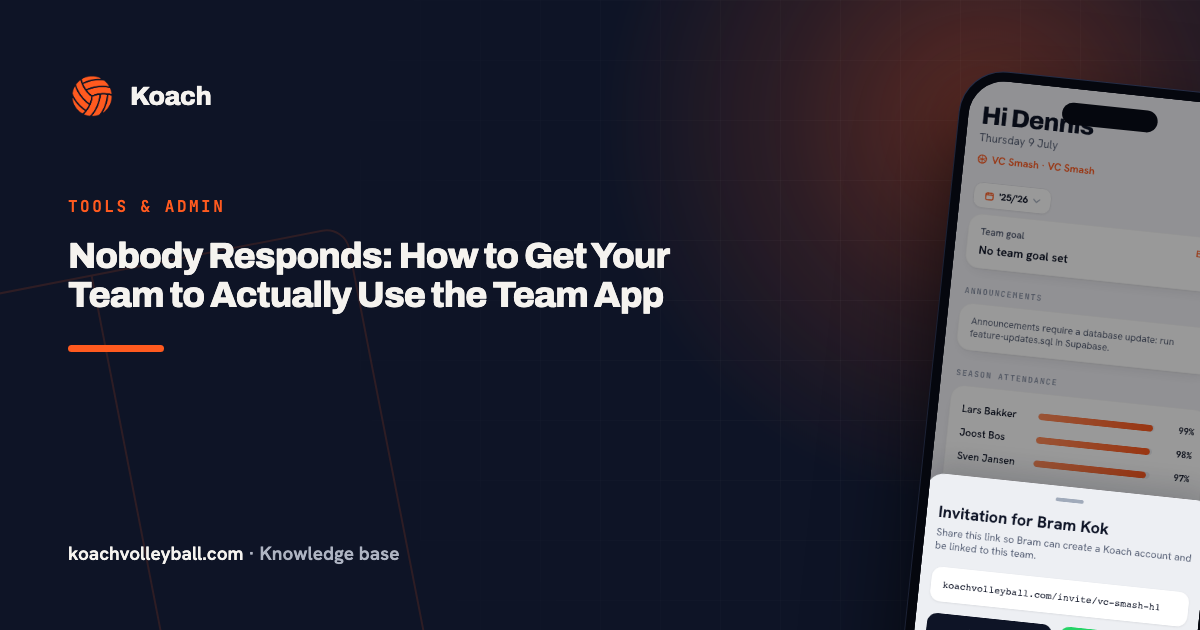
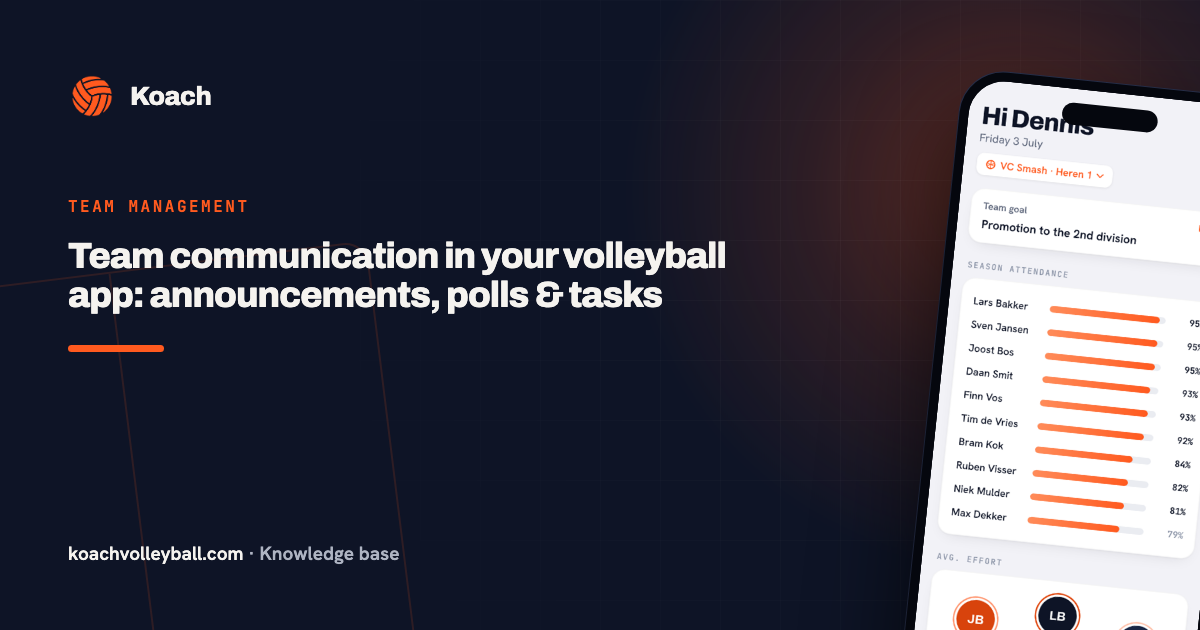
That last one is the only hard part. Give in once and post the lineup 'just to be safe' in the group, and you have taught your team that the app is optional. The tactics for turning that around are in how to actually get your team on board, and what announcements, polls and task lists solve in practice is in team communication in your volleyball app.
The honest counter-question: does your team need a system at all? Eight regular adults, one practice a week, no parents, no carpool schedule and a settled lineup — a well-run group chat is simply the best tool there. The gains start at twelve players, parents reading along, away matches and shifting availability.
How to make the move without a row
Announce it as relief, not as a measure: 'I don't want to have to chase you for availability any more.' Pick a date after a holiday or in the mid-season break. Enter the next four weeks of planning before you invite anyone, because an empty app convinces nobody. And let the group chat live on explicitly — say it in the same breath: 'the fun stays right here.'
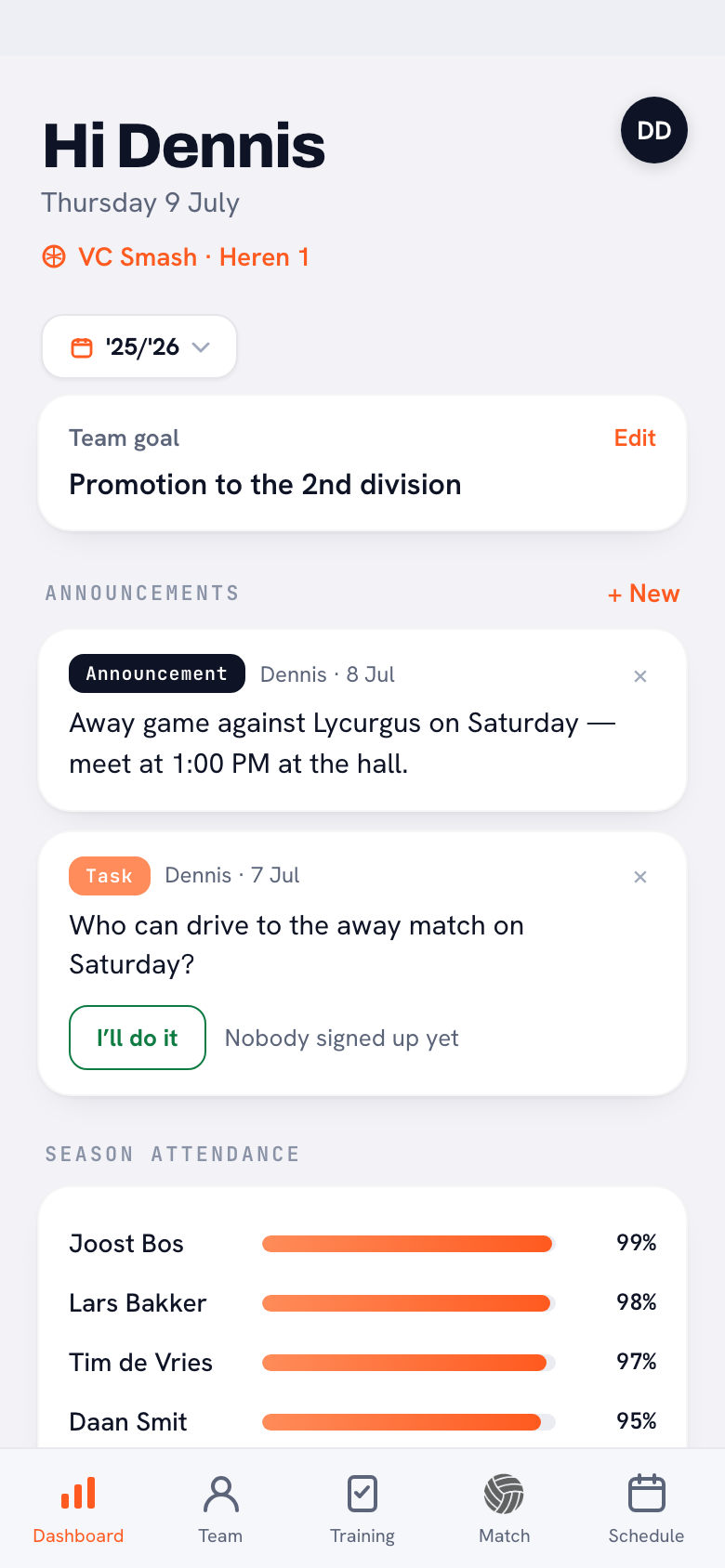
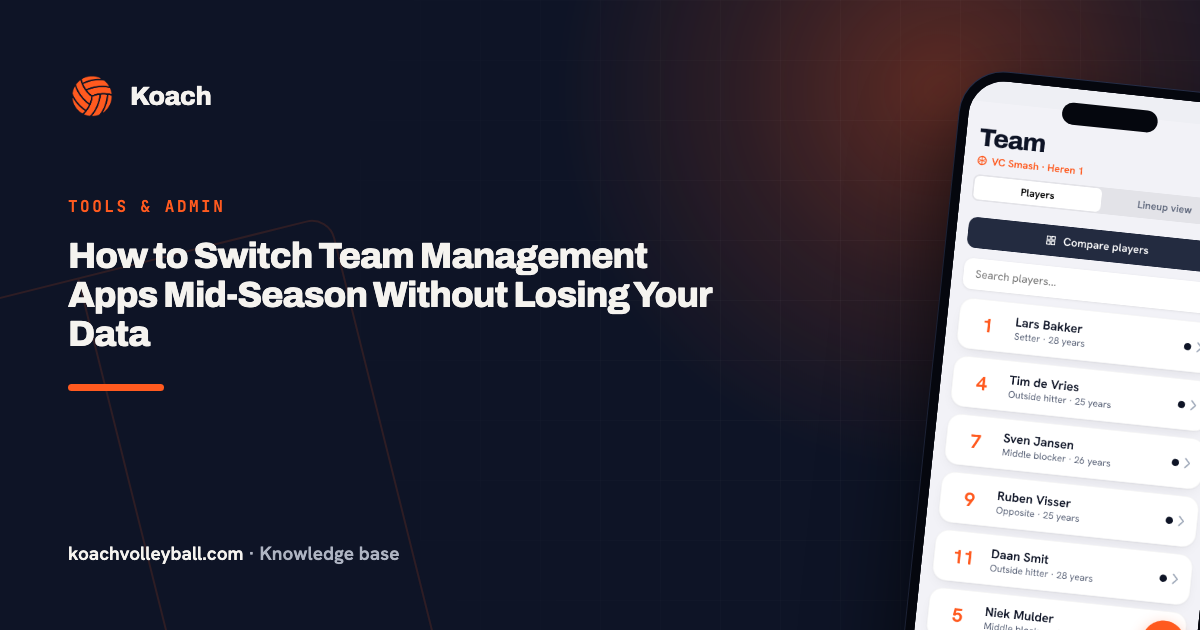
If you are already in another app and want to switch, the order is slightly different; that is in switching to another team app. If you are coming from a spreadsheet rather than an app, start with the roster and the rest follows on its own.
Frequently asked questions
Should I shut down the WhatsApp group if we use a team app?
No, and it is usually a mistake. Keep the group for banter and loose messages, and move only what contains a date, a list or an answer. A team that loses all its informal communication becomes more businesslike with nothing to show for it.
Why does a WhatsApp poll not work for availability?
Because a poll has no memory: it applies to one moment, drifts up the timeline and does not connect to your schedule. Anyone who changes their mind later floats loose in the chat and you have to tally it yourself.
Is a group chat a privacy problem for youth teams?
In a group everyone sees everyone's phone number, including parents and former members who were never removed. Work in an app with roles and you share only what is needed, keeping numbers out of sight.
When is a WhatsApp group genuinely enough?
For a small, settled adult team with one practice a week, no parents and barely any changes in availability. As soon as parents, carpool schedules or rotating lineups appear, the tallying starts — and a chat was never built for that.
Everything with a date in one fixed place
Schedule, availability, lineup and polls — Koach keeps them out of your group chat.
Get started with KoachOr read first what the volleyball coaching app does.