
How to fix a volleyball: leaking valve, hole or loose panel
The short answer
How to fix a volleyball depends on the damage: only small damage can be repaired. First use soapy water to find where the air escapes. If the leak is in the valve, check it for dirt, and with a new ball contact the seller. A hole in the bladder of an indoor ball usually cannot be fixed: then you replace the ball.
Your ball goes soft again after a few days, or an edge has come loose. Knowing how to fix a volleyball helps sometimes, but far from always. Here you read how to find where the air escapes, what to do about a leaking valve, why a hole in the bladder is usually the end and when to replace a ball.
Is your ball really leaking?
Every ball loses some air over time. About latex bladders, manufacturer Select writes in its care instructions for soccer balls that they gradually lose air on their own. And a ball you leave in a cold storage room or car feels softer without any air having escaped; why is explained in volleyball air pressure.
The Molten customer service (in Japanese, checked in November 2026) lists three things to check first when a ball keeps going flat: is the pressure right, is air leaking at the valve, and is there damage to the outer layer? So start with this test:
- Inflate the ball to the pressure printed next to the valve, and check it with a ball pressure gauge.
- Inflate a second ball of the same type at the same time, for comparison.
- Leave both in the same place for a day and measure again.
If both have dropped a little, that is normal air loss. If only your ball is clearly softer, it is leaking.
How to find the leak
- Pump the ball up firmly. To the specified pressure, so enough air comes out to see.
- Make soapy water. A cup of water with a few drops of dish soap.
- Start at the valve. Use your finger to put a drop of soapy water on the valve. If bubbles grow, the valve is leaking.
- Then the rest of the ball. Dab the soapy water on the ball panel by panel, especially along the seams and on spots with a scratch or dent. Turn the ball slowly and watch where bubbles form.
- Mark it and dry it. Put a small piece of tape next to the leak, wipe off the soap with a damp cloth and let the ball dry in an airy spot, not in the sun.
Do not dunk an indoor ball in a bucket or tub of soapy water. According to the Molten care instructions, the leather of their volleyballs is glued on, and water and heat can dissolve that glue, after which the leather comes loose. How to wipe a ball down with water safely and dry it is in how to clean a volleyball.
What do you do about a leaking valve?
- Check it for dirt. If air goes in with difficulty, Molten's FAQ names dirt and dust in the valve as something to check. Wipe the valve clean with a damp cloth and test again with a drop of soapy water. Do not expect too much from it: a damaged valve will not seal again because of it.
- Use the right needle. According to Molten, a needle that is too thick damages the valve; they recommend a thin, moistened needle that you insert slowly. A valve that is already damaged will not be repaired by that, but you keep it from getting worse. How to use the needle is in the article on cleaning a volleyball.
- Do not push anything into the valve. Do not force a needle, marker or pen inward. A valve that has fallen into the ball cannot be got out again, according to Molten.
- A new ball? If a ball you just bought is leaking, contact the seller. Molten also recommends that when you suspect a manufacturing defect.
- Have it checked. Asked whether a valve can be replaced, Molten in Japan refers to a paid inspection and repair service (in Japanese, checked in November 2026). Ask the seller or the manufacturer in your own country whether something like that exists for your ball.
Separate valves and sealants for balls are also for sale. They do not appear in the instructions of the manufacturers we checked. Keep in mind too that anything you put into the ball changes its weight, while a match ball for indoor volleyball has to weigh 260 to 280 grams (Rule 3.1 of the FIVB rules). A ball like that is one you use at practice at most.
A hole in the bladder: usually the end
According to the rulebook, an indoor ball has an outer cover of leather or synthetic leather, with a bladder of rubber or a similar material inside (Rule 3.1). With a glued ball you cannot get to that bladder without opening up the ball, and then you cannot get the panels back neatly. And if you do manage it, there is a patch in that spot that does not belong there, while a match ball has to be the same all over. How a ball is built is in which volleyball to buy.
With a simple rubber play ball without a cover it is different: there you can sometimes seal a small hole with a rubber patch kit. For a ball you practice or play matches with, a hole in the bladder is in practice a reason to replace it.
A loose panel or an open seam
- With a new ball: go back to the seller. If a panel comes loose after just a few practices, ask whether the seller will exchange it.
- A small loose edge on an older ball: clean and dry the spot, apply a thin layer of flexible glue for leather or rubber, press the panel down and hold it in place with tape for as long as the glue needs. Use it as a practice ball after that.
- A panel that is loose over a large area, or a spot where you can see the layer underneath: replace it. The glue will not hold properly there anymore.
- A stitched ball with a loose stitch: as long as the bladder is not pushing out, you can try to sew the seam shut with strong thread. If it does push through, the ball is finished.
Keep the balls out of a hot car. Water and heat can dissolve the glue under the panels, Molten warns, and the advice is to store balls cool and dry, out of the sun. A ball bag left in the trunk on a summer day is exactly what you want to avoid.
When do you replace a volleyball?
- It clearly loses pressure within a day, even after the valve has been cleaned.
- It is no longer round: there is a bulge, it does not roll straight or it bounces unevenly. The rulebook requires a spherical ball (Rule 3.1).
- A panel is loose over a large area, or the layer underneath is visible.
- The cover has become smooth and hard and no longer gives grip when setting.
For a match, all balls must have the same circumference, weight, pressure and type (Rule 3.2). A repaired ball that bounces differently does not belong there. What to look for in a new ball is in which volleyball to buy.
Who takes care of the balls?
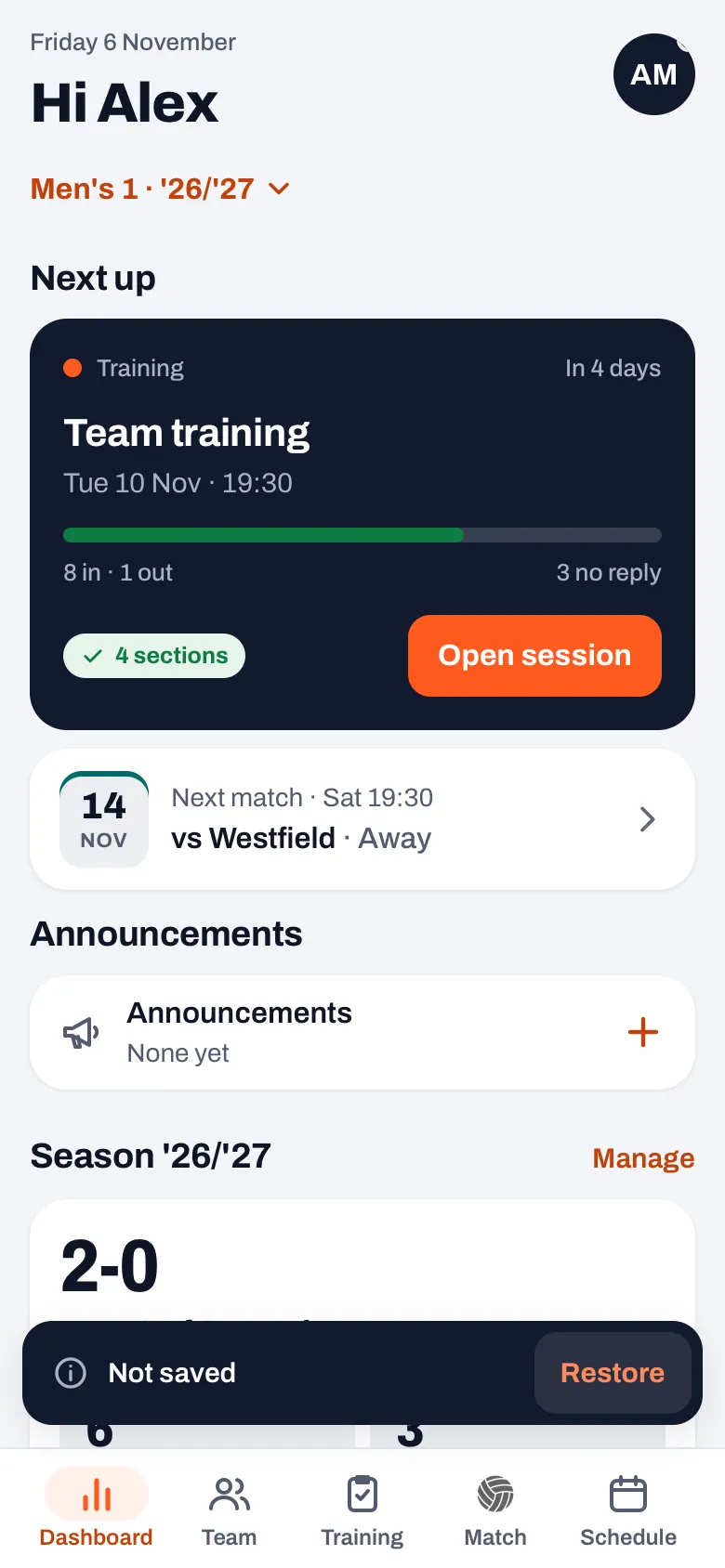
A broken ball often stays in the bag for months, because nobody knows who will take it. In Koach you add a job like that as a task under Announcements on the dashboard, for example "Who takes the leaking ball and gets a new one?". Whoever does it taps I’ll do it, and the whole team sees that it is taken care of. In a group chat a question like that disappears among the other messages; why that keeps happening is in why a WhatsApp group does not work for a volleyball team. If you accidentally close the sheet before posting, since version 3.1 you get your text back with Restore.
14 days free, no credit card. Post the ball check as a task and see who picks it up.
Try Koach with your teamWhat Koach costs after the trial is on the pricing page.
Frequently asked questions
Can you patch a leaking volleyball?
With an indoor ball, usually not. The bladder sits under glued panels, and to get to it you have to open up the ball. If you do manage it, there is a patch in that spot that does not belong there. With a simple rubber play ball, a small hole can sometimes be fixed with a rubber patch kit. If only the valve is leaking, first check whether there is dirt in it.
Why does my volleyball keep going flat?
Often the leak is at the valve, for example after damage from a needle that was too thick or dry; Molten recommends a thin, moistened needle. A small hole in the bladder is also possible. Every ball also slowly loses some air, and in the cold it feels softer. Inflate it, measure again after a day next to another ball, and use a drop of soapy water to find where the air escapes.
Can you use a repaired ball in a match?
Only if it still meets the rules. An indoor ball has to weigh 260 to 280 grams and have the right pressure, and all balls in a match must be the same in circumference, weight, pressure and type. For international matches and national competitions, the FIVB rules also require an FIVB-approved ball. If a repaired ball bounces differently, only use it at practice.
When is a volleyball worn out?
When it clearly loses pressure within a day, is no longer round, has a panel loose over a large area, or has a cover so smooth that it no longer gives grip. A ball that bounces differently from the rest comes out of the match set. For a warm-up or a technique block it can sometimes still be used, as long as it holds its pressure.


Sort out the balls with your team in Koach
14 days free, no credit card. Tasks, announcements and polls in one place.
Get started with KoachOr read first what the volleyball coaching app does.