
How to clean a volleyball without damaging it
The short answer
To clean a volleyball, wipe it with a soft, damp cloth. For stubborn dirt, use a little mild soap in lukewarm water, wipe off the soap residue and let the ball air-dry out of the sun. Do not soak it, do not dry it with a hair dryer and do not use products that leave a greasy film.
Knowing how to clean a volleyball takes a minute to learn, but with water, heat or the wrong product a ball gets damage you only see weeks later: a panel that comes loose, a slippery surface or a valve that leaks. This is how to keep your team's balls clean, and what you are better off not doing.
How do you clean a volleyball?
Under the FIVB rules, an indoor ball has a cover of leather or synthetic leather with a rubber bladder inside (rule 3.1). On many balls that cover is glued on. The Molten care instructions say it in so many words: water and heat can dissolve that glue, after which the cover comes loose or discolors. So you work from light to heavy:
- Wipe dry. Remove dust and sand from the gym floor with a dry, soft cloth.
- Wipe damp. A soft cloth or sponge, wet and well wrung out. Panel by panel, without scrubbing.
- Marks. Gray scuff marks from the floor or from shoe soles often come off with a soft eraser. For stubborn marks Molten mentions a cleaner for synthetic leather.
- Very dirty. Molten then mentions plenty of water with a mild soap, without leaving the ball in the suds, followed by rinsing well and letting it drain. If you want to keep the water away from the seams, work with a well wrung-out cloth and then wipe off the soap residue with a clean, damp cloth. Soap that stays on can make the ball slippery.
- Drying. Rub it dry with a clean cloth and let the ball air-dry in a well-ventilated place, not in the sun. Molten explicitly advises against a hair dryer or any other device.
How often? After every time you play outside, and for an indoor ball as soon as it looks gray or feels slippery. A quick wipe with a dry cloth after every practice saves you most of the work. Molten also advises against playing on a heavily waxed floor. If you practice in a gym where the balls feel slippery afterward, wipe them right after that practice, before the dirt settles into the surface.
What not to do with a dirty volleyball
- Soaking it. Never leave a ball in soapy water (Molten). A washing machine or dishwasher is completely out of the question: hot water and tumbling at the same time.
- Heat for drying. No hair dryer, radiator, tumble dryer or full sun. A car trunk in summer is also too hot to store balls in.
- Harsh products. Bleach, degreaser and abrasive cleaner do not belong on a ball. Molten only mentions water, mild soap and a cleaner for (synthetic) leather, and says you should wipe off any oil or cleaner that stays on the ball afterward. Some products can make the colors fade.
- Leather conditioner or shoe spray. Products for leather jackets or shoes make the surface slippery, Molten warns. A ball that slides is hard to set and pass.
- A scouring pad or stiff brush. Molten mentions a soft cloth and a soft eraser, nothing more. The texture of the surface gives you grip; you do not want to scrub it away.
Indoor ball, outdoor ball or beach ball: does it matter?
Synthetic leather is the standard for indoor balls; the steps above apply to it. Genuine leather is rare on volleyballs. For it, Molten recommends a small amount of cleaner for natural leather on a soft cloth, then removing the residue and buffing the ball.
Beach balls are made, under the FIVB beach rules, of a material that does not absorb moisture, because matches are also played in the rain (rule 3.1). Sand comes off most easily when the ball is dry: tap it off and wipe it with a dry cloth. Wipe the valve clean before you insert a needle. What else makes a beach ball different from an indoor ball is covered in choosing a beach volleyball. A ball for outdoors on grass or pavement gets dirty faster; keep it separate from your indoor balls, so the grit does not come into the gym with it.
Valve and needle: inflating the ball without damage
A ball that keeps getting softer does not always have a leak in the bladder; the valve can leak too. The Mikasa inspection manual for the beach ball, published by the FIVB, says to moisten the pump needle with a glycerin-based lubricant before inserting it, because a dry needle can damage the valve and cause air leakage (Mikasa Ball Inspection Manual). Molten says the same in its own words: a thin needle, moistened and inserted gently, and inflate to the pressure printed on the ball.
Under the rules, an indoor ball should have a pressure of 0.30 to 0.325 kg/cm², which is 4.26 to 4.61 psi (rule 3.1). How to measure that and what to do if you have no pressure gauge is covered in volleyball air pressure.
Storage: how your team's balls last longer
- Cool, dry and out of the sun. That is what the Molten instructions say, and it applies to the ball cart in the equipment room just as much as to the bag in the car.
- Dry first, then store. A wet ball that goes into a closed bag does not dry. Wipe off the moisture with a clean cloth and let it air-dry before it goes back into the bag or cart.
- Rotate your balls. Molten recommends using two or more balls in turn, so they last longer. So do not use the same two balls for the warm-up at every practice while the rest stay in the cart.
- One cart per type. Indoor balls, light youth balls and outdoor balls kept apart. Which ball fits which age is covered in volleyball size by age.
Make it a regular ball check. Once a month every ball gets checked, with three questions: is it clean, is it at the right pressure, and is there damage, such as a bulge, a loose panel or a leaking valve? A ball with a bulge or a loose panel comes out of the cart, because it bounces and flies differently from the rest.
At a club that check often falls through the cracks: everyone uses the balls, nobody is responsible. Agree per team who brings the ball bag and who does the check, and put that somewhere it does not get buried. Why a group chat is bad at that is covered in why a WhatsApp group doesn't work for a team. If you need a new set of balls, which volleyball to buy helps you choose.
Putting the ball check in your practice plan
Koach does not clean balls and does not keep track of equipment either. What does help: put the ball check in the plan of the last practice of the month as a fixed section. In the practice detail, tap + Add section, call it something like "Ball check", set the duration to 5 minutes and write the three questions under Add description. Save that plan through the menu at the top right with Save as template; the month after, you bring it back with Copy plan, ball check and all.
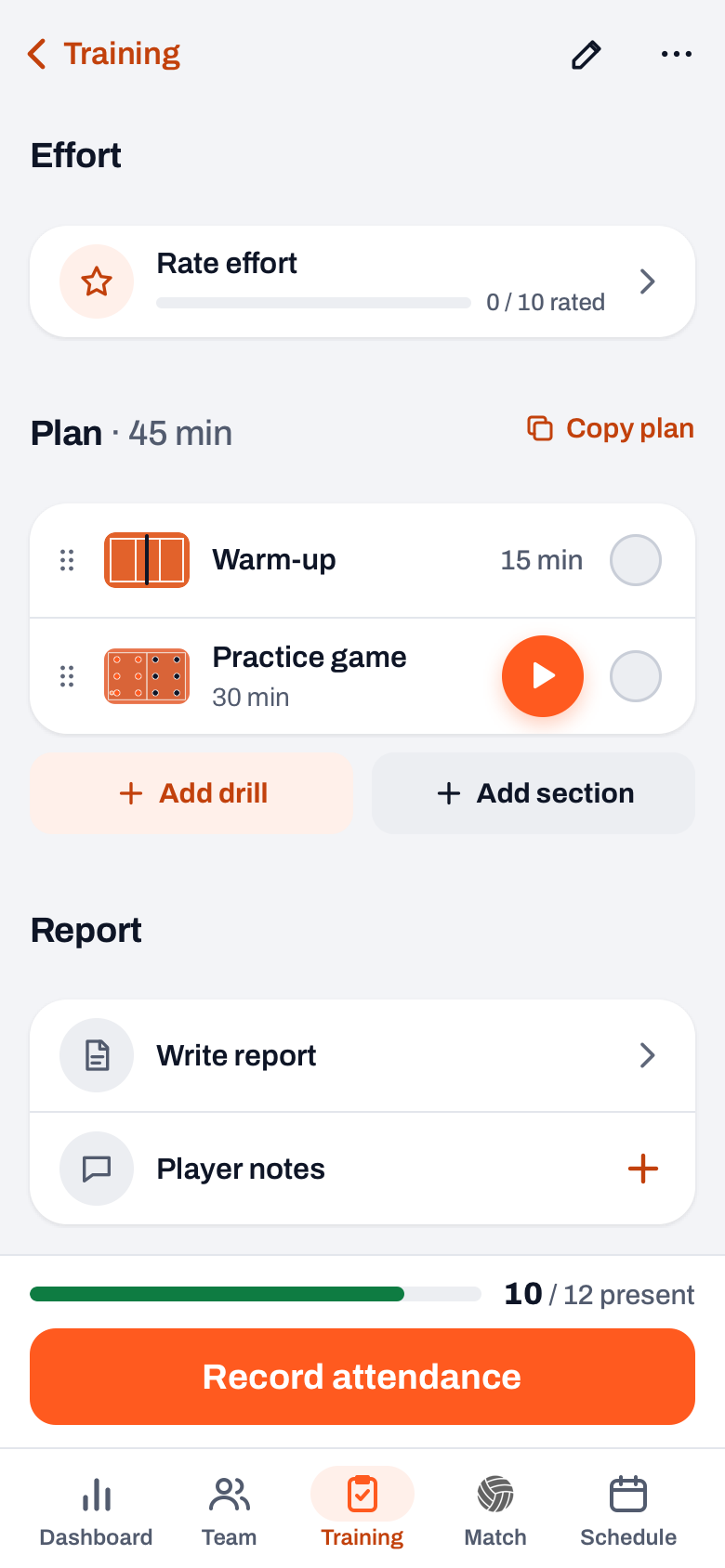
14 days free, no credit card. Put the ball check in your plan as a section and copy it back next month with one tap.
Plan your practice in KoachWhat Koach costs after the trial is on the pricing page.
Frequently asked questions
Can you put a volleyball in the washing machine?
No. Manufacturers such as Molten advise against leaving a ball in soapy water, and a washing machine or dishwasher combines hot water with tumbling. Water and heat can dissolve the glue under the panels, after which the cover comes loose or discolors. Use a wrung-out cloth with a little mild soap and wipe off the residue afterward.
How do you make a slippery volleyball grippy again?
A ball often gets slippery from dirt, sweat or soap residue. Wipe it with a wrung-out cloth and a little mild soap, remove the soap with a clean damp cloth and let it air-dry. Do not use leather conditioner or shoe spray: they make the surface even more slippery. If an old ball stays slippery, the surface is worn.
Can you disinfect a volleyball?
The Molten care instructions mention water, mild soap and a cleaner for (synthetic) leather, not disinfectants. If you want to clean balls thoroughly, for example because they pass through many hands, a cloth with mild soap is the safe choice. If you still want to use another product, try it on one ball first and wipe off the residue afterward.
What do you do when a volleyball gets wet?
Wipe off the moisture with a clean cloth and let the ball air-dry in a well-ventilated place, out of the sun. Do not use a hair dryer or a heater. Then check whether the panels are still firmly attached, because water can affect the glue, and only store the ball once it is completely dry.



Put the ball check in your practice plan
14 days free, no credit card. Next month it is ready and waiting.
Get started with KoachOr read first what the volleyball coaching app does.