
Beach volleyball ball: how it differs from an indoor ball
The short answer
Under the FIVB rules a beach volleyball ball is slightly bigger than an indoor ball (66 to 68 centimeters around), equally heavy (260 to 280 grams) and inflated much softer: 0.175 to 0.225 kg/cm². It does not absorb water. For official FIVB tournaments it has to be an FIVB-approved ball.
A beach volleyball ball looks like an indoor ball until you have passed it a few times. It is bigger, softer and made for sun, wind and rain. Here you read what the rules say, which ball fits the way you play and how to make it last a few summers.
What is the difference between a beach volleyball and an indoor ball?
The FIVB has separate rules for indoor and for beach, and in both the ball is covered in rule 3.1. Side by side:
| Under rule 3.1 | Beach ball | Indoor ball |
|---|---|---|
| Circumference | 66 to 68 cm | 65 to 67 cm |
| Weight | 260 to 280 g | 260 to 280 g |
| Inside pressure | 0.175 to 0.225 kg/cm² | 0.30 to 0.325 kg/cm² |
| Material | Does not absorb moisture, suited to outdoor play | Leather or synthetic leather |
| Color | Light, one color or a combination | Light, one color or a combination |
Source: the FIVB Official Beach Volleyball Rules 2025-2028 and Official Volleyball Rules 2025-2028. The beach rules state plainly why the ball must not absorb moisture: matches are also played in the rain.
The big difference is the pressure. A beach ball sits at roughly two thirds of the pressure of an indoor ball. That makes it feel soft, it gives more on bare forearms and fingers, and it comes off your platform less hard. Outside, the wind joins in too: players new to the sand see a serve drift more often than indoors. How to measure the pressure and in which unit is in volleyball air pressure.
How a ball is built beyond that, such as the number of panels, the outer layer and whether the panels are stitched or glued, is not in the rules. That differs per manufacturer and per model, so check the description of the model itself.
Which beach volleyball ball is right for you?
There is no ball that is right for everyone. Start with what you will use it for:
- Tournaments. For FIVB World and Official Competitions, rule 3.2 requires an FIVB-approved ball, and all balls in one match must be the same in circumference, weight, pressure, type and color. At those tournaments four match balls are ready (rule 3.3). National federations and organizers of summer tournaments often specify their own match ball. If you play a tournament, check the tournament rules for which ball it is, and practice with it.
- Practice and recreation. Pick a ball that meets the measurements in the table and is sold as a beach ball. Then you practice with the same feel as at a tournament. A light plastic beach ball is something else: it is lighter, flies differently and teaches you nothing for the real game.
- Kids. For young players there are lighter and softer balls; the rules say nothing about those, so the manufacturer is the source. With beginners on the sand, a ball that stays in the air longer helps. How to get kids playing on the sand is in beach volleyball for kids, and which indoor ball suits which age is in volleyball size by age.
- Grass and parks. A beach ball also works well outside on grass, because it can handle moisture. An indoor ball is not made for that: wet grass and rain make the outer layer slippery and heavy.
If you want a ball for the gym instead, the differences between indoor balls are in which volleyball to buy. And what else is different on the sand compared with indoors, from scoring to the tip, is in the beach volleyball rules.
How to recognize a good beach volleyball
- The measurements are printed on it. A full-size beach ball has a circumference of 66 to 68 centimeters and weighs 260 to 280 grams, and that is stated on the ball or the packaging. If there is no weight, ask or choose another model.
- The pressure is printed by the valve. A beach ball should have a recommended pressure within 0.175 to 0.225 kg/cm². If it shows the pressure of an indoor ball, it is probably not a real beach ball.
- It feels soft, but not flat. Press your thumb into the ball: it gives, but springs back right away. A ball that feels hard at beach pressure hurts on bare forearms.
- Light colors. The rules ask for light colors, and in practice you see such a ball better against a bright sky.
- Approved if you play officially. If you play tournaments with FIVB status, the ball must be FIVB-approved. For practice that is not needed, as long as the measurements are right.
How many balls do you need? For technique work in pairs, one ball per two players. For game-like drills, two or three per court, so nobody has to fetch the ball out of the sand or the water after every rally. On a tournament day, bring two to warm up with, of the type the tournament uses.
Check the pressure on the court, not at home. Air that warms up gives more pressure. A ball you set to 0.20 kg/cm² in a cool shed in the morning will be harder in full sun in the afternoon. Measure at the temperature you play in, and keep the balls in the shade between matches.
Caring for a beach ball: sand, sun and water
A beach ball has a tougher life than an indoor ball, and most balls do not break from playing but from what happens afterwards.
- Sand out of the valve. Tap the ball clean and wipe the valve before you put the needle in. Sand in the valve makes it leak.
- Salt and dirt off. If you play by the sea, rinse the ball with fresh water afterwards or wipe it with a damp cloth, and let it dry in the shade.
- Not in a hot car. A ball that lies for hours in a warm trunk or in the sun ends up with too much pressure, and the outer layer does not benefit either.
- Store it dry. Put it away dry in a bag or net, out of the sun, and check the pressure again at the start of the next season.
Summer on the sand with your indoor team
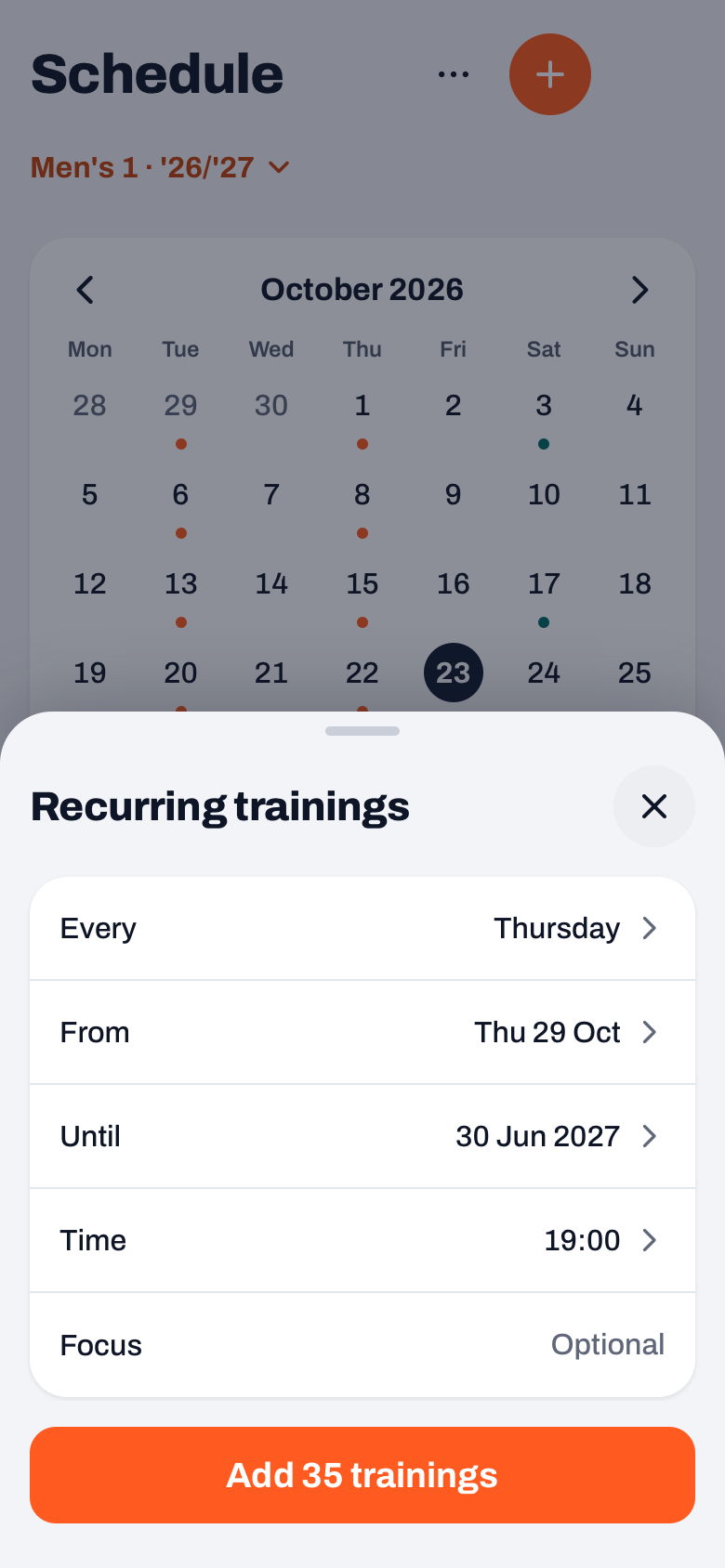
Many indoor teams spend a few weeks on the sand in summer. Koach is made for indoor volleyball, but you can use it for the organization around it. In the Schedule, Recurring trainings (via the three dots at the top) puts all your summer evenings in at once: you choose the day, the period with From and Until and the time, and the button counts how many trainings will be added.
The balls and the pump with a gauge you sort out with an announcement of the type Task on the dashboard, for example "Who brings the beach balls and the pump?". Whoever does it taps I’ll do it, and everyone sees their name next to it. In the group chat a question like that quickly disappears under the messages; why that keeps happening is in why a WhatsApp group does not work for a volleyball team. What Koach costs after the 14 free days is on the pricing page.
14 days free, no credit card. Put your summer practices in the schedule and have someone bring the balls without you having to ask.
Try Koach with your teamFrequently asked questions
Can you play beach volleyball with an indoor ball?
You can, but it is not a good swap. An indoor ball is pumped to a much higher pressure, feels hard on bare forearms and is not made for moisture, sand and sun. Sand and moisture wear down the outer layer of an indoor ball quickly. For the sand, use a beach ball: bigger, softer and made for outdoor play.
What is the air pressure of a beach volleyball?
Under the FIVB beach rules, 0.175 to 0.225 kg/cm², or 171 to 221 mbar. Converted, that is roughly 2.5 to 3.2 psi. An indoor ball is at 0.30 to 0.325 kg/cm², so a beach ball sits at roughly two thirds of that. Measure the pressure at the temperature you play in, because heat makes the pressure rise.
Is a beach volleyball bigger than an indoor volleyball?
Slightly. Under the rules a beach ball has a circumference of 66 to 68 centimeters, an indoor ball 65 to 67 centimeters. The weight is the same: 260 to 280 grams. Because it is inflated softer and is slightly bigger, it still feels clearly different in your hands and on your forearms.
Can you use a beach volleyball indoors?
Not for a normal indoor practice. A beach ball is bigger and softer, flies slower and bounces differently, so players have to readjust as soon as they play with the indoor ball again. For young kids there are special light and soft indoor balls; those work better for that than a beach ball.

Get your summer on the sand ready
14 days free, no credit card. All your practices in the schedule in one go.
Get started with KoachOr read first what the volleyball coaching app does.