What Size Volleyball for a 10-Year-Old? Sizes by Age
An official volleyball weighs 260 to 280 grams. On the forearms of a nine-year-old, that is the difference between learning to pass and learning to avoid the ball. With young children, which ball you put in the gym decides more of the learning than which drill you pick.
The sizes side by side
| Type of ball | Circumference | Weight | Suitable from |
|---|---|---|---|
| Foam or soft ball | 63-67 cm | 150-200 g | Up to about age 9 |
| Size 4 (youth ball) | 63-65 cm | 230-250 g | About ages 10-13 |
| Lightweight size 5 | 65-67 cm | 200-220 g | About ages 10-12 |
| Size 5 (official) | 65-67 cm | 260-280 g | From about age 13 |
Note the difference between the two middle rows: a size 4 is smaller and mid-weight, while a lightweight size 5 has the dimensions of the match ball but weighs considerably less. For kids who will move up to the full game within a year, that lightweight size 5 is often the smarter stepping stone — the dimensions are already familiar.
Why weight matters more than circumference
Circumference mainly determines whether a child can get their hands properly around the ball when setting. Weight determines nearly everything else. A lighter ball flies slower, stays in the air longer and therefore buys a child half a second extra to get under it — exactly the time they are short of. And it does not hurt: a 270-gram ball landing from five meters up on the forearms of a nine-year-old explains, all by itself, why some children flinch.
The effect in the gym is directly measurable in the number of rallies that last longer than three contacts. Heavier ball, fewer rallies, fewer repetitions, less fun — in that order. What goes wrong technically on the overhead contact is in teaching kids to set, and the build-up of the pass is in forearm passing technique.
What to put in the gym by age
- Ages 6-8: foam balls and soft balls, plus a few balloons or slow floaters for the first catching work. No match balls at all.
- Ages 8-10: soft balls as the standard, with a crate of lightweight balls alongside for whoever can handle them.
- Ages 10-12: size 4 or lightweight size 5 as the standard, plus a few official balls to get used to for serving and hitting.
- Ages 12-13: official size 5 as the standard, with lightweight balls in reserve for technical blocks with lots of repetitions.
Feel free to turn it around for skill work: even a thirteen-year-old learns a new movement faster with a light ball, because they can think about the movement instead of the impact. And the other way round: let a group already training with the official ball serve a block with the heavy ball now and then, so the weight does not come as a surprise in a match.
Do not confuse the youth ball with a beach ball, by the way. A beach ball is larger in circumference, softer on the outside and inflated to a lower pressure, so it is not a cheap substitute for a soft indoor ball. It flies differently and rebounds differently, which throws kids off the moment they go back to the indoor ball.
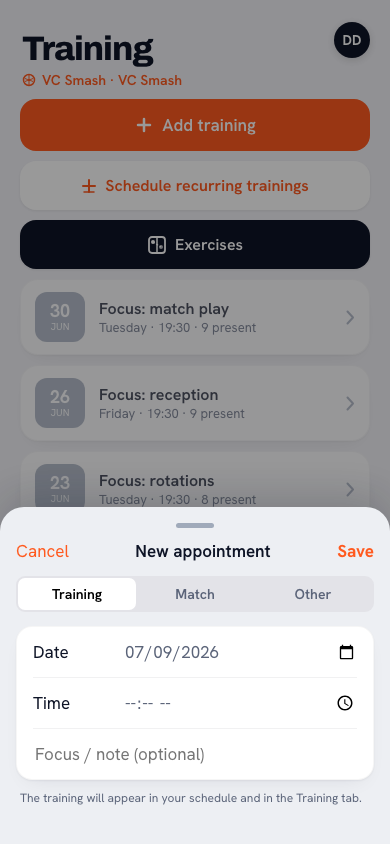
Which is exactly why it pays to note the ball in the practice plan: put in the Koach session outline which ball this group uses, and a stand-in coach grabs the right crate without having to call anyone. How to save and reuse an outline like that is in reusing a practice template.
When to move to the official ball
Do not look at the age, look at three criteria. First: the child gets eight out of ten serves over the net that belongs to their category — how high that hangs is in the overview of net heights. Second: the forearms do not hurt after a session with the heavier ball. Third: within a year the child will play matches in which that ball is compulsory.
Make the switch gradually. Start with a quarter of the session on the heavy ball and build that up over six to eight weeks. A group that moves over completely from one week to the next will lose a few weeks of rallies and confidence, guaranteed.
Practical tips for the ball cart
- Colour-code by weight. Use balls that look visibly different, or mark them with a marker. Otherwise heavy and light balls are mixed together within two sessions.
- Check the pressure monthly. An official ball sits at about 0.30 to 0.325 bar; soft youth balls you deliberately want a little softer. An over-inflated ball hurts more than a ball a hundred grams heavier.
- At least one ball per two children. All the benefits of the right ball evaporate if half the group is standing around waiting.
- Do not buy the cheapest. Hard, slick plastic balls fly unpredictably and are unpleasant; a decent youth ball lasts for years.
Frequently asked questions
Which ball is right for a ten-year-old?
A size 4 of 230 to 250 grams, or a lightweight size 5 of around 210 grams. Both are light enough to pass without pain and slow enough to get under in time; the lightweight size 5 has the advantage that the dimensions are already correct.
What is the difference between size 4 and size 5?
Size 5 is the official ball: 65 to 67 centimeters in circumference and 260 to 280 grams. Size 4 is slightly smaller at 63 to 65 centimeters and lighter at 230 to 250 grams, intended for children who cannot yet handle the match ball.
Can you play matches with a lightweight ball?
In league play the prescribed ball governs, so check the regulations for your age category. For practice and internal games a lighter ball is always allowed and with young children usually the wiser choice.


Try it yourself in Koach
Less admin, more coaching.
Get started with KoachOr read first what the volleyball coaching app does.