
Beach volleyball for kids: games, court sizes and a practice plan
The short answer
Beach volleyball for kids works well on small courts with a low net or a rope, a light ball and games of one against one or two against two, so every child touches the ball often. Keep practices shorter than indoors, plan fixed water breaks and avoid the midday sun.
Beach volleyball for kids is an easy way to teach them to fall, dive and jump without anyone being afraid of the floor. But an adult court and a hard ball turn a summer afternoon into mostly waiting. This is how to set up the sand for children aged six to fourteen, with games and a one-hour practice.
Why sand works well for kids
In the sand a child dares to do what they don't dare in the gym: fall, dive, chase a ball that is already gone. The ground is soft, so a dive costs nothing. On top of that you play with two or three children per side, and then everyone touches the ball far more often than in a gym with twelve children at one net. In two against two nobody is only a passer or only a hitter: every child does everything, and that fits this age exactly. What is achievable in skills and attention at each age is covered in coaching youth volleyball by age.
Sand also has a price. Running and jumping take more strength, you get to the ball more slowly, and children get tired sooner than they notice themselves. A 90-minute practice like in the gym is usually too long for children in the sand. For an indoor team of older players spending the summer on the sand, there is a full program in beach volleyball drills for your indoor team. This article is about children aged six to fourteen.
Court, net and ball by age
The official beach court measures 16 by 8 meters (rule 1.1 of the FIVB Official Beach Volleyball Rules 2025-2028). For children that is far too big: the ball then nearly always lands in an empty patch of sand. The FIVB doesn't prescribe a court size for young children, and federations and clubs use their own sizes. So the table is a rule of thumb. If rallies hardly get going, or the server wins almost every point, the court is too big.
| Age | Game format | Court per side |
|---|---|---|
| 6 to 8 years | 1 against 1 or 2 against 2, throwing and catching | About 3 by 3 meters |
| 8 to 10 years | 2 against 2, you may catch the first ball | About 4 by 4 meters |
| 10 to 12 years | 2 against 2 without catching | 5 to 6 meters wide and deep |
| 12 to 14 years | 2 against 2 | From 6 by 6 meters to the full 8 by 8 side |
The net. For youth players the FIVB beach rules give lower nets: 2.00 meters for 12 and under, 2.12 meters for 14 and under and 2.24 meters for 16 and under (rule 2.1). What else is in the beach rules is covered in the beach volleyball rules. For younger children a rope works better than a net. Hang it so that most children can just not reach it with their arms stretched: then the ball has to go over in an arc, and that is what they need to learn.
The ball. A real beach ball is bigger and softer than an indoor ball, but weighs the same: 260 to 280 grams (rule 3.1). For children up to about ten that is too heavy to play without pain. Use a light, soft training ball. Do watch the wind, though: a very light foam ball blows away, and then a light youth ball works better. Which size and weight suit which age is in the right volleyball for each age.
The lines. Mark them with a rope between four tent pegs or with a rake. Check the sand for shells, stones and glass first, especially on a public beach.
One rope, three courts. Stretch one long rope between two posts and set up the courts side by side under it. With twelve children you then play three games of two against two at once, and nobody is left waiting.
Six beach volleyball games in the sand
1. Sand ball over the rope (6 to 9 years)
Setup: one against one on a court of about 3 by 3 meters, with a rope between them. Rules: throw and catch, no walking with the ball. If the ball lands in the other player's sand, you score a point. Progression: catch the ball above your head and throw it back from that spot with two hands, in the shape of an overhead set. That way children learn to read the path of the ball and get under it.
2. Diving allowed (all ages)
Setup: the coach with a basket of balls, the children in a short line. Rules: the coach throws the ball just out of reach, and the child gets it with a dive or a roll and catches it. Progression: then play the ball instead of catching it, and then two balls shortly after each other: first short, then deep. This is the game you go to the sand for; in the gym many children only dare to do this years later.
3. Two against two with catching (8 to 11 years)
Setup: two against two on a court of about 4 by 4 meters. Rules: whoever gets the first ball catches it and throws it high to their partner, who plays it over with a set or a forearm pass. Progression: at first every first ball may be caught, then only a difficult ball, and finally none at all. After a rally of four contacts twice in a row, the pair may move a step back on the court.
4. Towel target (8 to 14 years)
Setup: two towels as targets on each court. Rules: serve underhand or, for the youngest, throw from behind the end line. Landing on a towel scores two points, in the court one. Progression: increase the distance, and let those who can serve overhand. A serve that gets over the net is often half won with children on sand, because the receiver has to move through the sand to the ball.
5. King of the court (10 to 14 years)
Setup: one court with a king's side; the other pairs wait behind the end line on the opposite side. Rules: the coach tosses an easy ball to the challenging pair. If that pair wins the rally, it takes over the king's side; if it loses, it goes to the back of the line. Progression: keep it to three pairs per court at most, or a child waits longer than they play.
6. Sand relay (warm-up)
Setup: lines of three, with a cone at five meters. Rules: shuffle to the cone while keeping the ball up, and back with short, quick steps. Progression: crossover steps don't work well in the sand, so let children shuffle sideways with their hips facing forward. More games that also work in the sand are in volleyball games for kids.
A one-hour beach practice
A plan for twelve children aged ten to twelve on three courts:
- 0 to 10 minutes: sand relay and a game of tag.
- 10 to 20 minutes: passing in pairs, a step to the side after every contact.
- 20 to 25 minutes: drinking in the shade.
- 25 to 40 minutes: diving allowed, then towel target.
- 40 to 45 minutes: drinking in the shade.
- 45 to 60 minutes: two against two, or king of the court.
For children aged six to eight, three quarters of an hour is a good rule of thumb, with more short games and less explanation. Better to stop at the high point than to carry on until the first ones sit down in the sand.
Sun, hot sand and drinking
On the beach the sun is a bigger risk than the ball. The WHO advises limiting time in the midday sun between 10 a.m. and 4 p.m., especially when the UV index is high, seeking shade, wearing protective clothing and a wide-brimmed hat, and using sunscreen of at least SPF 15, reapplied every two hours. According to the WHO children are more vulnerable than adults, so limit their exposure even more (source: WHO on ultraviolet radiation). So schedule summer practices in the early evening or the morning, and make sure there is shade by the courts.
- Hot sand. Feel the sand yourself with your hand or bare foot before the children go on it. If you can't stand on it calmly, play with sand socks or later in the day. Don't let children wait barefoot in the sun between games.
- Drinking. Every child has their own water bottle by the court. Plan fixed water breaks, more often than indoors, and don't wait until children ask for them.
- Overheated. Headache, dizziness, nausea, or a child who suddenly goes quiet and stops joining in: stop, take them to the shade, let them drink and cool them down. If they don't recover quickly, or seem confused, call a doctor or the emergency number right away. Symptoms that persist after practice are for a doctor.
Planning a summer series in Koach
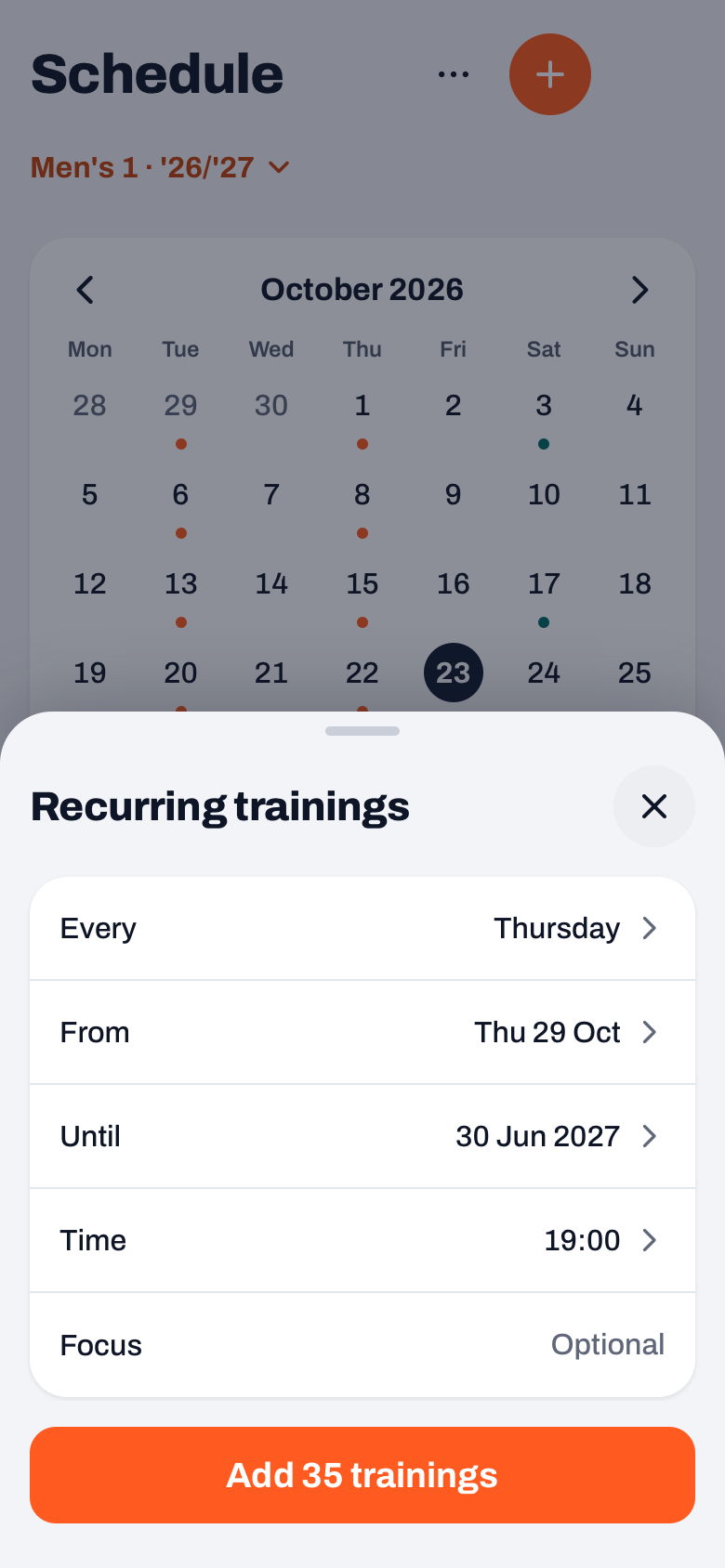
A beach series for youth players is usually a fixed evening, six or eight weeks long. In Koach you put it in the schedule in one go: under Schedule you choose More and then Recurring trainings, with the day, the first and last date, the time and a focus. The button counts how many practices are actually added.
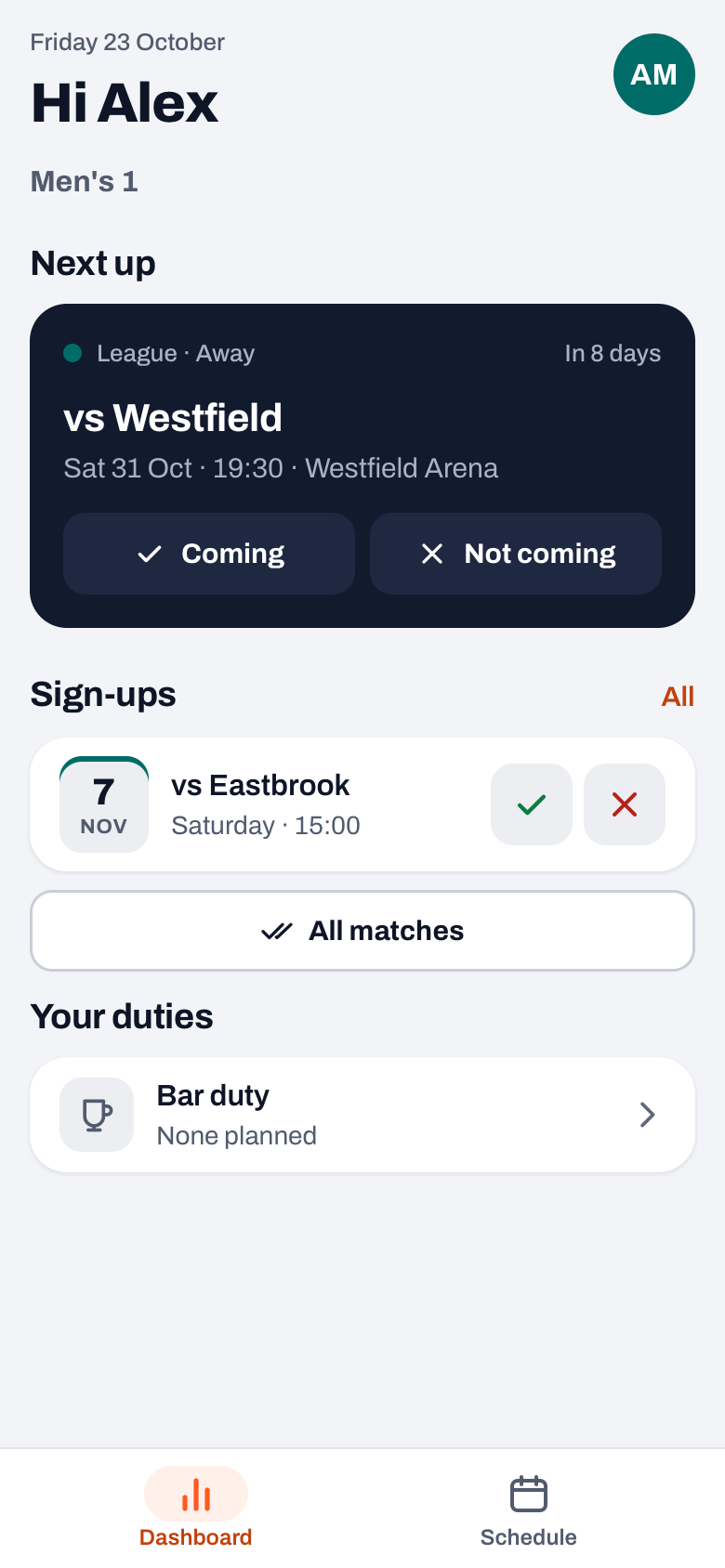
Parents see the practices on their own dashboard and in the schedule, and mark their child as coming or not coming. Parents pay nothing for that: their account falls under the team's subscription. That way you know in advance how many courts to set up. At practice you put the games into the plan as sections with their duration, and afterwards you record attendance.
What Koach costs after the 14 free days is on the pricing page.
14 days free, no credit card. Put your summer series in the schedule tonight and let the parents sign up their children themselves.
Plan your beach series in KoachFrequently asked questions
At what age can a child play beach volleyball?
Playing in the sand works from about six, with throwing and catching over a rope on a small court. Two against two without catching becomes achievable around ten to twelve, once children can pass and set. More important than age is that the court, net and ball suit the child, so that rallies happen.
How high is the net in beach volleyball for kids?
For youth players the FIVB beach rules give 2.00 meters for 12 and under, 2.12 meters for 14 and under and 2.24 meters for 16 and under. For younger children you use a rope or a lower net. Hang it so that most children can just not reach it with their arms stretched, so the ball has to go over in an arc.
What ball should kids use for beach volleyball?
A real beach ball weighs 260 to 280 grams and is too heavy for children up to about ten. Use a light, soft training ball, so passing doesn't hurt and the ball stays in the air longer. In wind a very light foam ball blows away; then a light youth ball works better.
Should kids play beach volleyball barefoot?
Under the official rules you play barefoot, unless the referee allows otherwise. At practice you decide yourself. If the sand is too hot to stand on calmly, or there could be sharp bits in it, let children wear sand socks. Check the sand yourself before every practice.


Put your summer series in the schedule
14 days free, no credit card. Parents sign up their children themselves, you know how many courts you need.
Get started with KoachOr read first what the volleyball coaching app does.