
Coaching youth volleyball: what works for each age group?
A practice for eight-year-olds that looks like a stripped-down adult practice — it is the most common mistake in youth volleyball. Kids are not small adults: what works shifts with every age group. This overview lays out, stage by stage, what your practice should revolve around.
Why age determines your practice design
A ten-year-old picks up movements at lightning speed but holds their attention for a few minutes at most. A fourteen-year-old is in the middle of a growth spurt and has to recalibrate every technique on longer arms and legs. A seventeen-year-old wants to know why a drill helps. Ignore that and run the same practice at every age, and you get kids who drop out — not because volleyball is boring, but because the practice does not fit their development.
Ages 6-9: catching, throwing and moving a lot
At this age the game itself has to be simplified. USA Volleyball's Simplified Youth Rules put children of roughly three to eleven in teams of two or four on a reduced court with a lighter ball, and most stepped mini-volleyball programs open with a version in which the ball is still caught and thrown. That is not dumbing the game down but a smart progression: catching and throwing teaches kids to read the flight of the ball — the foundation under every pass they will play later. At this stage your practice consists mostly of:
- Ball familiarity: rolling, bouncing, keeping the ball up, catching after one bounce — with as many balls in the gym at once as possible.
- General motor skills: tag games, climbing, jumping, somersaults. At this age you are building an athlete, not yet a volleyball player.
- Small-sided games: 1-on-1 and 2-on-2 over a low net or a bench — short turns, lots of switching.
Ages 10-12: the golden age for technique
Between ten and twelve, motor learning peaks. This is the moment to groove the fundamentals: the forearm pass, overhead passing and the underhand serve. This is the stage of small-sided games with real rallies: four a side on a reduced court teaches more here than six a side on a full one, whatever format your league runs. The rules for the younger divisions grow along with what kids can handle. Rules of thumb for this stage:
- Lots of repetitions in short blocks: six rounds of eight minutes beats two half-hour blocks.
- Always wrap technique in a goal: not "pass twenty times", but "how many of your passes hit the mat at the setter's spot?".
- Everyone does everything: no fixed positions yet, no fixed servers — broad development comes before winning.
Ages 12-15: the full-size court and the growth spurt
Then comes the move to 6-on-6 on the full court: a higher net, rotation and far more court per player. At the same time the growth spurt hits — players who moved smoothly last season suddenly trip over their own feet. That is normal and temporary. Keep repeating technique (the body has changed, so the technique needs recalibrating), keep an eye on jumping load and do not expect linear progress.
Practical emphases for this group: train the serve seriously (at this age the serve decides a lot of matches), always tie technique drills to movement across the bigger court, and work on three touches as the standard in every practice. The mental side matters more now too: teenagers are sensitive to how you deliver feedback, especially in front of the group. Correct individually and briefly; compliment out loud as much as you like.
Ages 15-18: specializing and learning to think tactically
Only now does it make sense to give players a fixed position and train tactically: blocking schemes, serve pressure, match scenarios. Involve players in decisions — a seventeen-year-old who understands why they are serving to zone 1 executes it better than one who is simply told to. The practice structure starts looking more and more like an adult practice, with one difference: you keep putting development above results, because late bloomers are still coming through at this age too. Also make room for ownership: let older youth players occasionally run a practice segment themselves or analyze a match — it is the best preparation for adult volleyball and for a possible coaching role of their own.
The common thread: fun is the program
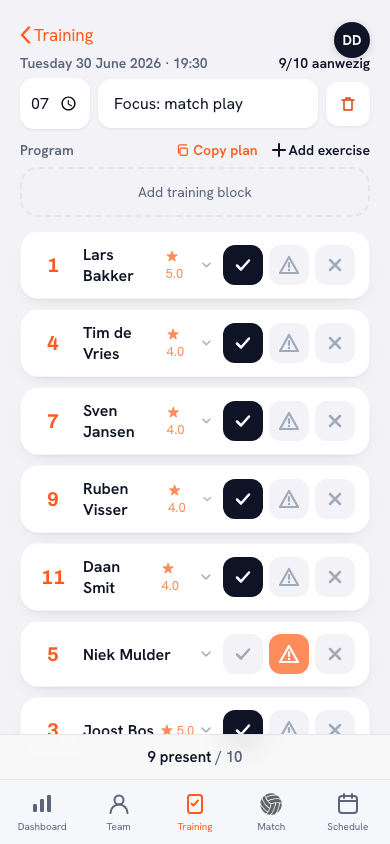
Research on youth sports is unambiguous: the main reason kids quit is not a lack of talent but a lack of fun. In concrete terms that means: many ball contacts per child, short explanations, plenty of game forms and attention for every child — including the child who never stands out. So track more than results: track turnout and engagement too. A coach who records each child's attendance and growth across the season has far more concrete conversations with the child and the parents — and spots in time who is quietly checking out. And do not forget the surroundings: good agreements with parents save you an enormous amount of energy as a coach.
Rule of thumb for every youth practice: every child touches a ball at least a hundred times and never stands in line for more than a minute. If you cannot hit that, your drill setup is the problem — not the group.
Frequently asked questions
At what age can a child start playing volleyball?
Most clubs start around age six with a simplified format where the ball is still thrown and caught; USA Volleyball's Simplified Youth Rules are written for ages three to eleven, and its youngest competitive divisions are 10U and 12U. Starting earlier is possible too, but then it is mostly about movement and ball familiarity, not volleyball.
How often per week should a youth team practice?
Up to around age twelve, once a week is fine, as long as kids also move in lots of other ways. From roughly the 12U and 13U divisions on, twice a week is common for teams playing a league schedule. More only makes sense if the child wants it themselves.
Should I give young children a position already?
No. Until roughly age fifteen you want everyone to play everything: passing, serving, attacking and setting. Early specialization brings a little short-term gain and costs you complete players in the long run.
What do I do with big skill differences in one group?
Differentiate within the same drill: same form, different demands (a bigger or smaller target zone, catching allowed or not). That way you practice together without the strongest kids getting bored or the beginners drowning.
 Your first practice with a youth team: structure and a sample plan
 CMV volleyball: the 6 levels of Dutch mini volleyball explained
 Volleyball skills checklist: free PDF and Excel by level
 How many serves in a row in youth volleyball? Limits of 2 to 5
 Rotate without scoring: the youth volleyball rule explained
 Youth volleyball stats: what to track at each age (and what not)
 200 volleyball drills with animations
Follow your youth team's growth
Attendance, development and fun per child at a glance — all season long.
Get started with KoachOr read first what the volleyball coaching app does.