
From the small court to the full court: guiding the transition
After years of four-a-side on a small court, a twelve-year-old suddenly stands six-a-side on a nine-by-nine-meter court, with a higher net and rotation rules. That move — in USA Volleyball terms roughly the step out of the youngest divisions into full junior competition — is the biggest change in a youth volleyball career, and with good guidance it becomes a logical next step instead of a rude awakening.
Everything that changes at once
The move from small-court mini volleyball to the full court changes almost everything in one go:
- From 4 to 6 players — more teammates, more coordination and considerably fewer ball contacts per child per match.
- A full 9×9 meters per side — often more than twice as much floor to defend as on the small court.
- A higher net — the net height climbs per age division toward the adult height. Under USA Volleyball's rules it goes from 2.13 m (7'0") at 11U and 12U to 2.24 m (7'4 1/8") at 13U and 14U, which suddenly makes serving and attacking harder.
- Rotation and positions — for the first time the rotation rules and the six position numbers apply, positional faults — overlaps — included.
- Sets to 25 — longer matches with a different rhythm than the short tournament games of mini volleyball.
Realize as a coach: each of these changes is a learning process in itself. So do not expect fluent play in September — the first half year on the full-size court is simply learning to play all over again. The match format itself is new too: instead of a tournament morning with five short games, the team plays real league matches, with sets to 25 points, timeouts and a scorer at the table. Deliberately walk the kids through it in the first weeks: explain how the set score works, what happens during a substitution and why everyone suddenly waits for the whistle before serving.
Start before the summer
The best transition starts in the final small-court season. In the last months, let the oldest kids get a taste of the full court: a 6-on-6 game at the end of practice, serving over the higher net, a session practicing with the older teams. The rotating-through of mini volleyball is secretly a gift as well: kids who are used to playing everywhere pick up the rotation faster than you would think. What you mainly want to prevent is the summer break becoming a hard cut between two worlds.
This is an organizational question too: the transition succeeds more often when the mini-volleyball coach and the new youth coach actually talk. A short handover per child — where do they stand technically, what do they need, what is going on socially — saves the new coach months of rediscovering what the previous one already knew. Schedule that conversation in June as standard, before the team assignments become final.
The first year: setting priorities
You cannot teach everything at once. A workable order for the first year on the full court:
- Rotation and lineup — first understand where you stand and when you rotate; without that, every match is chaos.
- Serving over the higher net — at this age the serve is the most decisive weapon; whoever gets it over is in the game.
- Passing on the big court — more court means more moving before the pass; tie technique to movement.
- Three touches as the standard — pass, set, attack. Only after that come tactical themes.
Deliberately keep positions broad: let kids play several spots in the first year before anyone gets the setter or libero label. Which roles exist is covered in the overview of volleyball positions — but specializing can wait for years. Think about the physical side as well: the higher net and the bigger court demand more from shoulders, knees and ankles, exactly in a period when many kids are growing fast. Build up jumping and serving load gradually and take complaints about aches seriously instead of saying "push through".
Expect a dip — and name it
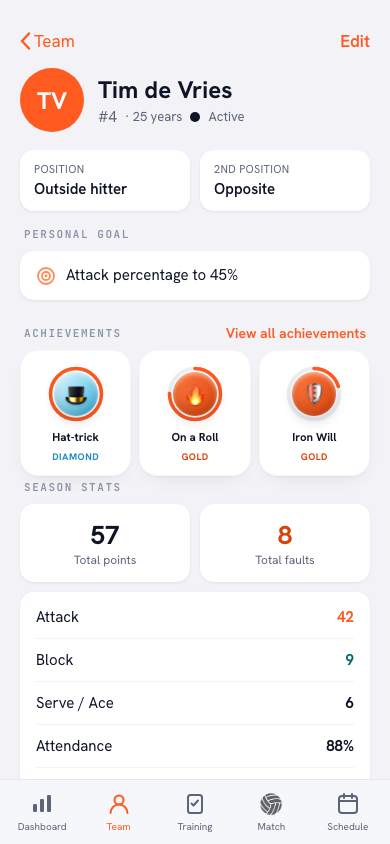
Almost every child temporarily gets "worse" after the transition: fewer ball contacts, more errors, lost matches against teams that have been on the full-size court longer. Kids (and parents) who did not see that coming get discouraged. So say it in advance: this is part of it, everyone goes through it, and in a few months it will click again. A coach who records each child's development can actually keep that promise: a growth line across the months shows in black and white that the one dip in October puts itself into perspective, and gives you something tangible for the conversation with a discouraged child or a worried parent. For the club, that same information is also the foundation under a solid move-up recommendation for the next season.
Tip for team assignments: where possible, keep kids who move up together with at least one familiar teammate. One known face next to you on the full-size court makes an enormous difference in how safe the transition feels.
Frequently asked questions
At what age do you move to the full-size court?
That depends on your federation. USA Volleyball allows a reduced court only up to 10-and-under, so from 11U on juniors already play the full 18-by-9 meter court; in the Dutch system the move comes after the season in which a child turns twelve. Clubs also look at development and team composition — the occasional child moves up earlier or a bit later.
My child still finds the full-size court too hard — now what?
A setback after the transition is normal and usually temporary. Discuss it with the coach: extra attention for serving and passing often helps, and sometimes a year in a team with more guidance is the better route.
What is the hardest part of the transition?
For most kids: the rotation and the higher net. The rotation demands understanding of the game, the higher net demands strength that twelve-year-olds are still developing. Both resolve with time and targeted training.
Do kids stay on the same team after the transition?
Not always: at the move up, mini-volleyball teams are often reshuffled by age and level. Try to keep friends together where possible — social safety weighs heavily at this age.



Try it yourself in Koach
Less admin, more coaching.
Get started with KoachOr read first what the volleyball coaching app does.