
How to teach volleyball rotations when your players keep getting lost
For the third practice in a row you draw the same sheet, everyone nods, and in the match two players are standing in the wrong place again. Plenty of coaches wonder how to teach volleyball rotations when the explanation never sticks, and the reason is usually that players memorise spots instead of the order: as long as everything goes the way it always does, it works, and as soon as one thing changes — a substitution, a different starting lineup, a libero coming in — it collapses. Below is how to build it up over three practices, from walking without a ball to rotating in a game.
How to teach volleyball rotations: players learn spots, not an order
Ask a player where they stand and they point at the floor. Ask where they will be two rotations from now and it goes quiet. That is exactly the difference that produces the mistakes in a match: a player who remembers a spot can handle one lineup; a player who understands the order can handle all six.
For that, two things have to sit separately in your players' heads. First, the six positions and their numbers — if those are not there, you cannot agree on anything or correct anything; they are explained in the position numbers on the court. Second, the rule itself: when you rotate, that the order is fixed and that the spot where you stand is temporary. That rule does not belong in this piece but in rotation order in volleyball — read that first, because everything below assumes your team has had that explanation once.
The rest is teaching, and you spread it over three practices. Not over forty-five minutes in one practice: rotating is a habit, and a habit comes from repetition with time in between, not from one long explanation.
One exception up front. With a group that cannot yet play a rally, explaining rotations is wasted time; there you start with the game, not with the order. Why that is so is in drills for adult beginners.
Practice 1: walking six rotations without a ball, in ten minutes
Put six players on court in the lineup you start with. No ball, no net, no more explanation. You call out only two things: "side out" and "we serve again". "Side out" means you won the rally on the opponent's serve: everyone moves one spot clockwise. On "we serve again" everyone stays put.
After every rotation, everyone says the number of their new position out loud. That sounds childish and it is the whole drill: you immediately hear the player who has to think too long. Six rotations and you are back at the starting lineup. Do it twice, so twelve rotations, and deliberately throw in "we serve again" a few times — that is exactly where it goes wrong, because a team that keeps walking automatically is mostly rotating on rhythm.
Then three variations, each about two minutes:
- From a different starting lineup. Put the same six players in a different rotation and go round again. Anyone who memorised spots gets lost here; anyone who knows the order still knows who comes before and after them.
- Without looking at the floor. Everyone keeps their head up, facing the net. Anyone who needs the lines to know where they are is found out here.
- With the substitutes included. Put the players who are not on court behind the end line and have them rotate along in the shadow of their own position. Then a substitute will also know where they come in later.
Ten minutes is enough, and longer is counterproductive. This is a warm-up form, not a lesson.
Practice 2: one sheet per rotation, and what does and doesn't go on it
In the second practice you work with paper, but not with the sheet you fill up yourself while explaining. One sheet per rotation, and that sheet is about three things: the six names in the six positions at the moment of the serve, who is serving, and the number of the rotation.
What is not on it matters just as much. No passing formation, no movement lines after the serve, no agreements about who takes which ball. A sheet with everything on it is read by nobody. The serve receive formation and shifting players around are a separate layer that you only add once rotating goes without thinking; they are covered in serve receive formations and, for the setter, in stacking in serve receive.
You do not have to draw those sheets yourself. In Koach's free rotation generator you enter your players, choose 5-1, 4-2 or 6-2, with or without a libero, and print all six rotations with those names on one sheet, plus a blank lineup form — no account needed. Each rotation appears as a separate card, so cut the sheet into six and you have one sheet per rotation. The sheet you redrew at every practice can go. If you would rather have the same six rotations running on a screen during the match, a rotation app is the form that goes with that.
The drill itself takes fifteen minutes and works like this: every player gets their own little stack of the six sheets. You call a rotation number, everyone walks to their position, and the last one in place is out of luck. For the first two rounds the sheets may stay in their hands; after that they go face down on the floor and you call the same numbers in random order. Finish with the question that does the real work: where will you be two rotations from now, without looking?
Practice 3: rotating in a game, with a check before every serve
Only now does the ball come in, and straight into a game. Play six against six and keep one rule: every time your side wins back the serve, everyone rotates, without you having to say so.
Add one thing to that: a check before every serve. The server calls out the number of the rotation, and one player on court — change who it is every set — looks around and says "good" or points at whoever is out of position. That check takes two seconds and is the habit you ultimately want to keep.
Attach a consequence as well, because without one it stays optional. If someone is out of position at the moment the ball is served, the point goes to the other side. That is the actual rule; what it says exactly and why teams make the fault is in preventing positional faults.
Have your players do the check, not yourself. A coach who calls out the positions from the sideline keeps the team dependent: on the day you are not watching, it goes wrong again. Pick one player per set to check, and only correct when they miss it.
For the weeks after that, the drills for volleyball coaches contain fixed forms in the Match play category that build on this: "Match with rotation", "Wave rotation" and "Team serve receive per rotation". Keep the check before the serve in all three.
5-1 or 6-2: the setter's extra route
One player always has it harder than the rest, and that is your setter. They need to know not only where they stand at the serve, but also how to get from there to the spot where they play the second ball. For the other players rotating is a matter of moving one spot along; for the setter the route changes with every rotation too.
In a 5-1 your setter is in the front row for three rotations and in the back row for three. In the front row the route is short. In the back row they have to come forward from the back after every serve, without running into the player in front of them. So they have to master two kinds of route side by side, and it is precisely the switch between the two that goes wrong at first.
In a 6-2 it works differently: the setter in the back row always sets. Both setters therefore always run the route from back to front, but it is the same kind of route every time, and as soon as one moves into the front row the other takes over. What you mainly teach there is the moment of handover.
Teach those routes separately, apart from the rest of the team. The setter walks them while the others watch: from the spot where they stand at the serve to the spot where they want to play the second ball, in all six rotations, without a ball. Do that in two consecutive practices, ten minutes each time, with the rotation sheet from practice 2 in hand.
In a 4-2 the setter in the front row always sets. That is where the route is shortest and teaching it is simplest, and for many teams that is the reason to start there. What else distinguishes the systems is covered in the 5-1 system, the 4-2 system and the 6-6 system. Make that choice before you start teaching, not halfway through: every change of system sends you back to practice 1.
When it still goes wrong in the match
It will go wrong at some point, even with a team that can do it in practice. Often in the same three situations: after a substitution, after a time-out and at the start of a new set. In all three something has been interrupted, and that is exactly when a team falls back on "where was I again?".
Three things help. The first is preparation: go through your six rotations once yourself before the match, so you know in which lineup things might get tight — see checking your six rotations before the match. During the match your players do the check from practice 3 before the first serve of every set. The second is the predecessor agreement from the piece on rotation order mentioned at the top: every player knows who serves before them, so they can correct themselves. The third is to let the substitute on the bench keep track instead of you — they can see it anyway and learn from it themselves.
With young teams, some of the mistakes simply come with the territory. Players moving from a small court with fewer players to the full court need more time than an adult team; what you should and should not expect in that phase is in moving up to the full court and in drills for twelve- to fourteen-year-olds.
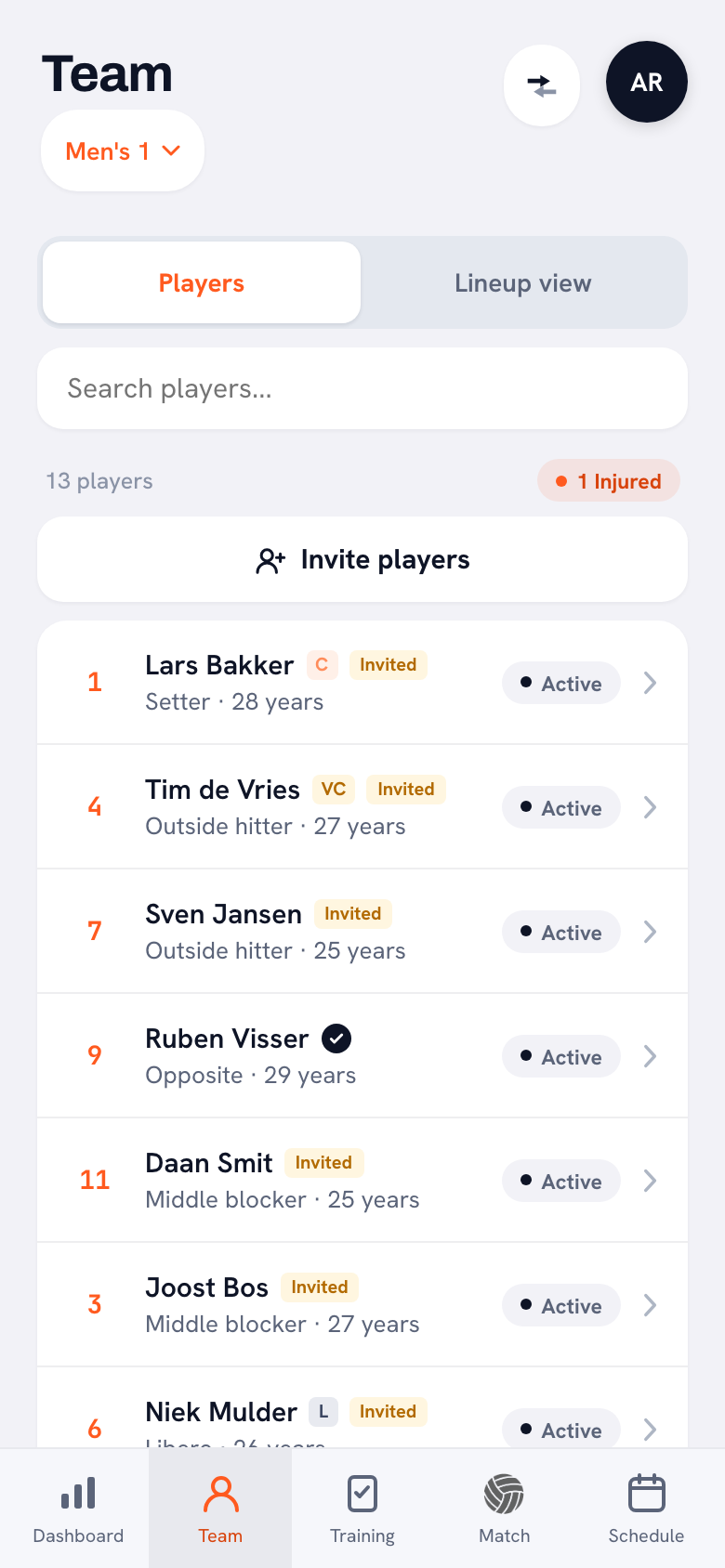
In practice you work with paper; on the bench you no longer need to. If you set up your 5-1, 4-2 or 6-2 in Koach, the live court keeps track of the rotation for you during the match, including the libero swap. Then you do not have to work out whose turn it is, and you can watch whether your team does the check before the serve on its own.
Frequently asked questions
How many practices does it take to teach a team six rotations?
The build-up above takes three practices: walking, the sheet, and the game. That lets a team that already knows the game understand how it works; making it automatic in a match takes repetition after that. So do not plan an hour-long block for it, but keep the check before the serve in every game form until nobody has to think about it any more.
Do you teach rotations with or without a ball?
Start without a ball. As long as there is a ball in play, all the attention goes there and nobody learns the order. Ten minutes of walking without a ball gives you more at this stage than a game you keep having to stop. As soon as the walking is right, do the opposite: only in a game, with a check before every serve.
What do you teach first: the order or the serve receive formation?
The order first, and with plenty of time in between. The rotation determines where a player starts; the serve receive formation determines where they move to next. Offer both at once and you get players who have to think again at every serve. Only add the second layer once rotating works without instructions.
What do you do with a player who still stands in the wrong place during a match?
Correct them briefly in the moment and without explanation — just name the spot where they should be — and pick it up afterwards. Then ask where they stood in the previous rotation; if they do not know, they memorised a spot and not an order. A player who knows the order can correct themselves without you being there.
Does a printed rotation sheet work better than an app on the sideline?
For teaching, yes: you can hand a sheet to six players at once, put it in a bag and lay it on the floor. During the match a screen that follows the rotation is handier, because it moves along with substitutions and the libero. The two do not exclude each other: paper in practice, a screen on the bench.



Try it yourself in Koach
Less admin, more coaching.
Get started with KoachOr read first what the volleyball coaching app does.