
The 5-1 system in detail: rotations, strengths and pitfalls
One setter, five attackers: the 5-1 is the standard in serious volleyball. But teams that merely 'play' the system without understanding the rotations leave points on the table in three of the six positions.
The principle: one playmaker, always
In a 5-1, the same setter runs all six rotations. Attackers therefore get the same type of set every rally — that is the big win over a 4-2, where two setters each bring their own signature. The price: your system is only as good as that one player, and for three rotations he is in the front row, where he cannot block at his weakest point and you have only two attackers.
The six rotations at a glance
- Setter in the back row (P1, P6, P5): three attackers at the net — your strongest attacking positions. After the serve, the setter penetrates towards position 2/3.
- Setter in the front row (P4, P3, P2): two attackers at the net. Here you compensate with the back-row attack (pipe or D-ball) and a smarter first tempo.
The classic starting choice: begin with your setter on position 1. On your own serve you immediately have three net attackers, and your strongest attacking sequence rotates through most often — more on that in choosing your starting lineup.
The three classic pitfalls
- Forgetting the penetration run. The setter penetrating from position 1 leaves a hole in the defense. Agree who covers zone 1 — and train it.
- Attacking up front as if you were three. With the setter in the front row, the pipe is not a luxury but a necessity. Without a back-row attack, every block knows where the ball is going.
- No plan B for a bad pass. When the pass lands far off the net, everyone must know who plays the second ball and who gets the high outside set. Lock that in before the match.
Setting up the 5-1 in Koach
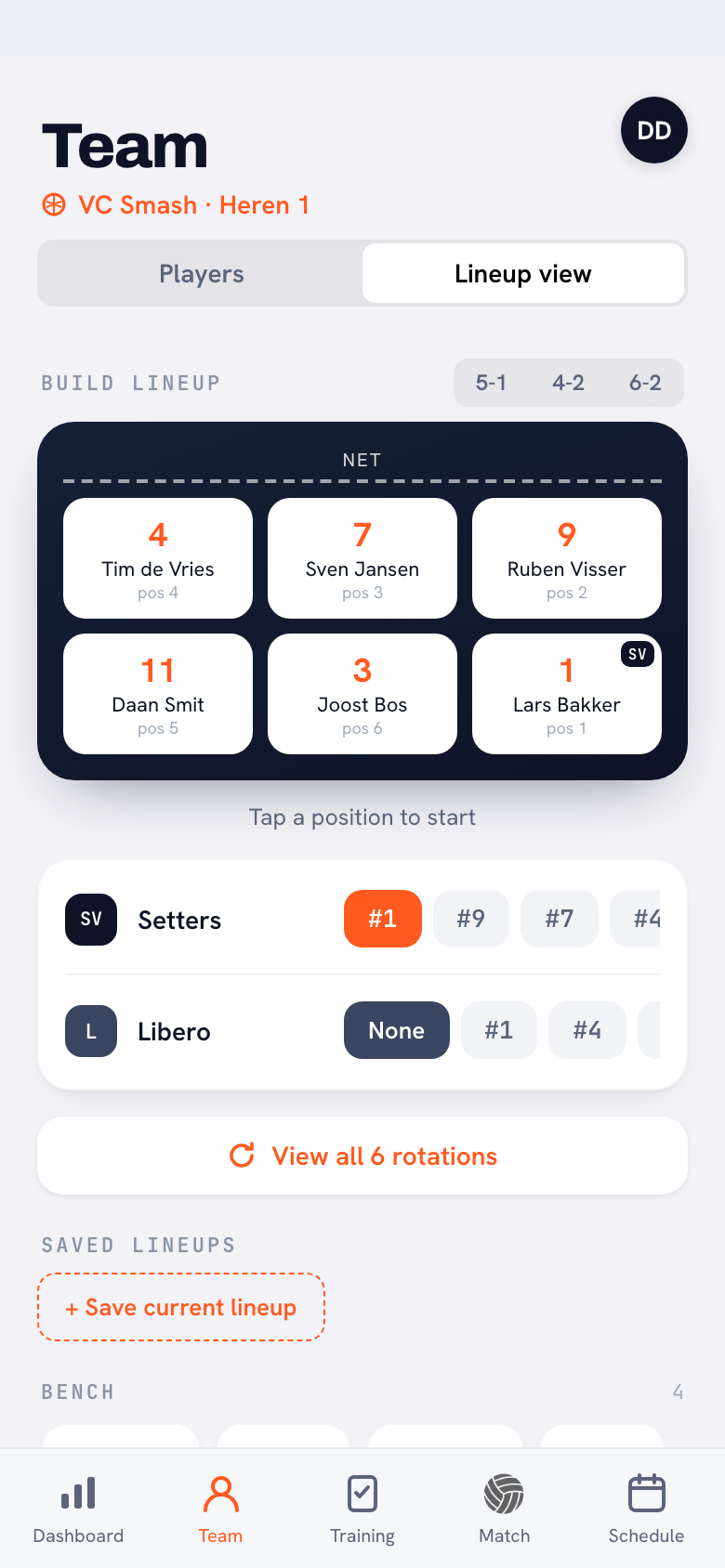
Under Lineup, choose 5-1, place your six starters on their positions and assign the setter and libero roles. During the match the app tracks the rotation, so at every substitution and every point you see who is actually on the court. How subs, the libero and all six rotations work is on the volleyball lineup app page; to map out the six rotations for your own roster, use the free rotation generator.
Train the setter-front-row positions twice as often. Teams prefer practising their strong rotations — those feel good. But matches turn in the three positions where you have only two net attackers.
Frequently asked questions
At what level does a 5-1 make sense?
As soon as one setter clearly stands out and the team has mastered the rotations. Many teams switch in the older youth ranks or lower senior divisions; level matters less than having that one setter.
What do I do when my setter has an off day in a 5-1?
Short term: accept more high outside balls and simplify the attack plan. Structurally: invest in your second setter, so a substitution becomes an option instead of a last resort.
Where do I place my best attacker in the rotation relative to the setter?
Usually as the opposite, three positions along: then he is in the front row exactly when your setter is in the back — your three strongest attacking positions coincide.

Try it yourself in Koach
Less admin, more coaching — starting at your next practice.
Get started with KoachOr read first what the volleyball coaching app does.