
The 6-2 system in volleyball: two setters, three attackers
The 6-2 is the system for teams that want more than to survive. Two setters, but they only set from the back row — so you always have three attackers in the front. More firepower, in return for a tougher rotation.
How it works: the setter penetrates from the back row
In a 6-2, two setters stand diametrically opposite each other, just like in the 4-2. The difference: the setter only sets when in the back row. From position 1 they penetrate to the net, distribute the ball and drop back. Whoever is in the front row is simply an attacker. So at any moment you have three net attackers — one more than in a 4-2.
Who is the 6-2 for?
- Teams with two complete setters who can also attack and block: in their front-row rotation they are a full attacker.
- Teams looking for attacking power: three front-row attackers put every block under pressure.
- Teams that can handle the rotation: the back-row setter's penetration run demands timing and a decent pass.
The price is complexity. The penetrating setter must release from the back corner in time, the pass must not go into their zone, and on a bad pass someone else has to take the second ball. For teams not there yet, the 4-2 is the calmer choice and the 5-1 the logical next step.
6-2 versus 5-1: which do you pick?
The 5-1 has one fixed setter and therefore consistency: the same hands, the same tempos, the whole match. The 6-2 trades that consistency for an extra front-row attacker. Do you have one standout setter? Choose 5-1. Do you have two setters who can both attack? Then the 6-2 gives you more weapons.
Setting it up in Koach
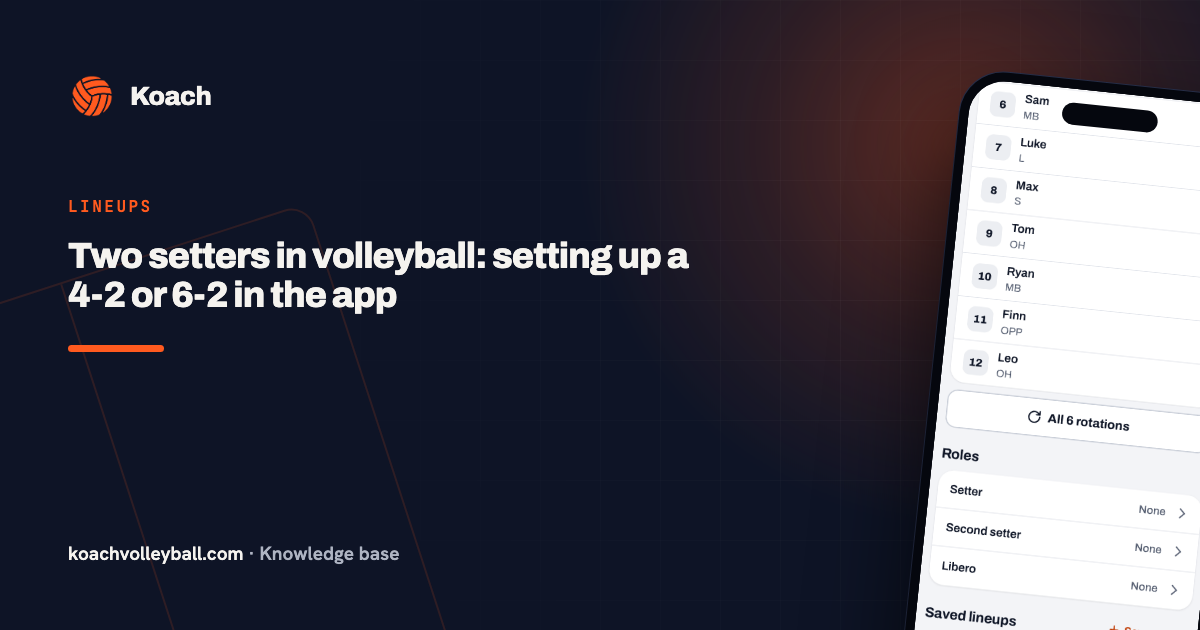
In the lineup (Team tab, Lineups), choose 6-2 under Formation and assign your Setter and Second setter under Roles; place them directly opposite each other on the court. More on that in setting up two setters. The libero does not go in the starting six: they come in for the back-row middle at the start and leave before reaching the front row, so the app itself prevents a positional fault with the libero. Save your base lineup as a preset and it is ready in one tap every match.
Is your team learning the 6-2 for the first time? Start with the penetration run without a ball. Have the back-row setter run the route from position 1 to the net and back ten times, until the timing clicks. Only then add the pass and the attack.
Frequently asked questions
What is the difference between a 6-2 and a 4-2?
In both systems two setters stand opposite each other. In a 4-2 the front-row setter always sets; in a 6-2 the setter penetrates from the back row and sets, so you always have three front-row attackers. The 6-2 gives more attacking power, but demands a better pass and timing.
Do I need a libero in a 6-2?
A libero is possible, but note: it replaces the middle blockers in the back row, while in a 6-2 your setter is the one who has to penetrate from the back corner. Many teams therefore play the 6-2 without a libero, or only sub the libero for the non-setter middles.
Can I switch between 5-1, 4-2 and 6-2 in Koach?
Yes. On the Team tab under Lineups you pick 5-1, 4-2 or 6-2 under Formation in one tap. With 4-2 and 6-2, Second setter also appears under Roles. Save each version as a saved lineup and you can set up a different system per opponent.

Set your 6-2 in Koach
Assign your setters, save the preset and it is ready every match.
Get started with KoachOr read first what the volleyball coaching app does.